
Reflective practice and autoethnography in photographic education
Reflective practice and autoethnography are two approaches that place personal experience at the centre of learning, both of which have a significant role to play in the professional development of photographers.
Reflective practice, most clearly articulated by Donald Schön (1983), involves systematically thinking about one’s own actions, decisions, and experiences in order to learn from them. For photographers, this might mean reviewing a recent shoot not only in terms of technical success but also considering emotional responses, ethical choices, and the alignment of the work with artistic or professional goals. Reflection-in-action allows a photographer to adapt in the moment – adjusting composition, engaging with a subject differently – while reflection-on-action encourages a deeper post-event analysis that can inform future projects. This cycle of self-examination and adjustment helps photographers refine their technical skills, strengthen their creative voice, and develop a more intentional practice.
Autoethnography extends this process by positioning the photographer’s lived experience within broader cultural and social contexts. Developed within qualitative research (Ellis & Bochner, 2000), autoethnography combines personal narrative with cultural critique. For photographers, this means moving beyond “what did I learn from this shoot?” to “what does my experience as a photographer reveal about identity, culture, or society?” A photographer might, for example, reflect autoethnographically on how their background, gender, or cultural position influences the kinds of subjects they approach, the way they represent them, and how those images are received by others. Autoethnography often draws on more creative, narrative, or even poetic forms of writing, allowing the photographer to explore the felt and embodied aspects of practice as well as the technical and conceptual.
Together, reflective practice and autoethnography create a powerful foundation for professional growth. Reflective practice strengthens day-to-day learning and adaptability, while autoethnography deepens understanding of the wider social meanings of photographic work. Used in combination, they help photographers to become more self-aware, ethically grounded, and culturally literate practitioners who are not only skilled in making images but also critically engaged in the roles those images play in society.
Bringing reflective practice and autoethnography together
In practice, photographers can combine reflective practice and autoethnography by treating their own lived experiences as both a source of immediate learning and as material for deeper cultural insight. Reflective practice provides the structure for ongoing improvement, while autoethnography supplies the perspective to situate those reflections within wider contexts.
A photographer might begin with routine reflective questions after a shoot: What went well? What challenged me? How did I respond in the moment? What might I do differently next time? These reflective prompts focus attention on technical decisions, creative choices, and interpersonal dynamics. However, the process does not stop there. An autoethnographic lens encourages a second layer of questioning: Why did I choose to frame this subject in this way? How do my own values, identity, or background influence this representation? What cultural assumptions shaped my interaction with the subject, or the way I expect the image to be read?
For example, a novice photographer working on street photography may notice feeling hesitant to photograph strangers. Reflective practice will help them analyse the moment – what stopped them pressing the shutter, how they negotiated consent, how their body language influenced the interaction. An autoethnographic approach then invites them to link this hesitation to cultural narratives: perhaps ideas of privacy in their community, their own socialisation around politeness, or contemporary debates about surveillance and representation.
To dig deeper, photographers can alternate between close-up reflection (the immediate technical, ethical, and emotional details of practice) and wide-angle reflection (the social, cultural, or political frames that give meaning to those details). This can be done through journaling, creative writing, or visual notebooks where images and text are placed side by side. The aim is not simply to improve technical proficiency but to cultivate awareness of the photographer’s role in producing meaning.
By integrating reflective practice and autoethnography in this way, photographers develop both craft and conscience. They learn not only how to take better photographs, but also how to interrogate what their work says about themselves, their subjects, and the societies they are part of.
Autoethnographic reflective practice
When reflective practice and autoethnography are combined, the hybrid nature of the approach means it is sometimes discussed under different names, each highlighting slightly different emphases. One of the most common is “reflexive autoethnography”, which foregrounds the reflective dimension of autoethnographic writing. Here, the act of revisiting one’s own practice is not only narrative but explicitly critical, encouraging students and practitioners to question how their positionality shapes both their work and its reception.
Another widely used label is “creative analytic practice” (Richardson, 2000), which emphasises the role of writing and creativity as methods of inquiry. This is especially relevant in photography, where creative writing, poetic reflection, or narrative accounts can accompany images, deepening understanding of the process and outcomes. Within this tradition, terms like “poetic inquiry” or “arts-based reflexivity” may also be encountered, stressing the aesthetic as much as the analytic.
In professional education, the combined approach sometimes appears under the banner of “critical reflective practice.” This name stresses the step beyond simple descriptive reflection into a more critical engagement with social, cultural, and political dimensions of practice. It is particularly useful in formal learning contexts, where students are encouraged to demonstrate both personal insight and awareness of wider systems of meaning.
A further term, “evocative autoethnography,” has been used by Carolyn Ellis and others to capture work that combines narrative, reflection, and cultural analysis in ways that are deliberately affective and personal. This label is especially apt when creative writing and imagery are combined to convey the lived texture of practice.
While each of these names carries different nuances, they all describe variations of the same principle: using the self as both subject and lens, integrating reflective learning with cultural analysis, and often employing creative expression to make sense of practice.
As tools for students on formal courses
For a student on a formal photography course, combining reflective practice with autoethnography fits directly into the ways of learning that higher education values, while also expanding them in distinctive directions.
First, it aligns with experiential learning models, such as Kolb’s cycle, where students learn by doing, reflecting, conceptualising, and applying. A photography student doesn’t just learn through lectures or reading about technique; they learn most vividly through making images, reflecting on outcomes, and then trying again. Reflective practice provides the structured framework for this cycle: What did I try? What was the result? What does this tell me about my strengths and limitations? What might I adjust next time?
Second, the autoethnographic dimension extends learning beyond personal skill development into critical self-awareness. Photography courses often emphasise contextual studies, where students situate their work in relation to traditions, movements, or cultural debates. Autoethnography allows students to bring their own lived experience into this process. They ask questions such as: How does my background shape the kinds of subjects I choose? What cultural narratives am I unconsciously reinforcing or resisting? How do my own values or identity enter the frame? This moves learning into the realm of critical pedagogy, where knowledge is not only absorbed but interrogated in relation to the learner’s own position.
Third, this combined approach fosters metacognitive learning – learning about how one learns. By reflecting systematically on their practice and connecting it to broader cultural meanings, students become more aware of how they construct knowledge as photographers. This deepens their capacity to transfer learning into new contexts and to articulate their process in assessments, critiques, and professional portfolios.
Finally, reflective practice plus autoethnography encourages integrative learning. Students connect technical, aesthetic, ethical, and cultural strands of photography rather than treating them separately. In doing so, they move towards becoming practitioners who are not only technically competent but also critically and ethically aware – precisely the kind of holistic learning outcome that formal photography courses aim to foster.
Reflective practice and autoethnography as essential counter-balances to AI
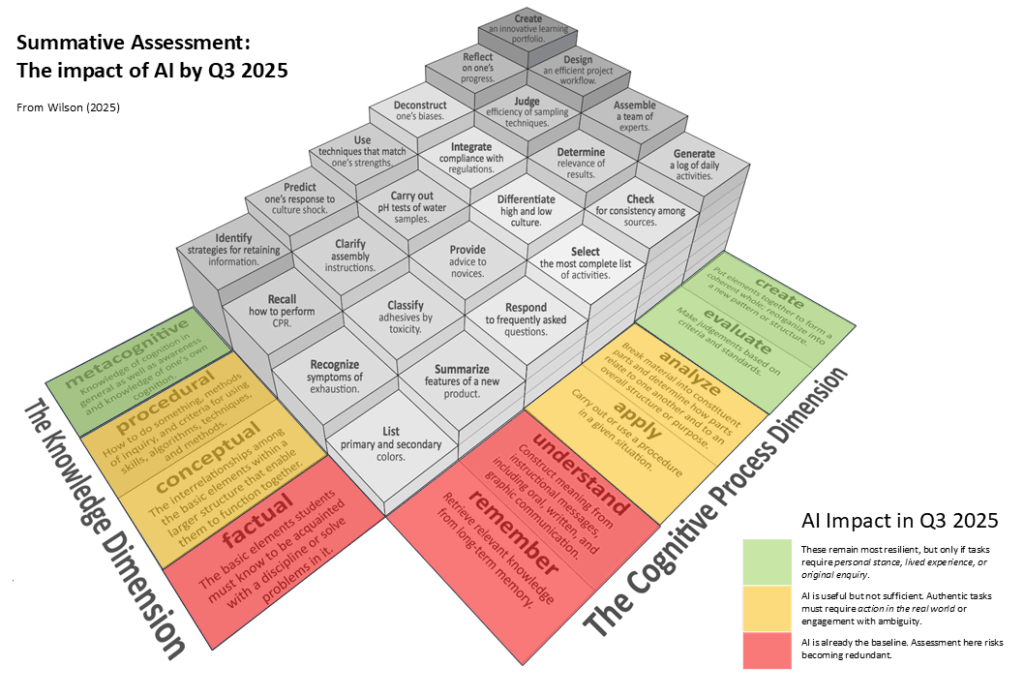
The growing presence of AI in creative education has made it harder to assess whether a student’s work genuinely represents their own thinking and effort. In photography courses, as in many other fields, AI tools can generate images, analyse technical flaws, or even draft contextual essays. What cannot be so easily outsourced, however, are the higher-order skills that sit at the top of Bloom’s taxonomy: the capacity to reflect on one’s own learning, to create in ways that are personally meaningful, and to demonstrate metacognitive awareness of how and why decisions are made.
This is precisely where the combination of reflective practice and autoethnography becomes invaluable. Reflective practice anchors learning in the student’s lived experience of image-making. It demands attention to the process – the trial and error, the emotions, the ethical dilemmas – that no AI tool can reproduce on the student’s behalf. A reflective account of why a photographer framed an image in a particular way, or how they adapted when a photo session did not go to plan, reveals both agency and growth.
Autoethnography extends this by asking the student to connect their personal practice to cultural, social, or political contexts. Here the student is not simply reporting a process but interrogating how their identity, values, and cultural positioning shape the images they make. This kind of writing and thinking goes well beyond technical description. It requires the student to integrate self-awareness with cultural critique, producing insights that are unmistakably their own.
When reflective practice and autoethnography are combined, students demonstrate not just what they can do with a camera, but how they think about their practice and why it matters in a wider context. This dual focus on reflection and creation embodies the evaluative and creative stages of Bloom’s taxonomy, where knowledge is not only applied but transformed through the student’s own lens. In assessment terms, it allows educators to distinguish between generic outputs that could be generated or imitated by AI and the authentic, situated knowledge that arises from the student’s unique perspective and engagement with practice.
References
Anderson, L. W., & Krathwohl, D. R. (Eds.). (2001). A taxonomy for learning, teaching, and assessing: A revision of Bloom’s taxonomy of educational objectives. New York, NY: Longman.
Bloom, B. S. (Ed.). (1956). Taxonomy of educational objectives: The classification of educational goals. Handbook I: Cognitive domain. New York, NY: David McKay.
Ellis, C. (2004). The ethnographic I: A methodological novel about autoethnography. Walnut Creek, CA: AltaMira Press.
Ellis, C., & Bochner, A. P. (2000). Autoethnography, personal narrative, reflexivity: Researcher as subject. In N. K. Denzin & Y. S. Lincoln (Eds.), Handbook of qualitative research (2nd ed., pp. 733–768). Thousand Oaks, CA: Sage.
Ellis, C., Adams, T. E., & Bochner, A. P. (2011). Autoethnography: An overview. Forum Qualitative Sozialforschung / Forum: Qualitative Social Research, 12(1), Article 10. https://doi.org/10.17169/fqs-12.1.1589
Kolb, D. A. (1984). Experiential learning: Experience as the source of learning and development. Englewood Cliffs, NJ: Prentice-Hall.
Leavy, P. (2015). Method meets art: Arts-based research practice (2nd ed.). New York, NY: Guilford Press.
Prendergast, M., Leggo, C., & Sameshima, P. (Eds.). (2009). Poetic inquiry: Vibrant voices in the social sciences. Rotterdam, The Netherlands: Sense Publishers.
Richardson, L. (2000). Writing: A method of inquiry. In N. K. Denzin & Y. S. Lincoln (Eds.), Handbook of qualitative research (2nd ed., pp. 923–948). Thousand Oaks, CA: Sage.
Schön, D. A. (1983). The reflective practitioner: How professionals think in action. New York, NY: Basic Books.