

Categories
MY PHOTO JOURNEY MY TEACHING JOURNEY PURE BLOG

Photographic Anniversaries – 2026 edition

I often begin a class, whatever the subject, with an introduction that looks at the history of the discipline in relation to the significant anniversaries for that year. So, I shall be starting this year’s photography classes with significant events from 1826, 1876, 1926, 1976, and 2001.

  • 1826 – First permanent camera photograph by Joseph Nicéphore Niépce
    Niépce produced View from the Window at Le Gras using heliography on a bitumen-coated plate. This image proved that light could form a lasting record through a camera, fixing photography as a technical and cultural possibility rather than a speculative idea.
  • 1876 – Motion analysis begins with Eadweard Muybridge
    Muybridge started his systematic studies of animal motion at Palo Alto for Leland Stanford. Photography shifted from static record to analytical tool, capable of breaking time into measurable parts.
  • 1876 – Gelatin dry plates enter practical use
    Dry plates allowed photographers to work without portable darkrooms and long preparation. This change shortened exposure times and widened access, laying the ground for faster reportage and later handheld cameras.
  • 1876 – Photography displayed as modern industry at the Centennial International Exhibition
    Photography appeared alongside engines and machines rather than fine art alone. The exhibition framed photography as part of scientific and industrial progress, shaping how nations valued photographic labour.
  • 1901 – Mass photography normalised through the Kodak Brownie
    Although released in 1900, 1901 marked its first full year of mass use. Photography became an everyday habit rather than a specialist skill, embedding image-making in family and social life.
  • 1901 – Death of Queen Victoria widely photographed
    Her funeral and mourning were circulated through photographs at national scale. Photography emerged as the primary medium for collective memory and public history.
  • 1901 – Camera Notes under Alfred Stieglitz peaks
    The journal framed photography as a serious art form through criticism and print quality. It prepared the cultural ground for modernist photography in the following decade.
  • 1926 – Eadweard Muybridge’s methods consolidated in scientific practice
    By this point, serial exposure and timed shutters had entered wider use. Photography gained authority as an analytical and evidential medium.
  • 1926 – Die Welt ist schön enters public debate
    Albert Renger-Patzsch promoted sharp focus and factual description. Photography aligned itself with clarity and surface truth as ethical stance.
  • 1926 – Bauhaus photography expanded by László Moholy-Nagy
    Moholy-Nagy argued that photography trained modern vision. The camera became central to design, education, and social change.
  • 1926 – Leica adopted for press and street work
    The small 35 mm camera moved from novelty to practice. Candid, mobile photography became feasible and reshaped reportage.
  • 1951 – Release of Kodak Ektachrome
    Ektachrome allowed colour processing outside Kodak labs. Colour photography shifted from specialist craft to routine tool.
  • 1951 – Nikon S establishes Japanese optics
    Press photographers praised Nikon lenses for sharpness and reliability. The camera helped shift professional trust away from European dominance.
  • 1951 – Festival of Britain uses photography as civic language
    Photography recorded optimism, design, and social progress. The medium became part of national storytelling rather than mere documentation.
  • 1976 – William Eggleston’s Guide
    Eggleston’s colour photographs entered a major modern art museum. Colour gained equal cultural status with black and white.
  • 1976 – New Topographics exhibition
    Photographers depicted human-altered landscapes without drama. The show reshaped landscape photography toward restraint and social reading.
  • 1976 – Polaroid SX-70 adopted by artists
    Instant colour images altered creative process and feedback. Speed became part of thought rather than post-production.
  • 2001 – 9/11 photographed in real time
    The attacks generated an unprecedented volume of images from professionals and civilians alike. Photography moved fully into live, shared history.
  • 2001 – Release of the Canon EOS‑1D
    This camera replaced film for daily press work. Digital photography became economically and ethically unavoidable.
  • 2001 – Launch of Wikipedia
    Images entered shared, edited archives with unstable authorship. Meaning became collective and contested.
  • 2001 – Magnum Photos accelerates digital transition
    Debates over workflow and control reshaped photographic labour. The cooperative model entered a long period of strain and adaptation.

Almost inevitably, I will have missed something that someone considers crucial, or got a date slightly wrong – there’s some debate about the year in which the first photograph was made, for example. Do let me know and I can either correct or add to this list. Thanks.

Dr Graham Wilson is a Departmental Tutor in Psychology and Counselling at the University of Oxford, the author of a number of Psychology, Photography, and Organisational Behaviour textbooks, and a member of the APHE executive committee.
Categories
MY TEACHING JOURNEY PURE BLOG

The difference between sharing information, responsibility and accountability for leaders

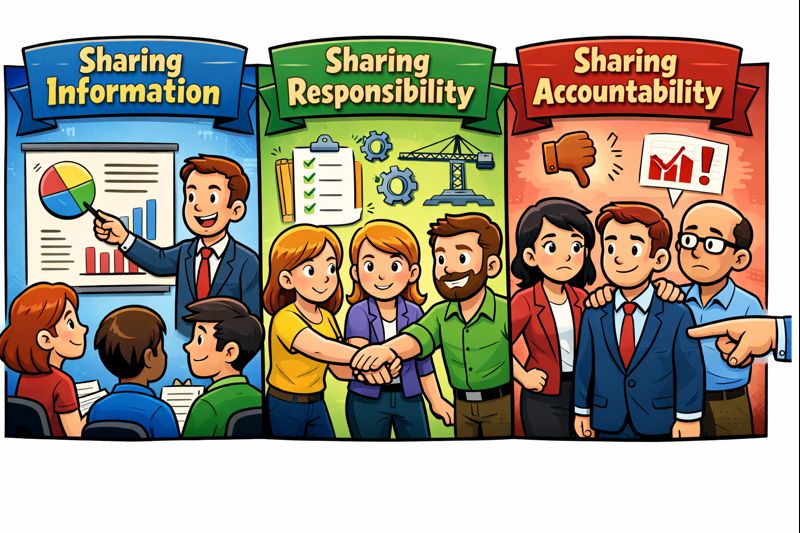
Leaders often speak of sharing, yet the word hides sharp moral and practical splits. To share information, to share responsibility, and to share accountability sound close, but each names a different act of power and risk. When leaders blur these acts, they invite drift, mistrust, and quiet harm. When they hold the line between them, they build trust and ethical grip within work groups (Mintzberg, 2009).

Sharing information sits at the lowest threshold. A leader gives access to facts, plans, data, or sense-making frames that others need to act. This act shapes who can think, judge, and respond. It does not, by itself, shift duty or risk. A leader can share a budget, a forecast, or a strategy while still holding all decisions and outcomes. Information sharing supports voice and skill, yet it can also serve control. Leaders sometimes flood teams with data while keeping choice and blame close. In such cases, the act feels open but stays hollow, as those who receive the data lack the right to shape what follows (Weick, 1995).

Sharing responsibility moves further. Here, a leader hands over part of the task itself. Others now carry defined roles, make choices, and act in their own name. Responsibility links to agency and competence. It answers the question, “Who does the work, and who decides how?” A leader who shares responsibility trusts others to judge trade-offs and manage limits. This shift alters daily power. It also asks more of people, as they must live with the strain of choice and effort. Yet this sharing still does not settle who answers when things fail. A leader can share responsibility for delivery while keeping final answerability tight at the top, which many firms do through role maps such as RACI models (Project Management Institute, 2021).

Sharing accountability marks the deepest and most risky step. Accountability names who must explain, justify, and, if needed, bear sanction for outcomes. It binds action to moral and social judgement. When leaders share accountability, they accept that others will stand beside them when praise or blame arises. This act reshapes hierarchy. It signals that failure will not fall on one neck alone and that success will not serve one career alone. Political theorists note that accountability links power to answerability before others who hold the right to question and judge (Bovens, 2007). Leaders who keep accountability while sharing responsibility often create fear. People sense that they must act yet cannot own the story when results turn sour.

The tension between these three forms of sharing often surfaces in times of change. Adaptive work, which lacks clear answers, demands shared sense-making and risk (Heifetz, Grashow, & Linsky, 2009). Leaders may share information about the challenge and ask others to act, yet retreat from shared accountability when outcomes threaten status or role. This pattern breeds cynicism. Teams learn that voice and effort carry cost but little protection. Over time, this erodes trust and dulls judgement, as people avoid bold choices that they cannot defend as their own.

Ethical leadership requires care with these boundaries. To share information without responsibility treats people as receivers rather than agents. To share responsibility without accountability treats them as buffers against blame. Only when leaders align all three do they honour the moral weight of leadership. This alignment does not mean that all roles carry equal risk. Leaders still hold formal power and often face greater exposure. Yet shared accountability means that leaders stand with others in review, learning, and repair. They speak in the plural when they explain outcomes, and they resist the urge to individualise failure.

In practice, leaders can test their stance through simple questions. Who decides when trade-offs clash? Who speaks first when results disappoint? Who carries the story to those outside the team? Clear answers reveal where accountability sits, regardless of fine words. Research on psychological safety shows that teams learn and adapt when leaders accept their share of blame and model open review (Edmondson, 2018). This stance turns error into data rather than threat.

Sharing information opens eyes, sharing responsibility engages hands, and sharing accountability binds hearts and reputations. Leaders who confuse these acts risk moral evasion. Leaders who align them create cultures where people think, act, and answer together. Such cultures support justice, learning, and sustained work in the face of strain.

References

Bovens, M. (2007). Analysing and assessing accountability: A conceptual framework. European Law Journal, 13(4), 447–468. https://doi.org/10.1111/j.1468-0386.2007.00378.x

Edmondson, A. C. (2018). The fearless organization: Creating psychological safety in the workplace for learning, innovation, and growth. Wiley.

Heifetz, R., Grashow, A., & Linsky, M. (2009). The practice of adaptive leadership. Harvard Business Press.

Mintzberg, H. (2009). Managing. Berrett-Koehler.

Project Management Institute. (2021). A guide to the project management body of knowledge (PMBOK Guide) (7th ed.). PMI.