
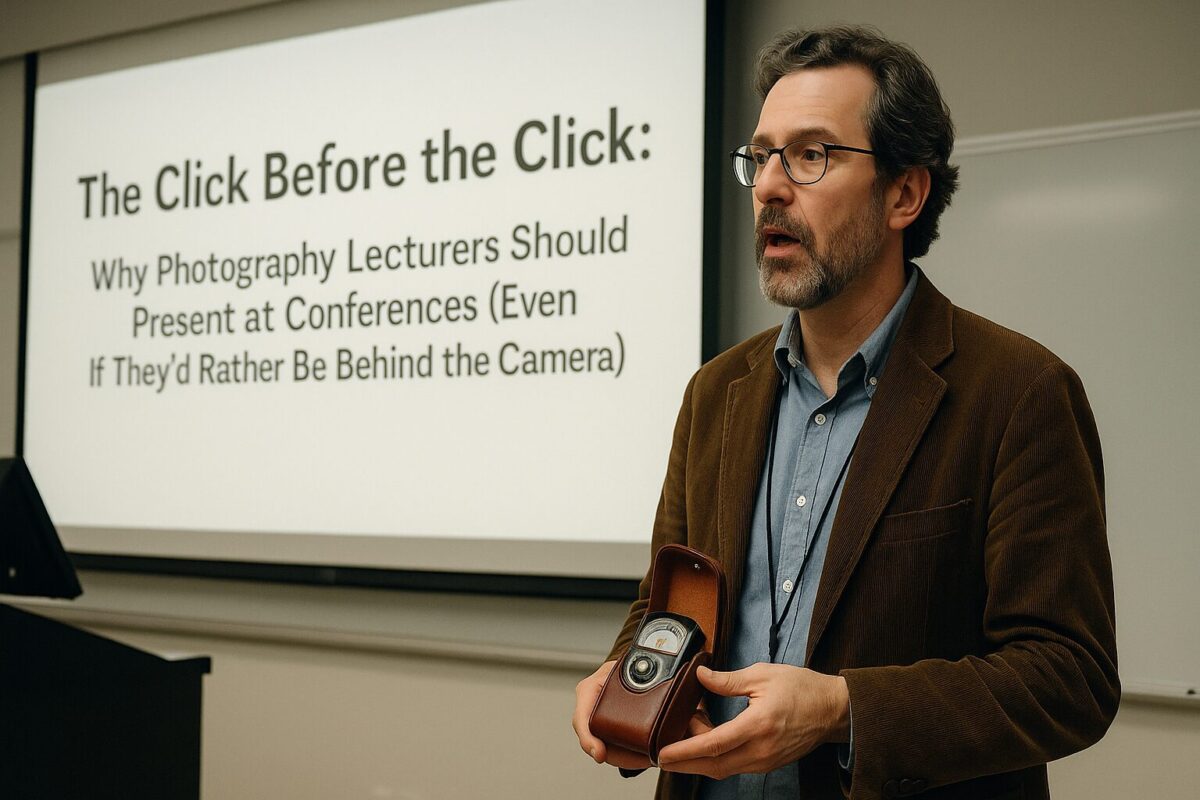
Why Photography Lecturers Should Present at Conferences (Even If They’d Rather Be Behind the Camera)
We’ve all been there. A call for papers lands in your inbox. The theme? Something suspiciously vague like “The Art of Play | The Power of Risk.” You consider it for half a second before returning to marking 42 nearly-identical student essays on the semiotics of the selfie. Presenting at a conference? Sounds exhausting. Aren’t conferences just places where people use words like “praxis” and nobody laughs?
And yet…
Photography lecturers – yes, you with the DSLR, the back issues of Source, and the perpetual hope that someone will understand your metaphor about shadows – have a lot to gain from stepping into the conference spotlight. No, not just for the free tote bags. Though those are nice.
Let’s start with the obvious: visibility. Not the kind you teach in Year 1 composition workshops, but academic visibility. Presenting at a conference lets your ideas be seen, discussed, occasionally misunderstood, and – if you’re lucky – admired. You get to position yourself not just as someone who teaches photography, but as someone who thinks photographically. Someone with opinions on the ethics of street photography and on whether AI-generated images should be allowed in student portfolios (answer: it depends how tired you are that week).
More importantly, conferences offer what academia rarely does: actual human contact. You meet people. You swap horror stories about assessment rubrics. You find out that the lecturer from Leeds has also been quietly collecting vintage light meters in old leather cases, for reasons they can’t quite explain. You remember that you’re not alone.
But oh, the hesitations. “I’m not really a theorist.” “My work’s more practice-based.” “I don’t do PowerPoint.” We hear you. Many photography lecturers carry the inherited trauma of art school critiques and the sneaking suspicion that their ideas won’t sound clever once spoken aloud. Also: imposter syndrome loves nothing more than a room full of academics nodding with performative slowness.
So how do you get past it?
Start small. Find a symposium with a friendly vibe—ideally one with a name that nods to theory but still feels safe to present something involving actual images, like ‘Framing Photographic Education‘. Propose something you’re genuinely curious about, not just what you think will sound smart. Bring images. Speak as if you’re telling a story over coffee, not delivering a sermon. Photography is, after all, a conversation with the world – so treat your talk the same way.
And remember: conferences are full of people just like you. People who use words like “liminality” but also secretly binge YouTube reviews of discontinued Fuji lenses. They’re not expecting perfection. They’re hoping you’ll say something real.
So yes, submit that abstract. Step up to the mic. Project your thoughts onto the world – just like you teach your students to do with their work. Because if photography is about seeing differently, then speaking about photography is how we help others see the seeing.
Worst case? They spell your name wrong on the programme. Best case? Someone hears your talk, nods, and says, “That made me think differently.” Which, in our line of work, is basically the Nobel Prize.