
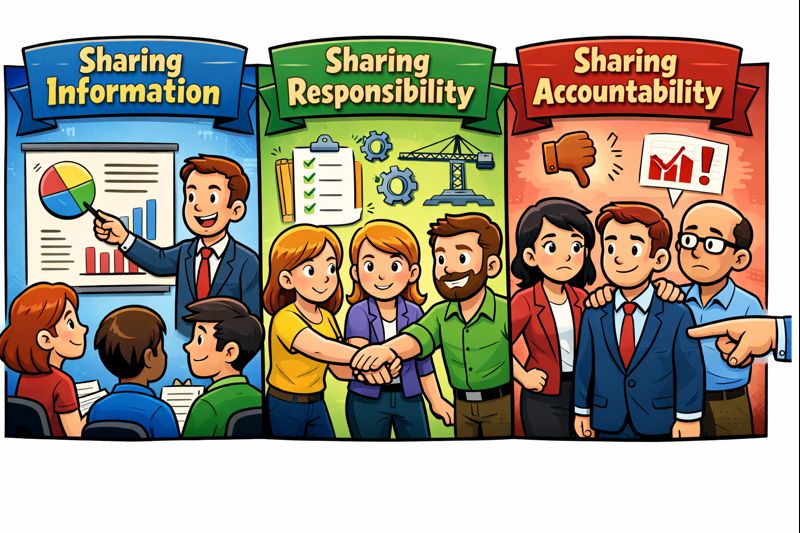
Leaders often speak of sharing, yet the word hides sharp moral and practical splits. To share information, to share responsibility, and to share accountability sound close, but each names a different act of power and risk. When leaders blur these acts, they invite drift, mistrust, and quiet harm. When they hold the line between them, they build trust and ethical grip within work groups (Mintzberg, 2009).
Sharing information sits at the lowest threshold. A leader gives access to facts, plans, data, or sense-making frames that others need to act. This act shapes who can think, judge, and respond. It does not, by itself, shift duty or risk. A leader can share a budget, a forecast, or a strategy while still holding all decisions and outcomes. Information sharing supports voice and skill, yet it can also serve control. Leaders sometimes flood teams with data while keeping choice and blame close. In such cases, the act feels open but stays hollow, as those who receive the data lack the right to shape what follows (Weick, 1995).
Sharing responsibility moves further. Here, a leader hands over part of the task itself. Others now carry defined roles, make choices, and act in their own name. Responsibility links to agency and competence. It answers the question, “Who does the work, and who decides how?” A leader who shares responsibility trusts others to judge trade-offs and manage limits. This shift alters daily power. It also asks more of people, as they must live with the strain of choice and effort. Yet this sharing still does not settle who answers when things fail. A leader can share responsibility for delivery while keeping final answerability tight at the top, which many firms do through role maps such as RACI models (Project Management Institute, 2021).
Sharing accountability marks the deepest and most risky step. Accountability names who must explain, justify, and, if needed, bear sanction for outcomes. It binds action to moral and social judgement. When leaders share accountability, they accept that others will stand beside them when praise or blame arises. This act reshapes hierarchy. It signals that failure will not fall on one neck alone and that success will not serve one career alone. Political theorists note that accountability links power to answerability before others who hold the right to question and judge (Bovens, 2007). Leaders who keep accountability while sharing responsibility often create fear. People sense that they must act yet cannot own the story when results turn sour.
The tension between these three forms of sharing often surfaces in times of change. Adaptive work, which lacks clear answers, demands shared sense-making and risk (Heifetz, Grashow, & Linsky, 2009). Leaders may share information about the challenge and ask others to act, yet retreat from shared accountability when outcomes threaten status or role. This pattern breeds cynicism. Teams learn that voice and effort carry cost but little protection. Over time, this erodes trust and dulls judgement, as people avoid bold choices that they cannot defend as their own.
Ethical leadership requires care with these boundaries. To share information without responsibility treats people as receivers rather than agents. To share responsibility without accountability treats them as buffers against blame. Only when leaders align all three do they honour the moral weight of leadership. This alignment does not mean that all roles carry equal risk. Leaders still hold formal power and often face greater exposure. Yet shared accountability means that leaders stand with others in review, learning, and repair. They speak in the plural when they explain outcomes, and they resist the urge to individualise failure.
In practice, leaders can test their stance through simple questions. Who decides when trade-offs clash? Who speaks first when results disappoint? Who carries the story to those outside the team? Clear answers reveal where accountability sits, regardless of fine words. Research on psychological safety shows that teams learn and adapt when leaders accept their share of blame and model open review (Edmondson, 2018). This stance turns error into data rather than threat.
Sharing information opens eyes, sharing responsibility engages hands, and sharing accountability binds hearts and reputations. Leaders who confuse these acts risk moral evasion. Leaders who align them create cultures where people think, act, and answer together. Such cultures support justice, learning, and sustained work in the face of strain.
References
Bovens, M. (2007). Analysing and assessing accountability: A conceptual framework. European Law Journal, 13(4), 447–468. https://doi.org/10.1111/j.1468-0386.2007.00378.x
Edmondson, A. C. (2018). The fearless organization: Creating psychological safety in the workplace for learning, innovation, and growth. Wiley.
Heifetz, R., Grashow, A., & Linsky, M. (2009). The practice of adaptive leadership. Harvard Business Press.
Mintzberg, H. (2009). Managing. Berrett-Koehler.
Project Management Institute. (2021). A guide to the project management body of knowledge (PMBOK Guide) (7th ed.). PMI.