

The UK Government announced today that it was banning the use of MOBILE phones in schools in England (Schools in England should be phone-free all day, education secretary says | Schools | The Guardian). The decision has had mixed responses.
Those in favour see phones as a distraction, a source of ‘cheating’, and an unsafe medium being brought into a place that should be safe.
Those against it, say that smartphones are a useful tool in teaching – used for in-class research, to engage students through polling apps and collaborative tools. In the absence of a smartphone, many students will need to bring more expensive laptops to school or borrow them on-site.
For the last three years, I’ve been running therapeutic photography sessions through a local FE college. Yes, my students were all adults, but several of them have had no other camera than the one in their smartphone. They would not be able to use them in the future.
The point that many opponents to this policy make is that the ‘issue’ is not with the young people’s use of the technology. It is that ADULTS create the stuff that distract them, whether it is algorithms and entertainments intended to promote their scrolling behaviour, or worse. Instead of regulating the makers and developers, we are potentially penalising the next generation.
Yes, there’s some evidence that suggests that the technology assisted learning can diminish some aspects of cognition. But there’s evidence the other way too.
To me, one of the signs that the policy makers have not done a good enough job in preparing the new rules, is their use of the term, ‘mobile phone’.
The shift from mobile phone to smartphone did not happen at a fixed point. It unfolded across the late 1990s and 2000s, with the new term settling into common use by the early 2010s.
In the 1990s, a mobile phone was a device that made voice calls, with text as an add-on. Early hybrids blurred the line a little, with Nokia’s Communicator range in 1996 offering email and basic web access, yet people still called it a mobile phone. The word smartphone existed, but few outside trade press used it, and its meaning lacked a firm definition.
The term gained ground in the early 2000s as devices fused phone, organiser, and internet tools. BlackBerry popularised push email for work users, while Symbian devices from Nokia added apps and web browsing. At this stage, the term smartphone helped make the contrast clearer. It represented a phone that did more than call and text, rather than naming the default object itself (Agar, 2013).
A decisive shift came after 2007 with the iPhone and, soon after, Android devices. These phones had touch screens, app stores, and constant data use. By around 2010, UK media, retailers, and network firms used smartphone as a standard category. Ofcom reports from this period show smartphone adoption rising fast, while mobile phone began to sound vague or dated (Ofcom, 2011).
The ngram shows this shift in the terminology.
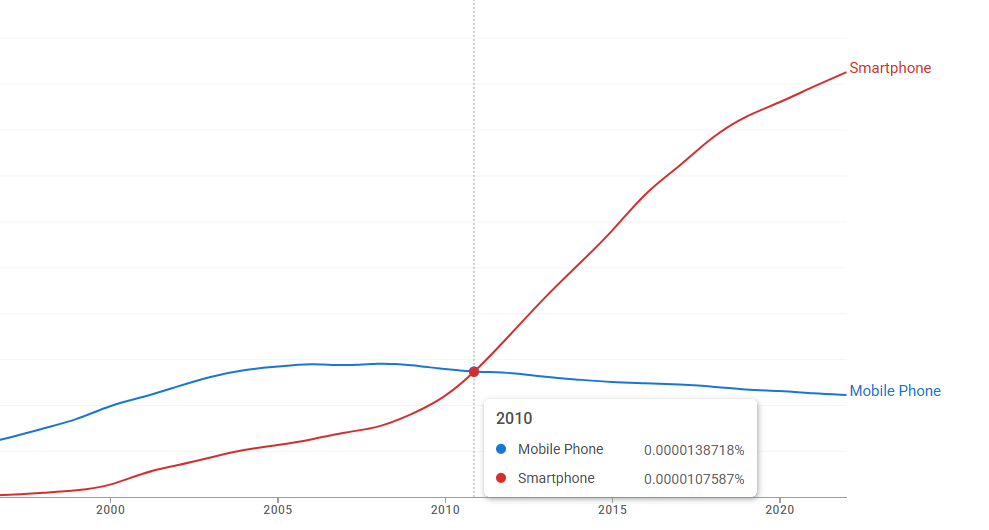
By the middle of 2010, the linguistic balance flipped. A mobile phone now implied a basic handset, while smartphone named the device most adults owned. In everyday speech, people then shortened this again to phone, since the “smart” features no longer felt special. This pattern fits a common path in language. A marked term names novelty, spreads with the thing itself, then fades once the feature becomes assumed (McCulloch, 2019).
What you don’t do, however, is go back to the legacy term. That the Department for Education have done so is simply a sign that they haven’t paid enough attention to the detail. And, if they haven’t to this basic fact, then what about the essence of the rules? Instead of regulating the makers and developers, they are penalising the next generation.
References
Agar, J. (2013). Constant touch: A global history of the mobile phone. Icon Books.
McCulloch, G. (2019). Because Internet: Understanding the new rules of language. Riverhead Books.
Ofcom. (2011). The communications market report. Ofcom.
Oxford English Dictionary. (n.d.). Smartphone.