
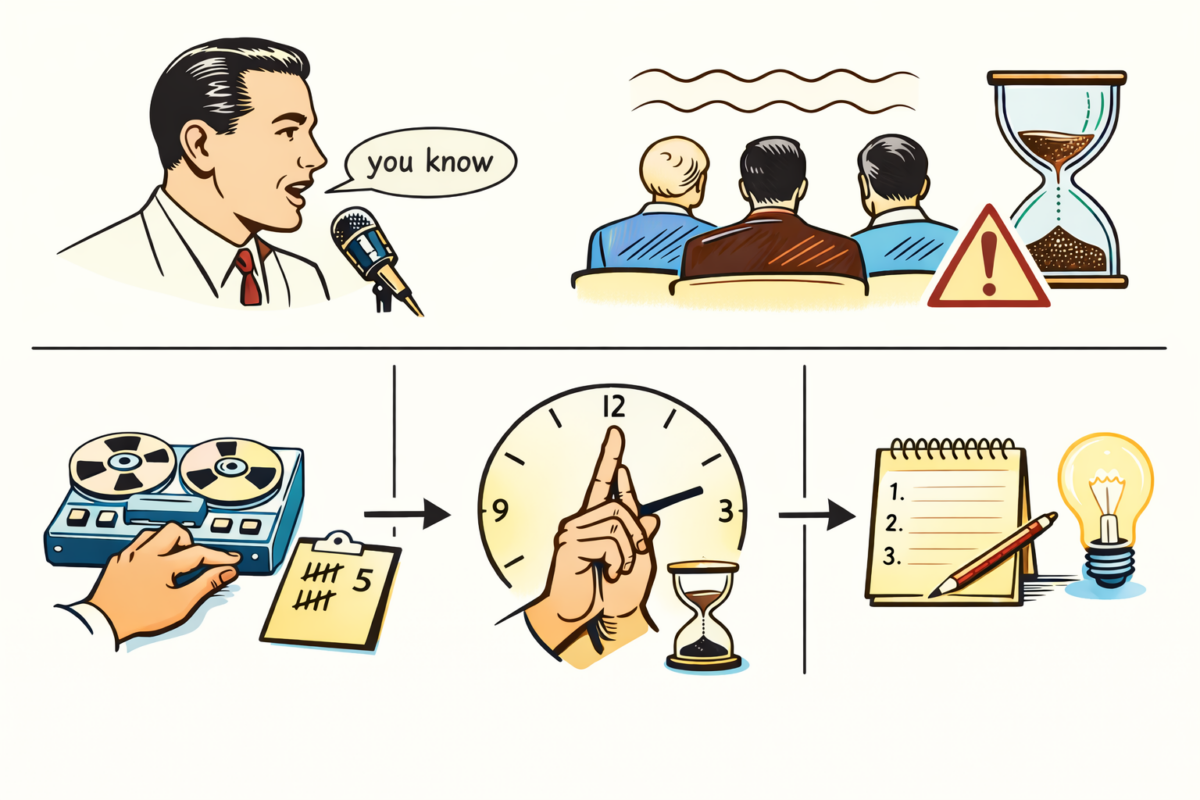
Many of us lean on the phrase “you know” when we present, often without any awareness that we are doing so. It slips into our speech at the end of a clause or just before we launch the next idea. We do not usually mean it as a question. We use it as a bridge while we gather our thoughts. Yet what feels natural and helpful to us can feel distracting to those who listen. Over time, repeated use erodes the speaker’s clarity, weaken their authority, and taxes the audience’s attention.
To be fair, “You know” sits within a wider family of discourse markers such as “um” and “er”. When we speak without a script, we plan ideas while producing language, monitoring tone, and reading social cues. This process places high demand on our working memory. Under that load, our brains insert short, low-cost phrases to hold the floor while we prepare what comes next (Clark & Fox Tree, 2002). In everyday conversation this rarely causes difficulty. Casual talk tolerates repair, overlap, and verbal padding because connection matters as much as precision.
Presentations operate under different expectations. When we stand in front of a group, we signal that we will offer structured thought. Our listeners expect deliberate phrasing and coherent flow. Each time we say “you know”, we interrupt that flow. We signal shared understanding but add no new information. Meaning stalls for a moment, then resumes. One instance passes unnoticed. Repetition accumulates. What began as a thinking aid becomes a strain on attention.
Research on cognitive fluency helps explain why this irritates. When ideas feel easy to process, we judge them as clearer and more credible. When processing feels effortful, we attribute that difficulty to the speaker rather than to the situation (Alter & Oppenheimer, 2009). We rarely think, “This talk contains minor disfluencies.” Instead, we feel that the speaker lacks preparation or confidence. Our judgement forms quickly and without conscious intent.
We may also react to the social signal embedded in the phrase. “You know” assumes shared knowledge. Used sparingly, it can create warmth. Used repeatedly, it shifts responsibility onto the listener, as if understanding already exists and agreement should follow. Linguistic work on discourse markers suggests that repeated bids for assumed common ground can produce subtle resistance, especially in formal settings where clarity matters (Schiffrin, 1987).
There is another cost. Pauses serve us well as listeners. They allow us to group ideas, reflect, and integrate meaning. When we replace silence with fillers, we remove those moments of cognitive rest. Instead of a clean boundary between thoughts, we offer noise. Over time, our audience grows tired.
None of this implies low intelligence or poor preparation. Evidence shows that disfluency links more strongly to real-time cognitive demand than to ability (Bortfeld et al., 2001). Even experienced speakers increase filler use when material grows complex or when social pressure rises. The habit reflects the brain at work.
The issue lies in mismatch. The patterns that support us in conversation do not always serve us in presentation.
How to reduce your… You knows
If we wish to address this in ourselves or in others, we should frame it around care for our audience rather than fault in the speaker. Excessive “you know” is not morally wrong. It is cognitively costly. It asks our listeners to work harder than necessary. Clear delivery shows respect for their time and attention.
Awareness forms the first step. Most of us underestimate how often we repeat a filler. When we record ourselves and count its frequency over two minutes, the pattern becomes visible. Hearing our own speech can unsettle us, yet it provides concrete feedback that memory cannot supply.
The second step involves substitution rather than suppression. If we try to ban the phrase while speaking, we increase our anxiety and often worsen our fluency. Our brain needs an alternative behaviour. A short pause works best. A breath before the next clause may feel long to us, yet it sounds measured to others. With practice, silence replaces the filler.
The third step concerns structure. We tend to insert fillers where our thinking feels heavy. If we organise our material into clear segments with deliberate sentence endings, we reduce planning load in the moment. Our speech becomes steadier because our ideas already sit in order.
Remember that the load on our brain increases when it is emotional. We often use “you know” most when discussing material that matters to us. Emotion and complexity increase cognitive demand. The habit may signal engagement rather than carelessness. Our aim is not to strip our speech of warmth, but to align natural thinking with audience comfort.
Effective communication depends not only on what we say, but on how easily others can absorb it. Small verbal habits shape large social judgements. Fluency breeds trust. Disruption breeds doubt.
Silence, in this context, is not a failure. It is structure. When we allow our ideas space, we signal thought rather than uncertainty. Where repetition clutters meaning, a pause restores clarity.
When we replace fillers with measured silence and clear phrasing, our authority often rises without any change in content. Our words feel chosen rather than rushed. Our presence feels steady rather than strained.
The paradox remains that what helps us think can hinder others from understanding. The craft of presentation lies in bridging that gap with awareness, care, and practice.
References
Alter, A. L., & Oppenheimer, D. M. (2009). Uniting the tribes of fluency to form a metacognitive nation. Personality and Social Psychology Review, 13(3), 219–235. https://doi.org/10.1177/1088868309341564
Bortfeld, H., Leon, S. D., Bloom, J. E., Schober, M. F., & Brennan, S. E. (2001). Disfluency rates in conversation: Effects of age, relationship, topic, role, and gender. Language and Speech, 44(2), 123–147. https://doi.org/10.1177/00238309010440020101
Clark, H. H., & Fox Tree, J. E. (2002). Using uh and um in spontaneous speaking. Cognition, 84(1), 73–111. https://doi.org/10.1016/S0010-0277(02)00017-3
Schiffrin, D. (1987). Discourse markers. Cambridge University Press. ISBN 9780521339225