
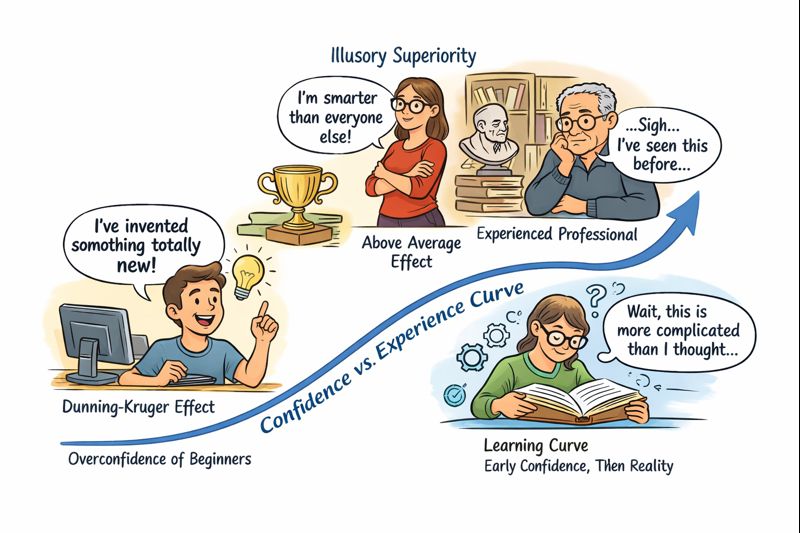
As professionals get older, they often seem to encounter younger individuals who come across something for the first time and assume that it is either new or that they have invented something that nobody has heard of before. In effect, those younger people are simply ignorant of the history of their subject and naïve to think that nobody would have thought of it before them. They have an inflated sense of their own capability. There is a body of academic research about this…
Scholars frame this phenomenon in terms of expertise, metacognition, and learning stages, rather than age per se. Research across social and cognitive psychology shows that people new to a field often mistake first exposure for innovation, and early insight for mastery. This pattern reflects predictable limits in self-assessment rather than a flaw of character.
The most influential account comes from work by David Dunning and Justin Kruger. Their research on what became known as the Dunning–Kruger effect showed that individuals with low skill in a domain tend to overrate both their competence and the quality of their ideas (Dunning & Kruger, 1999). The key claim does not rest on arrogance. Instead, it rests on metacognitive limits. The skills needed to judge quality overlap with the skills needed to produce it. When people lack those skills, they cannot see the gaps in their own knowledge. As a result, they believe their ideas show originality when they simply repeat earlier work.
Later studies refined this claim. Kruger and Dunning argued that as expertise grows, confidence often falls before it stabilises (Kruger & Dunning, 2009). Increased knowledge exposes prior debates, failed approaches, and unresolved tensions. This process weakens inflated claims of novelty. It also explains why experienced professionals tend to greet bold claims from newcomers with scepticism rather than excitement. They recognise the idea, even when the speaker does not.
A second strand of research concerns illusory superiority, sometimes called the better-than-average effect. Studies show that people routinely rate their abilities, insight, and originality above those of peers, especially where standards remain vague or feedback remains slow (Alicke & Govorun, 2005). Intellectual and creative work offers fertile ground for this bias. Claims of originality resist easy testing, and many fields reward confidence in speech more than accuracy in history. Under these conditions, novice thinkers may assume their perspective stands apart when it merely stands early.
Educational psychology adds further depth. Research on learning curves shows that beginners often pass through a phase of high confidence soon after first contact with a topic. Bjork, Dunlosky, and Kornell describe this as an illusion of understanding, where surface fluency masks shallow grasp (Bjork et al., 2013). Early models feel clear because they remain simple. Learners have not yet met contradiction, context, or edge cases. This stage invites premature claims of insight and invention.
Work on expertise development supports this view. Studies of expert performance show that mastery involves long exposure to prior work, criticism, and failure. Experts learn to locate their ideas within a lineage rather than outside it (Ericsson et al., 2006). Novices lack that map. Without it, they mistake personal discovery for historical novelty. The claim “no one has thought of this before” often translates to “I have not yet read enough”.
Importantly, the literature avoids moral judgement. These effects do not imply that younger or less experienced people lack intelligence or creativity. They reflect normal cognitive limits during learning. Many researchers note that early confidence can serve a motivational role. It sustains engagement long enough for deeper learning to begin. The problem arises when institutions reward confidence without insisting on historical grounding.
From a professional standpoint, the tension reflects a clash between short memory and long memory. Early learners work from immediate insight. Experienced practitioners work from accumulated context. Each position carries value, but confusion arises when novelty becomes a social claim rather than an empirical one. Academic research strongly supports your observation. It also explains why time in a field tends to foster restraint, citation, and humility rather than louder claims of invention.
My first real exposure to this came when I was trying to help managers in a chemical plant implement problem-solving groups. The managers had a fraction of the experience of the employees who were operating the plant. The operators, on the other hand, didn’t have access to the experimental design skills that [a handful of] the managers had. Once they were helped to run their own trials, the operators soon demonstrated their superior ability to optimise the plant, and the managers learnt to eat humble pie.
References
Alicke, M. D., & Govorun, O. (2005). The better-than-average effect. In M. D. Alicke, D. A. Dunning, & J. I. Krueger (Eds.), The self in social judgment (pp. 85–106). Psychology Press.
Bjork, R. A., Dunlosky, J., & Kornell, N. (2013). Self-regulated learning: Beliefs, techniques, and illusions. Annual Review of Psychology, 64, 417–444. https://doi.org/10.1146/annurev-psych-113011-143823
Dunning, D., & Kruger, J. (1999). Unskilled and unaware of it: How difficulties in recognising one’s own incompetence lead to inflated self-assessments. Journal of Personality and Social Psychology, 77(6), 1121–1134. https://doi.org/10.1037/0022-3514.77.6.1121
Ericsson, K. A., Charness, N., Feltovich, P. J., & Hoffman, R. R. (2006). The Cambridge handbook of expertise and expert performance. Cambridge University Press. https://doi.org/10.1017/CBO9780511816796
Kruger, J., & Dunning, D. (2009). Unskilled and unaware of it: How people fail to recognise their own incompetence. Perspectives on Psychological Science, 4(1), 30–46. https://doi.org/10.1111/j.1745-6924.2009.01130.x