
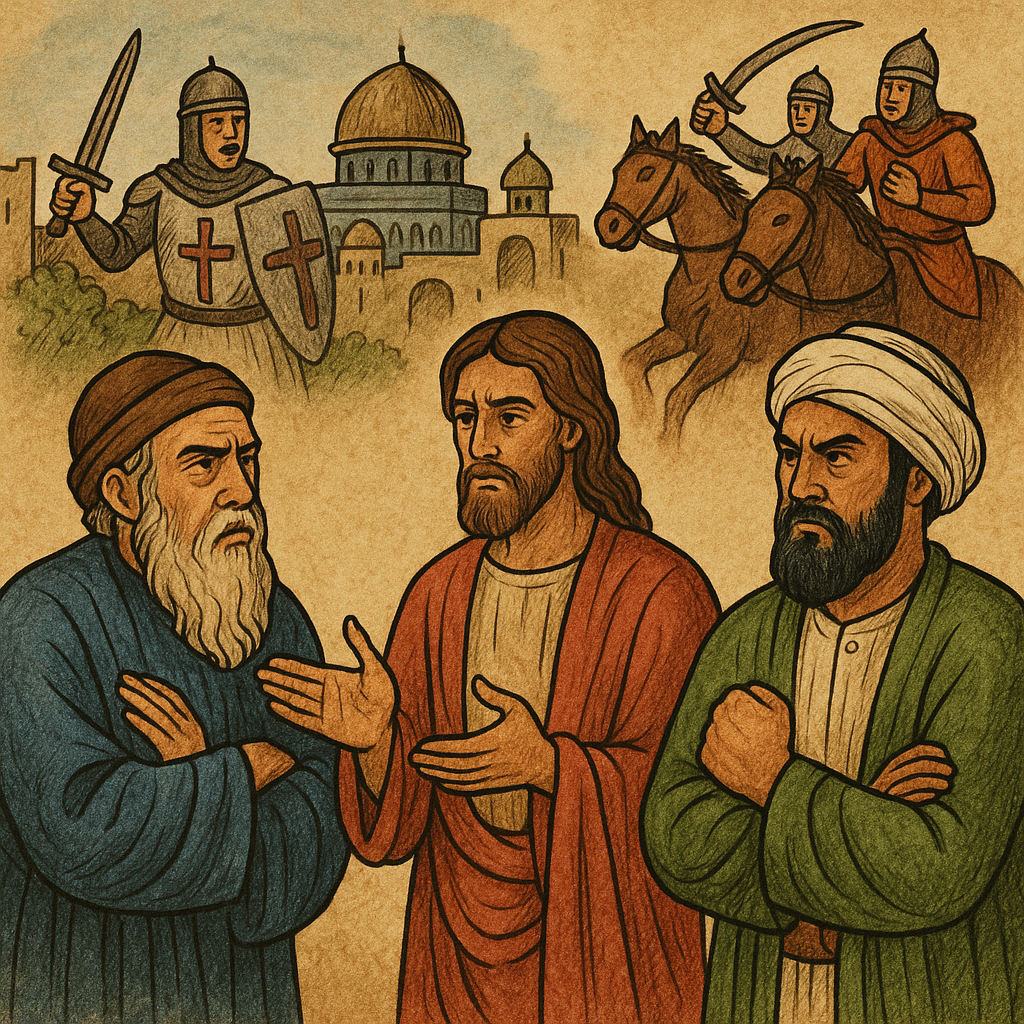
Christians, Jews and Muslims share deep roots and long rivalry. The Israelite religion centred on the Temple in Jerusalem – completed c. 957 BCE and destroyed in 587/586 BCE. Christianity grew inside Judaism in the first century CE after Jesus’ life and death. Islam began in Arabia around 610 CE with Muhammad’s first revelations. (Encyclopaedia Britannica, 2025).
Religions formed identity and power. Early Christian leaders framed Jews as religious rivals and often blamed them for Jesus’ death. That set a pattern of exclusion and legal limits that fed anti-Jewish popular feeling in medieval Europe. Scholars link this to theological “replacement” ideas and to social conflict in weak states. (Langmuir, 1990).
Christian–Muslim war has both sacred and worldly causes. From the late eleventh century the Crusades mixed papal aims, noble ambition and trade with a call to liberate holy places. Crusading created cycles of violence across the eastern Mediterranean and fuelled mutual fear. (Asbridge, 2004).
Jews in Muslim lands often fared better than in Christian lands. Muslim rulers made Jews “dhimmis” – second-class but usually protected. That status gave room for study, trade and relative security until local politics or conquest brought trouble. (Cohen, 1994).
Modern patterns stem from nationalism and empire. Zionism, Ottoman decline, British rule and settler colonisation in Palestine after 1917 created a clash over land, rights and statehood. That struggle hardened into long war and acute distrust between many Jews and many Muslims today. (Khalidi, 2020).
Attitudes among Christians to Jews now split. The Holocaust and Vatican II prompted major Christian shifts. The 1965 declaration Nostra Aetate rejected collective guilt and urged dialogue. Some churches and Christians now pursue repair and strong ties with Jews. Others keep older suspicions or view Israel through politicised lenses – so views vary by theology, politics and local memory. (Vatican, 1965).
In short, old theology, social rivalries and state power made much early conflict. Modern war and mistrust flow more from colonialism, nationalism and competing claims to land and security. Religious difference still shapes feelings, but politics now drives the fiercest fights.
References
Asbridge, T. (2004). The First Crusade: A New History. Oxford University Press.
Cohen, M. R. (1994). Under Crescent and Cross: The Jews in the Middle Ages. Princeton University Press.
Encyclopaedia Britannica. (n.d.). Temple of Jerusalem; Christianity; How was Islam founded? Retrieved 2025.
Khalidi, R. (2020). The Hundred Years’ War on Palestine: A History of Settler Colonialism and Resistance, 1917–2017. Metropolitan Books.
Langmuir, G. I. (1990). History, Religion, and Antisemitism. University of California Press.
Vatican. (1965). Nostra Aetate: Declaration on the Relation of the Church to Non-Christian Religions. Vatican.