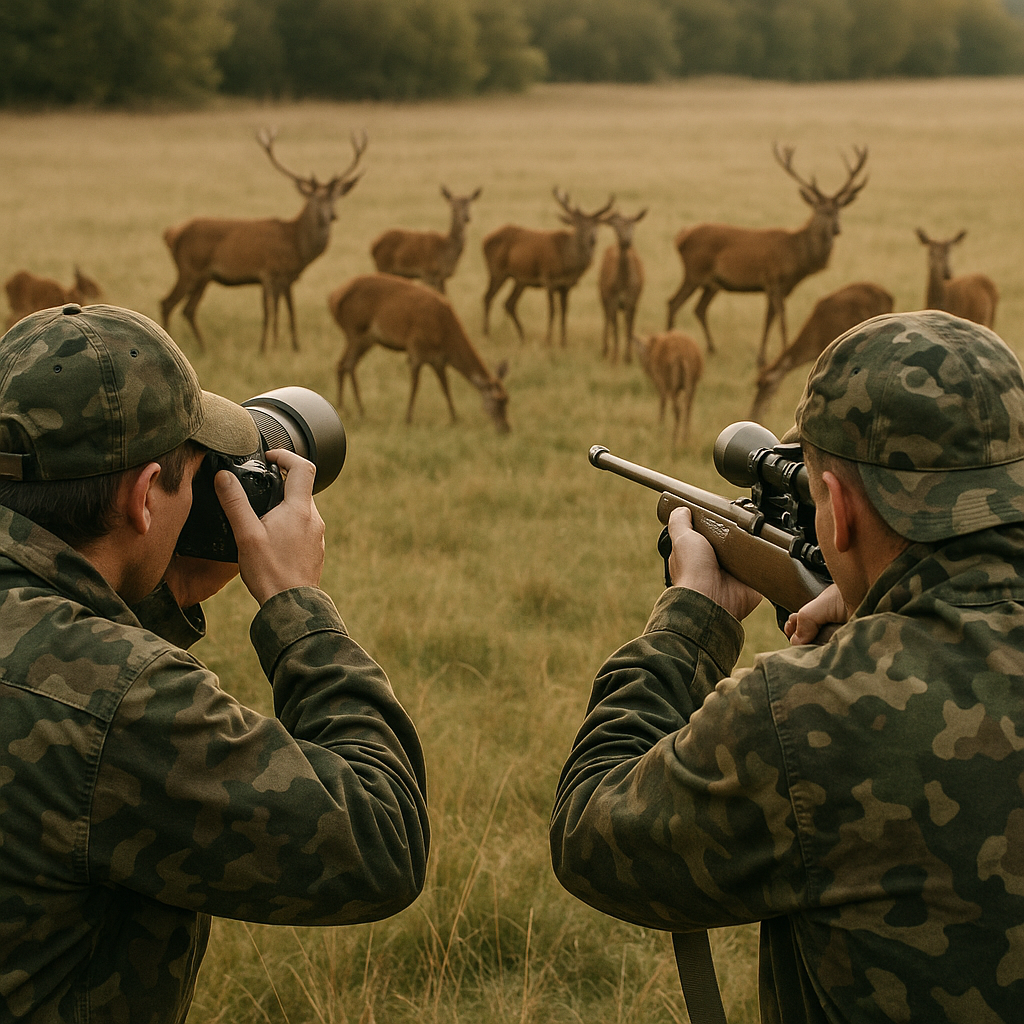
Photography’s vocabulary is steeped in the imagery of military conflict and the hunt. This is not accidental. When the medium emerged in the nineteenth century, the people who adopted it often moved in the same social worlds as soldiers, explorers, and sportsmen. Many were men of means who hunted game and collected trophies, and they brought that language with them into their new pastime. Cameras themselves were often large, tripod-mounted devices that to the untrained eye resembled surveying or gunnery equipment. In colonial and military contexts, this resemblance was more than superficial: cameras were used for reconnaissance, mapping, and documenting occupied territories. From its early decades, photography was described in terms of aiming, targeting, loading, and shooting – metaphors that framed the act as one of pursuit, precision, and control.
Hunting and military vocabulary in photography
Many familiar photographic terms reveal this legacy. This has been a concern of mine for many years. Given the state of the world today, I feel that we need to be challenging it with particular urgency.
| Militaristic / Hunting Term | Non-violent Alternative | Reasoning |
|---|---|---|
| Shoot a picture | Make an image | Suggests creation rather than attack. |
| Take a picture | Create a photograph | Implies active making, not seizing. |
| Capture a moment | Hold / Honour the moment | Frames it as care and respect, not seizure. |
| Aim the camera | Align / Compose the view | Emphasises arrangement and artistry over targeting. |
| Target the subject | Focus on the subject | Removes adversarial connotation, keeps precision. |
| Sniper shot | Fleeting glance | Retains sense of quickness without violence. |
| Load film / card | Prepare the camera | Implies readiness without weapon imagery. |
| Pull the trigger | Press the shutter | Gentle, tactile action without firing metaphor. |
| Gun the lens (slang) | Adjust the lens | Avoids weapon reference, keeps meaning. |
| Burst shooting | Continuous mode | Neutral description of rapid exposures. |
| Fire off a few shots | Make a quick series | Focuses on process, not attack. |
| Stalking a subject | Follow patiently | Suggests observation rather than predation. |
| Hunt for images | Search for images | Keeps exploratory feel, removes kill metaphor. |
| In the crosshairs | In the centre of the frame | Clear, descriptive, without gun-sight imagery. |
| Shot list | Image list | Keeps organisational meaning without ammunition link. |
| Take aim | Set your composition | Shifts from combat to craft. |
| Under fire (critique) | Under close review | Retains scrutiny, removes battlefield imagery. |
| Kill the lights | Turn off the lights | Functional, not violent. |
| Trigger happy | Quick to act | Keeps sense of eagerness, avoids recklessness. |
Why these metaphors persist
These metaphors have persisted for several intertwined reasons. Historically, the overlap between photographic and military technologies reinforced the association. Cameras were deployed in wartime for aerial mapping, intelligence gathering, and propaganda, which kept martial language in circulation. In the civilian sphere, the adoption of hunting language reflected the cultural norms of the era: many amateur photographers were also members of hunting clubs, and the metaphor of “capturing” a scene seemed natural. On a deeper level, these words appealed to the psychology of control – the idea that a photographer actively seizes a moment, asserts authority over a subject, and renders it immobile. This view mirrored broader imperial and industrial attitudes of the nineteenth and early twentieth centuries. Even as photography became a mass hobby and later a professional discipline, the linguistic habits of its earliest practitioners remained embedded in advertising copy, instruction manuals, and everyday speech. By the time most people forgot the origins of phrases like “shoot from the hip” or “target the subject,” the terms had become part of the craft’s working vocabulary.
Pacifist and non-violent alternatives
Replacing these metaphors with pacifist alternatives offers more than linguistic tidiness; it reshapes how photographers think about their work and their relationships to what they photograph. Violent metaphors encourage an adversarial or extractive stance, in which the photographer takes something from a scene or person. Pacifist language suggests instead that photography is an act of engagement, not conquest. Speaking of “making” rather than “taking” an image implies a shared process of creation. Choosing to “align” or “compose” a view rather than “aim” at a target shifts attention from domination to arrangement and care. Instead of “capturing” a moment, one might “hold” or “honour” it. The phrase “fleeting glance” can replace “sniper shot” without losing the sense of speed and transience. “Prepare the camera” is gentler than “load,” and “press the shutter” feels less aggressive than “pull the trigger.” Such changes may seem small, but they can help foster a culture of attentiveness, respect, and reciprocity between photographer and subject.
Why changing the language matters
Such a change in vocabulary is not just a matter of personal style; it can foster ethical awareness, particularly in fields such as socially engaged or therapeutic photography where trust is central. It can also disrupt the colonial, gendered, and militaristic residue that lingers in visual culture, encouraging photographers to think of themselves less as hunters or marksmen and more as collaborators, witnesses, and stewards of the moment.
In teaching contexts, this shift can help students reflect critically on the power dynamics of image-making. In public discourse, it signals a rejection of conquest-based thinking in favour of relationship and care. In both cases, reimagining the language of photography opens space for new metaphors – ones that suggest curiosity rather than control, and empathy rather than extraction.