
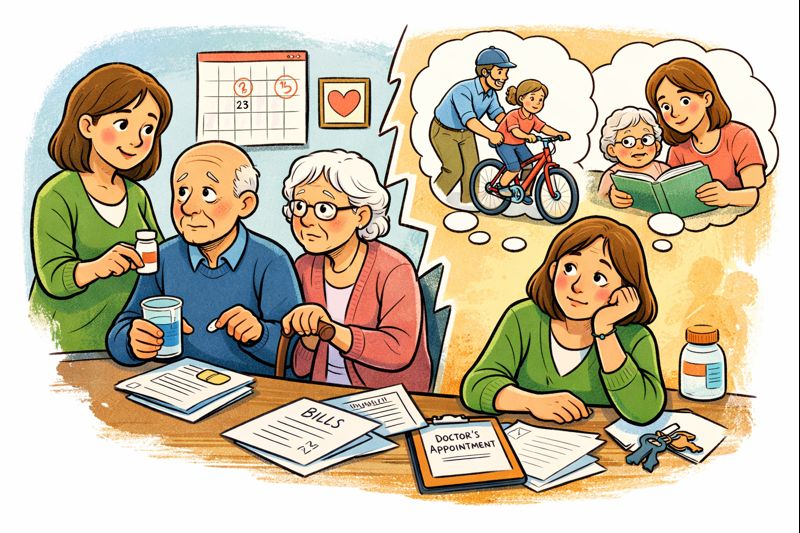
People often describe a moment when their parents begin to feel like children. The phrase captures something real, yet it also misleads. What changes is not a return to childhood, but a shift in responsibility, power, and care. This shift unfolds through health, loss, and social context rather than age alone. Understanding this distinction matters because it shapes how adult children respond, and how older parents retain their dignity and sense of self.
The first signs tend to appear in midlife. An adult child notices small lapses in memory, growing trouble with forms, or unease with new systems. These moments mark the start of a role change. The parent no longer acts only as guide or protector. They begin to need support. Blenkner (1965) described this process as “filial maturity”, where the adult child learns to see the parent as a vulnerable other rather than as an authority figure. This change does not depend on the number of years lived; it depends on a new balance of risk and care.
As health declines, so the shift deepens. Illness, frailty, or bereavement can erode habits that once happened without any thought. The adult child now steps in to manage appointments, finances, or safety. Many people describe this as becoming “the parent”, but what they often mean is that they now hold foresight and responsibility. Zarit et al. (1980) showed that this change in role places a heavy emotional load on adult children, not because care itself feels wrong, but because it alters their own identity and expectations. The past relationship does not vanish, it rubs alongside the present one.
It is tempting to read this change as regression. Yet psychological theory argues against this view. In Erikson’s (1982) account of the life course, later life centres on meaning, loss, and review, not a return to earlier stages of dependence. Older adults may seek routine, resist change, or rely on others, but these acts arise from adaptation to loss rather than from childlike development. Baltes and Smith (2003) frame ageing as a mix of gains and losses, managed through selective dependence and compensation. Dependence here reflects skill and judgement, not failure.
Calling older parents “like children” also risks infantilisation. Children grow towards autonomy and power. Older adults often move away from them. On the surface these may look alike; both may need help with dressing, transport, or planning, for example. However, the meaning differs, as the older person carries a lifetime of identity, values, and memory. Treating dependence as a return to childhood erases this history and can strip dignity. Steinman (1979) warned that role reversal should never imply a loss of personhood, since the parent remains a full moral agent even when dependent.
The emotional strain of this shift often links to unfinished business. Brody (1985) showed that distress in caregiving stems less from the tasks themselves and more from earlier conflict, guilt, or unmet needs within the relationship. When adult children hold power over parents who once shaped their lives, old wounds can surface. Care then becomes a site of moral testing. Can one offer help without revenge? Can one guide without control?
Culture and social structure shape when and how this shift occurs. In families with shared homes or strong kin networks, responsibility may spread across many hands. The change then feels slower and less stark. Conversely, in societies where work and housing pull families apart, crisis often triggers a sudden role reversal. Finch and Mason (1993) showed that class, gender, and cultural norms all govern who provides care and how it feels. Policy also matters as strong health and social care systems can delay dependence and reduce strain on individuals and families. Weak systems, though, push families into roles they may feel unready to hold.
It helps to replace the idea of parents becoming children with a more nuanced perspective. What unfolds is a renegotiation of responsibility across time; authority softens, care flows back. The parent does not shrink into childhood, but enters a phase marked by loss, need, and reflection. The adult child enters a phase marked by duty, grief, and moral labour. Each must adapt.
This distinction matters. It protects older adults from being spoken to as if they lacked sense or worth. It also frees adult children from the false belief that care means dominance. Good care recognises dependence while honouring history. It supports without erasure. The task is hard, because it asks people to hold two truths at once. The parent needs help. The parent remains themselves. Age sets the stage, but life writes the script.
References
Baltes, P. B., & Smith, J. (2003). New frontiers in the future of aging: From successful aging of the young old to the dilemmas of the fourth age. Gerontology, 49(2), 123–135.
Blenkner, M. (1965). Social work and family relationships in later life. Social Service Review, 39, 318–329.
Brody, E. M. (1985). Parent care as a normative family stress. The Gerontologist, 25(1), 19–29.
Erikson, E. H. (1982). The life cycle completed. New York: Norton.
Finch, J., & Mason, J. (1993). Negotiating family responsibilities. London: Routledge.
Steinman, S. (1979). The older parent–adult child relationship. Journal of Marriage and the Family, 41(2), 275–287.
Zarit, S. H., Reever, K. E., & Bach-Peterson, J. (1980). Relatives of the impaired elderly: Correlates of feelings of burden. The Gerontologist, 20(6), 649–655.