
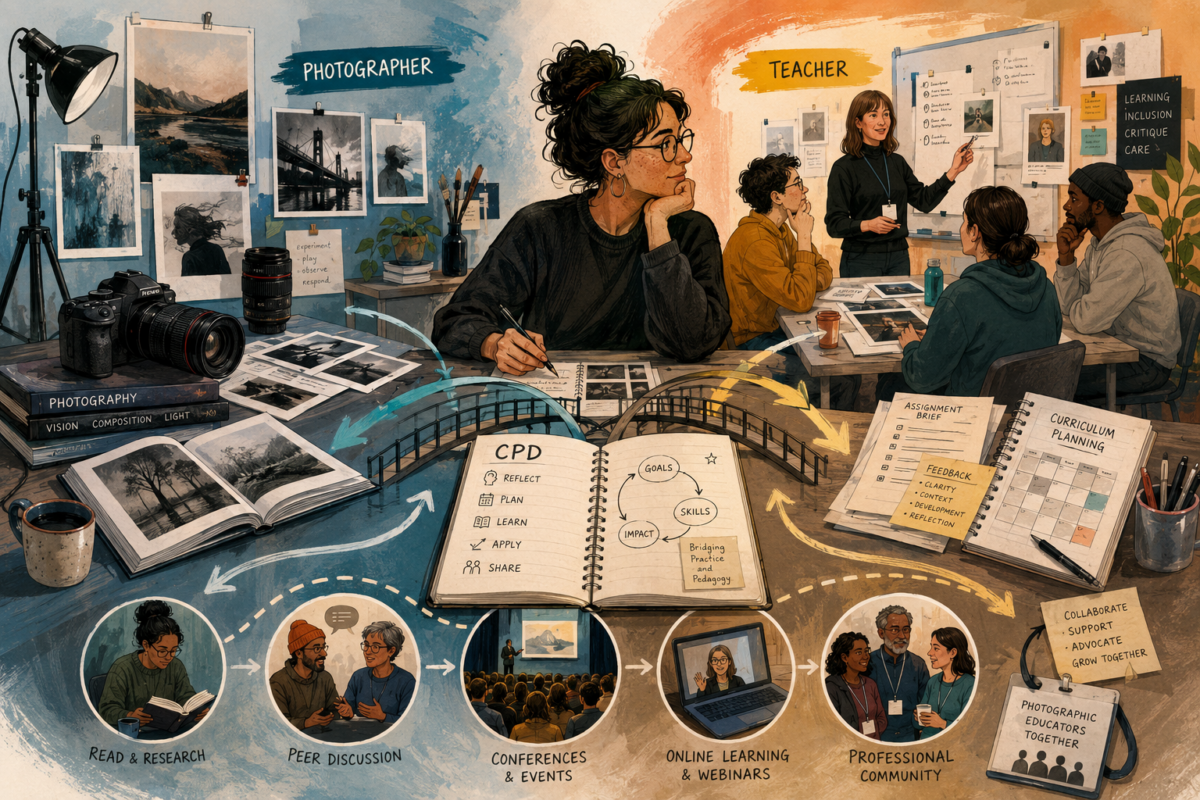

Continuing professional development (CPD) matters in any profession because past skill cannot guarantee current competence. Knowledge shifts, tools change, ethical concerns emerge, and the needs of those we serve develop. For photographic educators, however, CPD carries added weight because they often work as dual professionals. They must sustain skill and judgement both as photographers and as educators.
The idea of dual professionalism has strong roots in further education. The Education and Training Foundation describes teachers in vocational settings as people who need both credible vocational expertise and sound teaching practice. This creates a more complex duty than that faced by a practitioner whose main concern is to remain fit to practise within one field. A practising photographer may ask whether CPD has improved their image-making, business skill, technical knowledge, ethical judgement, or place within the field. A photographic educator must ask all these questions and one more: has this development improved my students’ learning?
This distinction should shape an annual CPD plan. Photographic educators need to keep their own practice alive. They might undertake a personal project, seek peer critique, publish or exhibit work, study photo books, attend exhibitions, test new tools, or renew contact with commercial, documentary, artistic, or community practice. Current practice need not mean paid commissions alone. Research, writing, curating, visual inquiry, collaborative work, and sustained personal practice can also keep a tutor engaged with the changing field.
At the same time, educators must develop their teaching. CPD might address course design, assessment, critique, feedback, inclusion, student support, digital practice, or the use of AI. A strong plan should also focus on the point where photography and pedagogy meet. How should a tutor teach visual judgement? How can critique challenge students without crushing risk-taking? How should courses address consent, authorship, copyright, representation, climate harm, synthetic images, or changes in photographic work? These are not purely photographic questions or purely educational ones. They sit at the centre of dual professionalism.
CPD should therefore move beyond attendance. A conference badge or online course certificate shows activity, but not development. The stronger test concerns change. What has the educator revised in a module, assignment, critique method, reading list, assessment task, or form of student support? What evidence suggests that the change helped? ETF material on CPD stresses sustained professional growth rather than isolated activity, while recent sector discussion links investment in CPD with teaching quality and dual professionalism.
This is also where APHE can play an important role. The Association for Photographic Education now frames its community across secondary, further, and higher education, united by shared pedagogic and practice-based interests. It offers photographic educators a forum for debate, peer contact, challenge, and shared thought about current photographic culture and educational practice. Membership, conferences, working groups, peer exchange, and active contribution can therefore form part of a serious CPD plan rather than sit outside it.
Each photographic educator might ask four questions at the start of the year: How will I remain a credible photographer? How will I become a better educator? How will I strengthen the link between those roles? Who will challenge my own view of my competence? A planned answer to those questions turns CPD from a yearly duty into part of professional identity. For dual professionals, that is not an optional extra. It lies at the heart of responsible photographic education.
References
Association for Photographic Education. (2026). Our mission, governance, and operational policies.
Association for Photographic Education. (2026). Join APHE.
Education and Training Foundation. (2026). Professional development and CPD for further education.
Education and Training Foundation. (2026). ETF Partnership: Long-term professional development for FE organisations.
Education and Training Foundation. (2026). Stay up to speed.
Leave a Reply
You must be logged in to post a comment.