
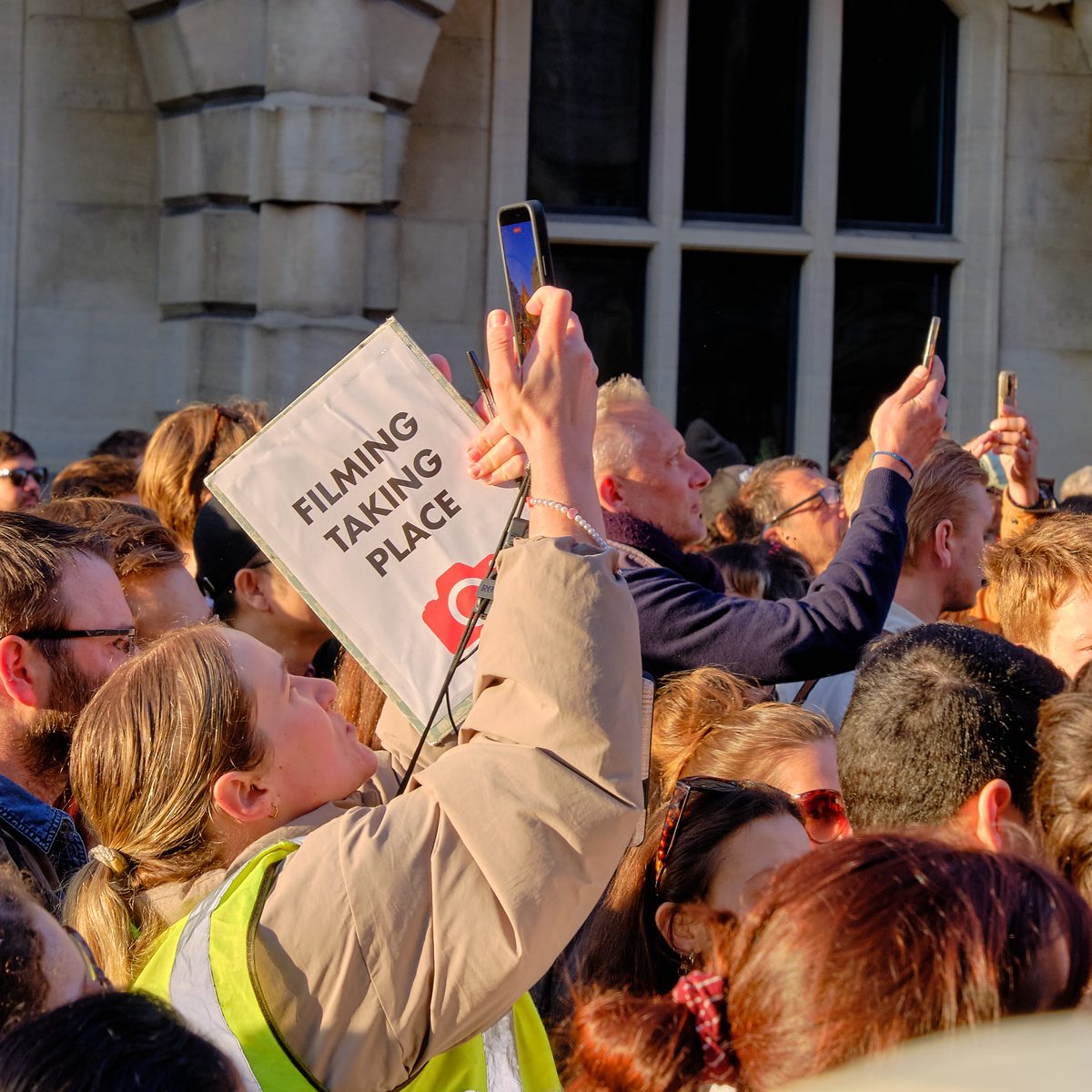
This image is strongest when read not as a photograph of one woman in a crowd, but as a study of symbolic authority after its practical force has weakened. The woman’s sign and hi-viz jacket mark her as someone with an official role. They signal visibility, safety, and authorised recording. Yet she stands within a crowd in which many people are already doing the same thing. This creates the image’s main tension: the official sign warns of filming, but the event has long since become a field of mass recording.
Photographically, the image uses compression and density to make this point. The frame is packed with heads, arms, phones, faces, and fragments of bodies. There is no clean gap between observer and observed. Everyone seems folded into the same visual system. The raised phones form a pattern of shared conduct, while the sign interrupts that pattern as both message and irony. It declares “filming taking place”, but the photograph shows filming taking place everywhere. The warning has become less a useful act of notice than a ritual sign of institutional compliance.
This is where the sociological reading becomes important. Goffman’s work on the presentation of self helps explain the woman’s role. In public life, people wear signs, uniforms, badges, and other markers to define the situation and make their role legible to others (Goffman, 1959). The hi-viz jacket and sign tell the crowd: “I am not merely another person with a phone. I am here in an authorised capacity.” Yet the crowd weakens that claim because the same act – filming – has become common, casual, and dispersed. Her authority depends on difference, but the photograph shows sameness.
Bourdieu’s idea of symbolic capital also helps. The sign and jacket carry institutional capital: they suggest permission, legitimacy, and perhaps responsibility (Bourdieu, 1984). The woman’s visual markers try to convert ordinary recording into authorised documentation. But this capital has unstable value in a culture where every spectator can record, upload, and circulate images. The difference between official and unofficial seeing no longer sits in the device. It sits in the claim made around the device.
Psychologically, the image speaks to role performance and social norms. A hi-viz jacket changes how a person is seen and may also change how that person acts. It can authorise confidence, create a sense of duty, and reduce the social unease of raising a camera in a crowded public setting. At the same time, the crowd’s conduct shapes what feels normal. Asch’s work on conformity showed how group behaviour can pull people towards shared forms of action, even when each person feels they are acting alone (Asch, 1956). Here, filming appears less like a set of private choices and more like a crowd norm. To take part is to record.
Sontag’s account of photography as a way of certifying experience remains useful. The people are not only watching May Morning; they are making proof that they were there (Sontag, 1977). The woman’s sign, then, has a double meaning. It warns the crowd that they may be filmed, while she herself joins a crowd that is already turning the event into images. This gives the photograph a dry social humour. It shows how the old distinction between camera operator and spectator has broken down.
The image’s main risk is visual excess. It is busy, and the viewer must work to sort its elements. Yet that busyness is part of its force. The photograph captures a world in which public ritual, self-documentation, institutional caution, and mass phone use converge. Its critique lies in this paradox: the woman tries to mark filming as a special act, but the crowd shows that filming has become an ordinary way of being present.
References
Asch, S. E. (1956). Studies of independence and conformity: A minority of one against a unanimous majority. Psychological Monographs: General and Applied, 70(9), 1–70. https://doi.org/10.1037/h0093718
Bourdieu, P. (1984). Distinction: A social critique of the judgement of taste (R. Nice, Trans.). Harvard University Press.
Goffman, E. (1959). The presentation of self in everyday life. Doubleday.
Sontag, S. (1977). On photography. Farrar, Straus and Giroux.