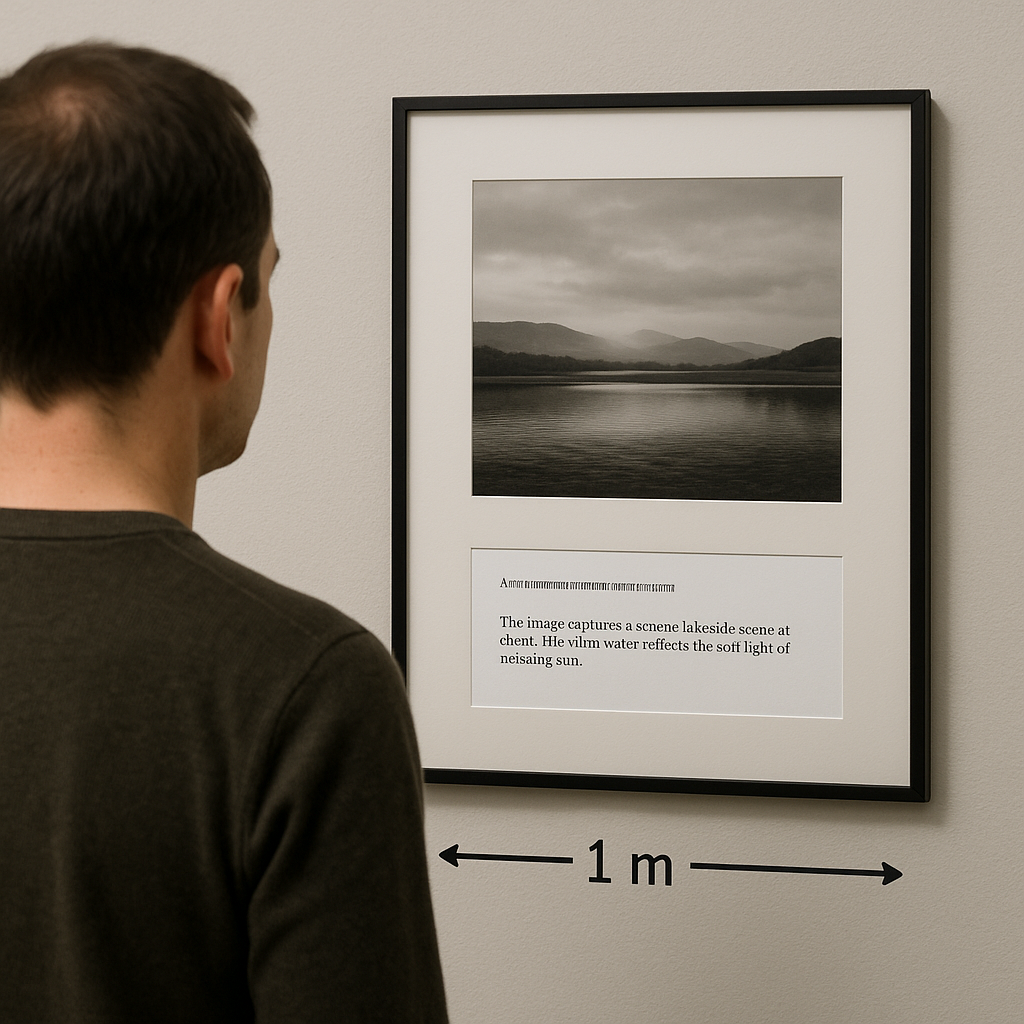
When we look at a photograph on the wall of a gallery, we seldom think about how far away we stand. Yet distance matters. Too close and we cannot take in the whole image. Too far and the detail is lost. For an A3 photograph, with a short caption beneath it, the optimum position is not guesswork but can be worked out with some simple rules.
An A3 print measures 297 × 420 millimetres. Its diagonal is about half a metre. A long-standing rule of thumb suggests that the most comfortable viewing distance for a print is between one and a half and two times its diagonal. In practice this means that for A3 the ideal range is 75 centimetres to 1 metre. At this point the viewer can take in both the detail of the image and the whole frame without the need to shift back and forth.
The caption is the next test. Exhibition text is usually set in type between 14 and 18 points, which equates to about 4–6 millimetres in height. Research on print legibility shows that letters of this size are clear to a reader with standard vision at around 50–70 centimetres. This aligns well with the optimum viewing distance for the image. At about 70 centimetres to 1 metre, the photograph and the words can both be seen without moving position.
If a viewer finds that they cannot see the photograph well at this distance, or cannot read the caption without stepping closer, this points to a shortfall in visual acuity. The most common cause is simple: they need corrective lenses. For some, it may be age-related near-sight changes such as presbyopia, which make it hard to focus on text at arm’s length. For others, it may be blurred distance vision. In either case, the gallery setting becomes a test of sight.
This has wider implications. In the UK, the legal minimum for driving is the ability to read a number plate at 20 metres, which equates to a visual acuity of about 6/12. Someone who struggles to read 14–18 point type at less than a metre may fall short of this level if uncorrected. If they cannot resolve detail in a photograph from 1 metre, they may also have difficulty seeing road signs, detecting hazards, or reading dashboard instruments without strain.
Of course, art galleries are not opticians, and the point of an exhibition is not to diagnose sight loss. Yet the experience of standing in front of an A3 photograph can reveal more than we expect. The clear zone at 70 centimetres to 1 metre is a practical guide. It allows the image to be seen in full, the caption to be read with ease, and the viewer to remain still and engaged. For those who cannot achieve this, it may serve as a quiet prompt to seek an eye test.
In short, the way we stand before a picture speaks to more than aesthetics. It touches on the everyday demands of seeing well—on the page, in the street, and behind the wheel.
One more point – which is why I researched and wrote this in the first place – when you are in a crowded gallery, having somebody bobbing in and out between you (with normal or corrected sight) and the image is VERY annoying!