
Categories
My Major Personal Project MY PHOTO JOURNEY Sophistication (Mastery)

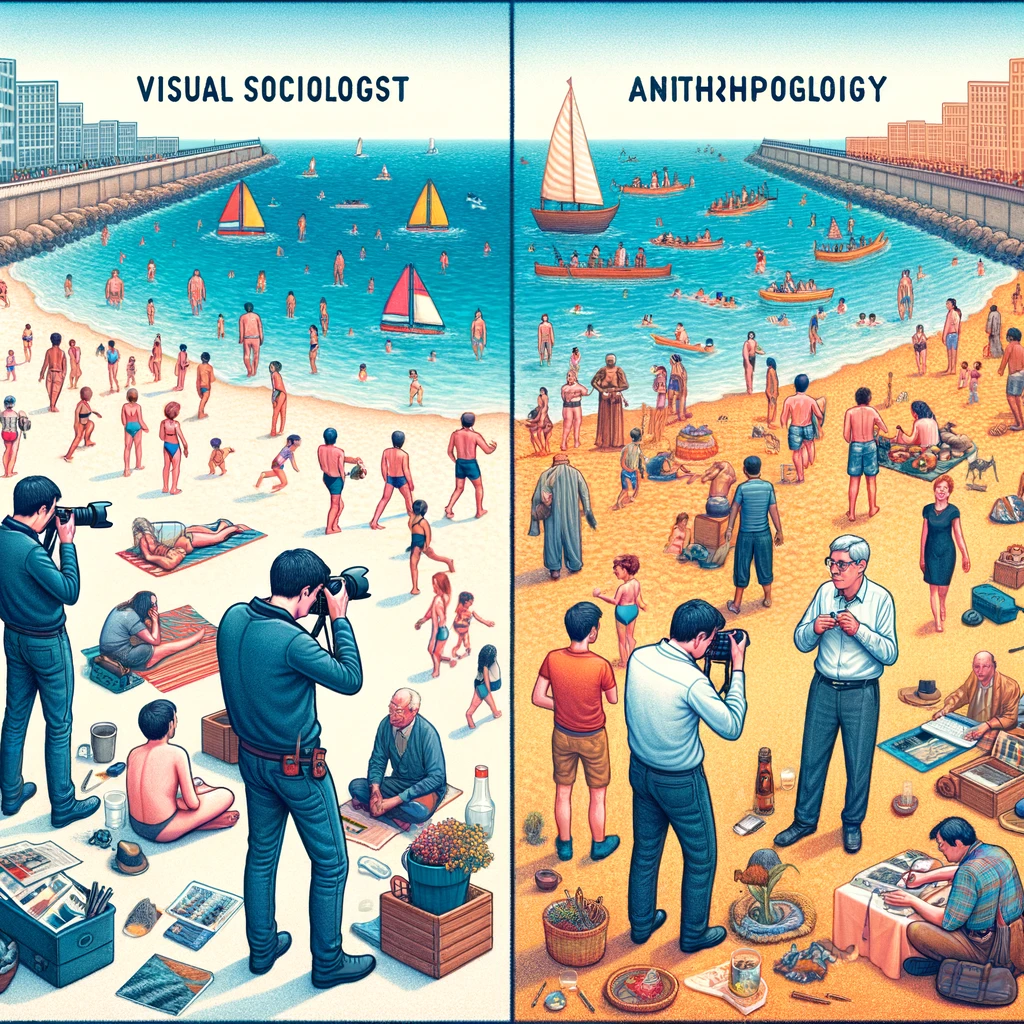
How would a visual sociologist and anthropologist approach a visit to the seaside?

A visual sociologist and an anthropologist would approach a visit to the seaside with distinct but complementary perspectives, each using their disciplinary tools and methodologies to understand and interpret the experience and significance of the seaside in social and cultural terms.

Visual Sociologist: A visual sociologist would likely focus on the visual aspects of the seaside experience, paying close attention to the landscape, the interaction of people with the environment, and the symbols and signs present in the area. They might:

  • Document through photography or video: Capture images or footage of beachgoers, architectural elements, and natural scenery to analyze the visual culture of the seaside.
  • Analyze visual representations: Examine how the seaside is portrayed in media, art, and personal photographs to understand societal perceptions and the construction of the seaside as a cultural symbol.
  • Observe public behavior and social interactions: Note how different groups use the space, including family dynamics, youth culture, and social stratification visible through activities and beach attire.
  • Study environmental interaction: Look at how people engage with the natural environment, such as swimming, sunbathing, and conservation practices, to explore human-nature relationships.

Their goal would be to understand how visual elements and social interactions at the seaside contribute to its meaning within the broader cultural and social context.

Anthropologist: An anthropologist would approach the seaside with an interest in the cultural practices, rituals, and social meanings embedded in the seaside experience. They might:

  • Conduct ethnographic research: Spend time observing and participating in seaside activities to gain a deep understanding of the cultural significance of the seaside and its role in the community.
  • Interview beachgoers and locals: Collect personal stories and perspectives on the seaside to understand its significance in individual and collective memory, identity, and well-being.
  • Examine historical and cultural context: Research the history of the seaside as a social space, including its development as a leisure destination, to understand how cultural attitudes towards the seaside have evolved.
  • Analyze symbolic meanings: Explore how the seaside is symbolized in rituals, folklore, and cultural narratives, and how these contribute to its perceived value and meaning.

The anthropologist aims to provide a comprehensive understanding of the seaside’s cultural significance, exploring how it shapes and is shaped by human behavior, social norms, and cultural practices.

Both the visual sociologist and the anthropologist would offer valuable insights into the seaside experience, the former through a lens focused on visual culture and social interaction, and the latter through a broader examination of cultural practices and meanings. Their approaches, while different, would complement each other in providing a holistic understanding of the seaside as a significant cultural and social space.

Categories
My Major Personal Project MY PHOTO JOURNEY Sophistication (Mastery)

A short summary of “The New New Journalism” by Robert Boynton (2005)

“The New New Journalism” by Robert S. Boynton presents a comprehensive exploration into the evolution of American literary journalism since the 1960s, building upon the foundation laid by Tom Wolfe and others who championed the original New Journalism movement. This book, published in 2005, profiles a generation of journalists who have continued and expanded upon the narrative techniques and deep reportorial practices characteristic of their predecessors. Through in-depth interviews with 19 leading practitioners, including Ted Conover, Susan Orlean, and Jon Krakauer, Boynton elucidates the methodologies, philosophies, and intricacies of what he terms “The New New Journalism.”

These journalists distinguish themselves by their immersive reporting methods, often spending extensive periods with their subjects, delving into the complexities of the topics they cover, and employing narrative techniques more commonly found in fiction to craft compelling nonfiction stories. The book emphasizes the rigorous approach to factual accuracy and the ethical considerations these journalists navigate in their quest to tell true stories that are as engaging as they are informative.

Boynton’s analysis begins with a historical overview, tracing the lineage of literary journalism from its precursors in the early 20th century to the New Journalism of the 1960s and 70s, and finally to the contemporary scene. He identifies a shift in focus from the flamboyant style and celebrity culture that partly defined the earlier movement to a more subdued, yet deeply investigative approach that prioritizes the stories of ordinary people caught in extraordinary circumstances. This shift reflects broader changes in American society and the media landscape, including the rise of digital media and the changing economic conditions of print journalism.

The heart of the book lies in its detailed portraits of the journalists themselves. Through these interviews, Boynton reveals how each writer approaches their craft, from the initial conception of a story idea to the exhaustive process of reporting, writing, and revising. He delves into the personal motivations that drive these journalists to pursue their stories, often at great personal cost and risk. The profiles also highlight the diverse subjects these journalists tackle, ranging from the intricacies of subcultures and communities to the broad sweep of political and social movements.

Boynton does not shy away from the challenges and criticisms faced by the New New Journalists, including debates over the subjective nature of their narratives, the potential for exploitation of subjects, and the tension between storytelling and journalistic objectivity. He argues, however, that these journalists have developed sophisticated methods to address these concerns, striving to maintain the delicate balance between being closely involved with their subjects and retaining enough distance to ensure journalistic integrity.

The book concludes with a reflection on the future of literary journalism in an era of rapidly evolving media. Boynton suggests that despite the uncertainties facing the publishing industry, the fundamental human desire for compelling, well-told stories ensures that there will always be a place for the kind of in-depth, narrative-driven journalism that the New New Journalists exemplify.

In “The New New Journalism,” Boynton offers a rich and nuanced understanding of a significant current in American journalism. By focusing on the practitioners who are reshaping literary journalism for the 21st century, he not only pays homage to their work but also provides valuable insights into the art and craft of storytelling within the nonfiction realm. This book serves as both a critical study and a celebration of a genre that continues to push the boundaries of how we understand the world and each other through the medium of written word.

[Written and illustrated with the help of ChatGPT 4 and Dall-e 2.]