
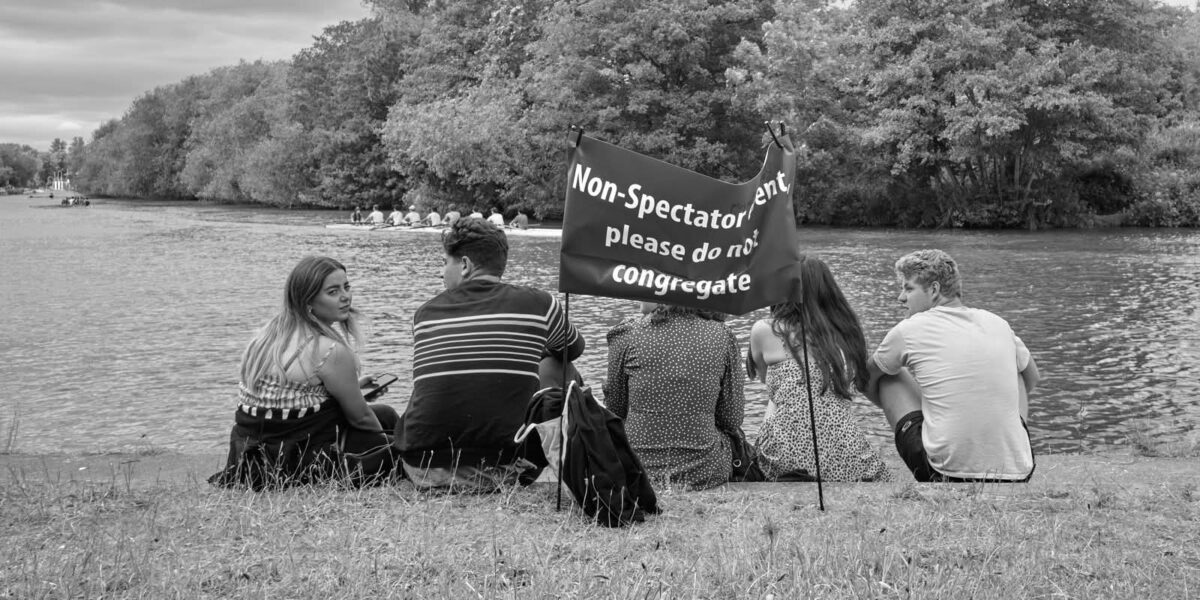
Another from my ‘clocked’ collection… On the same day… The image turns a small civic rule into a wider question about power, leisure, and public space. Its irony is clear, perhaps almost too clear, but the work gains depth through social tension rather than novelty. The sign marks some people as valid viewers and others as bodies to be managed. Against that, the group’s presence asserts what Lefebvre calls a ‘right to urban life: the right to remain, gather, and take part in shared space’. The decisive moment lies in the backward glance, which may act as Barthes’ punctum, because it pierces the neat joke and makes the photographer (and the viewer) part of the politics too.
I am slowly building up a collection of images where I, the photographer, have been ‘clocked’ (in other words, ‘seen and reacted to’) by the subject.
It isn’t a ‘project’ as I am not trying to tell a story with the selection and sequence. So we don’t really need any descriptive context.
The image here stands alone. A group of young people have sat together in the lee of a sign that tells them not to congregate. The ironic humour of that is pretty obvious to any English speaker (though it would be potentially lost on others, which is one of the weaknesses of the image).
The act of obviously noticing the photographer is a very simple example of Roland Barthes’ principle of the punctum. Photos lacking a punctum have little to capture the eye of the viewer – such images often do need others and a written narrative – thereby becoming ‘documentary’.
In a street context, it is the coming together of elements that make the image more than a random picture of people sitting together. This is what Cartier Bresson (in translation) described as the ‘decisive moment’ – a fraction of a second sooner or later and it would be lost.
The sociologist, Lefebvre, suggested that we all have a right to congregate – it is an intrinsic human right. However, the growth of far-right thinking in the world, which discourages gatherings other than those in its favour, is said to be compromising this. I refer to this as a ‘social tension’. The political message in this image is one of the defiance of the young people against the event organisers who represent the ‘establishment’. Is there something in the photo that I feel strongly about? That would be this denial of a basic human right. Who gave the organisers the power to tell people not to watch an activity taking part in a public space? The young people, through their defiance are denying the organisers this power, when other people have seemingly acquiesced.
To raise our game as photographers (let alone street ones) we try to go beyond simple observation, aesthetic considerations, and technicalities. We play with the underlying theories that our forebears articulated, testing and occasionally improving on them. That leads to progress in our own practice, to the advancement of the discipline, and to change in society. Otherwise, we might as well stay in bed. 😉