
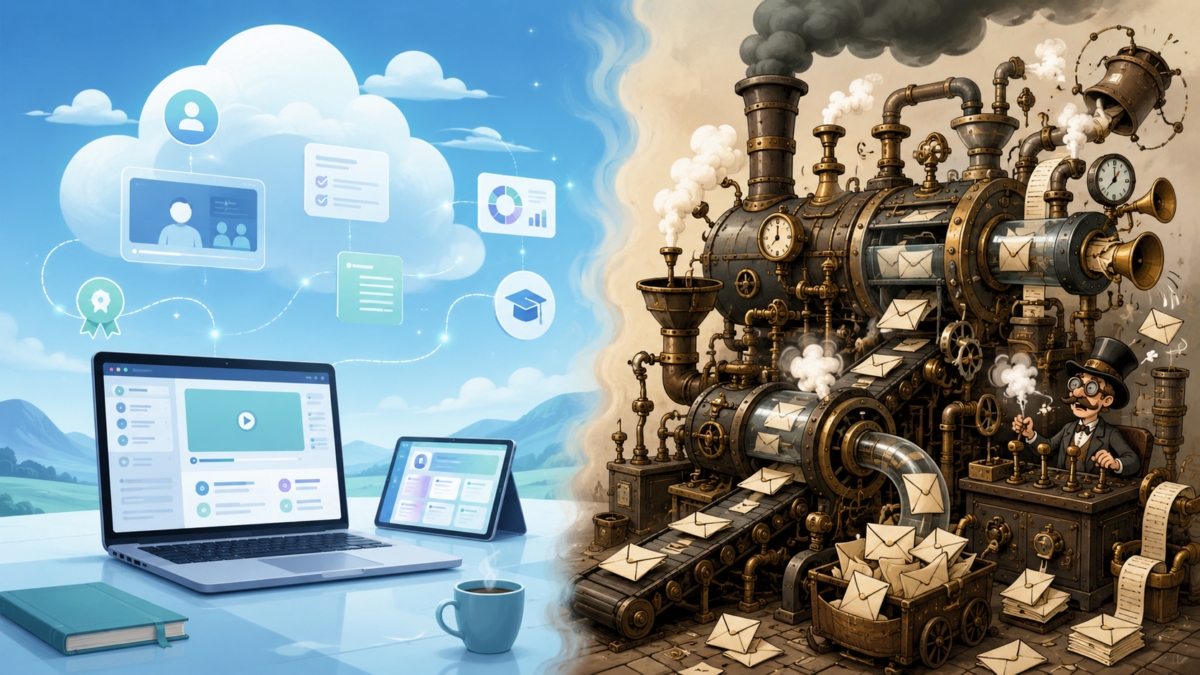
For one-day courses, what are the benefits of using a VLE like Canvas or Moodle rather than materials being emailed centrally on the days before and after?
For a one-day course, a VLE such as Canvas or Moodle gives more than a place to store files. It gives the course a small but clear learning space. This can matter most when the course has short contact time, diverse students, and a need to help people prepare, take part, and then carry the work back into their own setting.
The main gain is structure. Email sends materials as a set of messages, each with files attached or linked. A VLE can present the course as a sequence: pre-course welcome, aims, timetable, readings, activities, slides, handouts, follow-up tasks, and further reading. This helps students see how the parts fit together. It also reduces the risk that key material gets lost in an inbox, blocked by spam filters, or buried under later messages.
A VLE also supports better preparation. Before the day, students can complete a short prompt, poll, quiz, or reflective task. This gives the tutor a sense of the group before teaching starts. For one-day courses, this can sharpen the day because the tutor does not have to spend so much time finding out what students need.
During the day, the VLE gives one stable place for slides, worksheets, links, and activity briefs. Students can open the correct task without hunting through emails. This works well if the tutor wants students to move between taught input, group work, and short written tasks. It also means late joiners or absent students can still find the material.
After the course, the VLE helps sustain learning. A follow-up page can hold reading, prompts for practice, model answers, optional tasks, and links to future study. This can make the day feel less like a stand-alone event and more like the start of a small learning process.
There are also practical and institutional benefits. A VLE gives clearer version control, better accessibility options, and a more consistent student experience. It can support captions, alternative formats, screen-reader access, and clearer navigation. It can also provide an audit trail: what was made available, when, and to whom. This can help with quality assurance and student support.
Email still has a place. It works well for brief reminders, joining instructions, and personal messages. But it is a poor main learning platform. It fragments the course, puts too much burden on the student to organise material, and gives the tutor little sense of engagement. For a one-day course, the best model is often simple: use email for prompts and reminders, but use the VLE as the single, ordered source for course content.