
Categories
MY TEACHING JOURNEY

Ways in which Tutors can use ChatGPT

Our job titles are rather misleading (elsewhere we’d be called a lecturer if on the staff, or even a visiting professor in some places). We don’t have many purely administrative responsibilities being focused almost entirely on teaching.

The University has provided equal access to ChatGPT for all students and staff encouraging them to explore it and use it where appropriate to enhance their studies. However. within the Department, we still have quite a few members of staff who are extremely resistant to the use of AI. They speak in terms of policing – catching students using it for their essays and punishing them accordingly.

Our department recently advertised a role as a tutor in which they included a job description. Using the job description as a basis, I thought it would be interesting to get ChatGPT to suggest ways in which the tutors could use it to support their work.

The Job Description

Departmental tutors design and deliver a variety of classes/courses across the Department’s portfolio of programmes. This teaching is delivered throughout the calendar year. Most classes are held at the Department for Continuing Education, although some may be delivered on University or College premises, or online.

They work in support of teaching which includes contributing to curriculum development and review, assessment and examination, quality assurance and professional development.

The role holder will design content or learning materials within existing frameworks and make appropriate modifications to existing materials on the basis of the knowledge or experience of the learner(s).

Departmental Tutors work collegiately with colleagues, sharing in collaborative decisions affecting the course and proposing and implementing improvements to working methods, to ensure high standards are maintained.

  • Lecture, teach, and supervise undergraduate and postgraduate students and other lifelong learners.
  • Teach in person and online across the full range of provision in the subject area as appropriate: this may include award-bearing courses, accredited short courses, day and weekend events, CPD and summer schools.
  • Produce accessible and inclusive course materials and activities, reading lists, and reference guides
  • Plan classes within the relevant confirmed programme, reviewing and updating course materials
  • Engage in assessment and marking
  • Maintain good communication with students, advising on any queries and providing guidance as necessary.
  • Act as first point of contact for student matters relating to attendance, conduct, coursework, performance, and welfare (referring matters to appropriate others)
  • Participate in student admissions processes
  • Gather and analyse feedback from students and colleagues, and modify course design, content, or delivery as appropriate
  • Engage with relevant professional development activities and scholarship appropriate to the discipline and in line with departmental needs
  • Contribute to collaborative projects with colleagues at the University and share skills and expertise in relevant networks within and outside the University.
  • Maintain an awareness of current research and developments in pedagogy.

ChatGPT’s suggestions for tutor usage

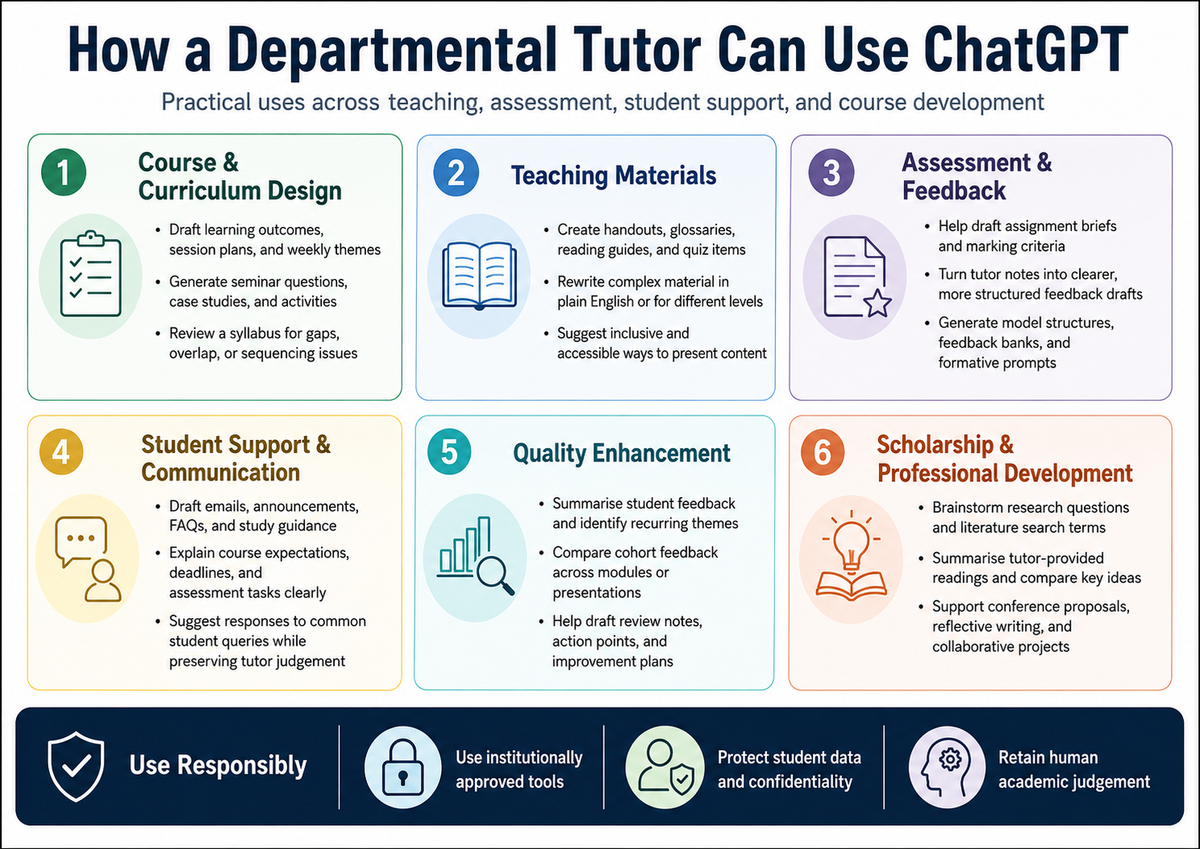
A Departmental Tutor could use ChatGPT as a structured academic support tool across most parts of the role. It should assist professional judgement rather than replace it, especially in assessment, student welfare, admissions, and academic decision-making.

Course and curriculum design.

ChatGPT can help shape course aims, learning outcomes, weekly plans, seminar tasks, case studies, discussion prompts, and experiential exercises. A tutor could ask it to map activities against a course framework, check the balance between knowledge, skills, and attitudes, or suggest changes for learners with varied prior experience. It can also compare an existing course with a new syllabus and flag gaps, overlap, or weak links between sessions.

Teaching and learning materials.

It can draft handouts, lesson summaries, glossaries, reading guides, slides, quizzes, formative tests, role plays, and online learning tasks. It can recast dense material in plain English, offer versions for different levels of study, and suggest ways to make content more inclusive and accessible. Tutors must still check all facts, sources, and claims, since ChatGPT can produce errors or false references.

Assessment and feedback.

ChatGPT can help create essay questions, marking guides, assessment criteria, model structures, and feedback banks. It can review whether an assignment brief is clear and whether marking criteria match the stated learning outcomes. A tutor might also use it to draft feedback from their own notes, but should not submit student work or personal data to an AI system without clear approval and strong data safeguards.

Student support and communication.

It can draft emails about attendance, deadlines, course changes, study guidance, or common student concerns. It can also help produce FAQs and explain course rules in clear terms. It should not assess risk, diagnose distress, or make welfare decisions. Those tasks require direct human judgement and referral through formal routes.

Quality review and course improvement.

ChatGPT can sort student feedback into themes, compare feedback across cohorts, and help identify changes to course content or delivery. It can draft course review notes, action plans, and reports, while the tutor checks whether the analysis reflects the full context.

Scholarship and professional development.

It can help refine research questions, generate search terms, summarise papers supplied by the tutor, compare theories, and identify themes for further study. It can also support bids, conference proposals, collaborative projects, teaching observations, and reflective practice.

Used well, ChatGPT can reduce routine drafting, widen the range of teaching ideas, and help tutors revise material with more care. The tutor must retain control of accuracy, ethics, confidentiality, academic standards, and all decisions that affect students.
Categories
MY PHOTO JOURNEY MY TEACHING JOURNEY PURE BLOG

A Recurring Technological Displacement Narrative: Educational Technology from the Printing Press to Artificial Intelligence

Historians of education have noted that debates about new technology tend to follow a remarkably stable pattern. Each innovation attracts two competing claims. Advocates present it as a means to improve learning, widen access to knowledge and reduce routine work. Critics argue that it will replace rather than support human thought, leading to a decline in core cognitive skills. Larry Cuban (1986) showed that schools have repeatedly overestimated both the benefits and the harms of new technologies, while Neil Postman (1992) argued that technological change alters educational culture in ways that provoke predictable forms of resistance. More recent analyses reach a similar conclusion, suggesting that public debate often follows a cycle of technological optimism and moral concern rather than accumulating evidence (Buckingham, 2007; Selwyn, 2011). This recurring pattern may be described as a recurring technological displacement narrative – the belief that new tools displace essential cognitive abilities instead of extending them. The phrase is intended as a descriptive label for a historical pattern rather than as an established technical term.

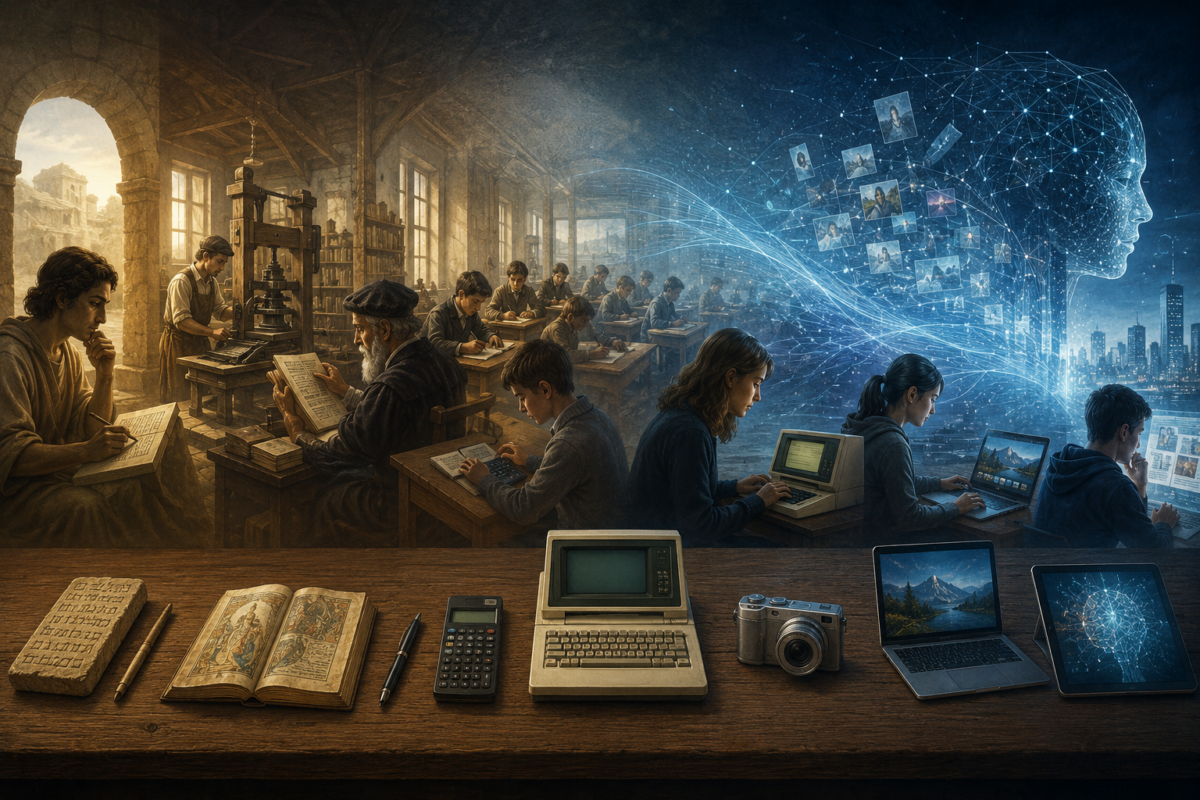
The roots of this narrative extend far beyond the digital age. In Plato’s Phaedrus, Socrates argues that writing itself will weaken memory because people will depend upon written words rather than internal recall (Plato, c. 370 BCE/2002). Similar concerns resurfaced after the invention of the printing press. The rapid spread of printed books prompted fears that readers would rely upon easily available texts instead of cultivating memory and close scholarship. Historians of print culture argue that these anxieties reflected uncertainty about changing forms of knowledge rather than evidence of declining intellectual ability. Printing altered the organisation and circulation of knowledge, but it also stimulated literacy, scholarship and scientific exchange on an unprecedented scale (Eisenstein, 1979; Johns, 1998).

The twentieth century reproduced the same pattern. During the 1950s and 1960s many teachers resisted the widespread adoption of the ballpoint pen. Critics argued that it encouraged poor pen control, untidy handwriting and careless habits because it demanded less skill than a fountain pen. Although this debate generated little formal research, it illustrates an important feature of technological displacement narratives. The criticism centred upon the assumption that making a task easier would inevitably reduce competence. As handwriting historians have noted, changes in writing instruments reflected broader social and educational change rather than a measurable decline in literacy (Thornton, 1996).

Pocket calculators produced one of the first educational controversies to receive systematic empirical investigation. During the 1970s many teachers, parents and commentators argued that calculators would undermine mental arithmetic because pupils would rely upon machines instead of learning numerical methods. Professional journals debated whether calculators represented educational progress or intellectual decline (Quinn, 1976). Yet subsequent meta-analysis painted a different picture. Hembree and Dessart (1986) reviewed seventy-nine studies and concluded that appropriate calculator use did not reduce mathematical achievement. Instead, calculators often improved mathematical reasoning by allowing students to concentrate on concepts and problem solving rather than repetitive calculation. The feared displacement of mathematical thinking failed to materialise.

Word processors and spell checkers generated almost identical concerns during the 1980s. Newspaper commentators suggested that automatic spelling correction would encourage pupils to abandon spelling altogether. Ackermann (1985), writing in The Washington Post, portrayed spell checkers as symbols of a wider tendency to delegate intellectual work to computers. Educational writers likewise acknowledged widespread concern that pupils would become dependent upon electronic correction (Eiser, 1986). When researchers tested these claims, however, they found little evidence to support them. McClurg and Kasakow (1989) reported that pupils who used word processors and spell checkers performed at least as well as those taught through traditional methods. Later studies suggested that spell checkers supported revision and editing without undermining spelling development (MacArthur et al., 1996). The debate therefore moved from speculation to evidence, and the evidence contradicted many of the early predictions.

Digital photography provoked comparable anxieties during the late 1990s and early 2000s. Photographers argued that unlimited exposures, automatic settings and instant image review would discourage careful observation because photographers no longer needed to plan each image. Critics contrasted this with film photography, where every exposure carried a financial cost and therefore demanded greater discipline. Scholars of photography have argued instead that digital technology redistributed photographic skill rather than eliminating it. Technical constraints became less important, while image selection, editing and visual storytelling assumed greater significance (Rubinstein & Sluis, 2008; Ritchin, 2009). The technology transformed photographic practice without removing the need for aesthetic judgement.

Grammar checkers, search engines and online encyclopaedias extended this debate into the early twenty-first century. Critics warned that automated correction would weaken writing and that immediate access to information would erode memory and independent research. Educational researchers again found a more nuanced picture. Digital technologies changed how students located, evaluated and organised information, but educational outcomes depended far more upon teaching methods, assessment design and critical reflection than upon the technologies themselves (Selwyn, 2011; Buckingham, 2007). The central question became not whether students used digital tools, but whether they used them critically.

Generative artificial intelligence represents the latest and perhaps most significant expression of a recurring technological displacement narrative. Large language models can draft essays, summarise research, generate computer code and answer complex questions with remarkable fluency. Unsurprisingly, many commentators argue that students will cease to write, analyse or think for themselves. These concerns deserve careful attention because generative AI differs from earlier technologies in both scope and capability. It can generate sophisticated language that resembles human reasoning, creating genuine challenges for assessment, academic integrity and independent learning. Early reviews nevertheless suggest that AI can either strengthen or weaken learning according to the educational context in which it is used. Well designed teaching can encourage students to critique, verify and improve AI-generated material, while poorly designed assessment may encourage passive dependence (Kasneci et al., 2023; Tlili et al., 2023; UNESCO, 2023).

Viewed across five centuries, the persistence of this recurring technological displacement narrative reveals a striking feature of educational change. Each generation tends to regard its newest technology as unprecedented while overlooking earlier predictions that proved exaggerated. This does not mean that concerns about new technologies lack merit. Every innovation creates new risks alongside new opportunities. The historical evidence does suggest, however, that technologies rarely determine educational outcomes by themselves. Instead, they redistribute cognitive effort, reshape established practices and create new forms of expertise. As Cuban (1986) concluded after reviewing decades of educational innovation, schools usually adapt new technologies to existing educational practices rather than allowing technology to transform education on its own. Artificial intelligence appears likely to follow the same historical trajectory, although its broader capabilities make careful evaluation more important than ever.

References

Ackermann, M. (1985, 2 June). The Invasion of the Spelling People. The Washington Post.

Buckingham, D. (2007). Beyond Technology: Children’s Learning in the Age of Digital Culture. Polity.

Cuban, L. (1986). Teachers and Machines: The Classroom Use of Technology Since 1920. Teachers College Press.

Eisenstein, E. L. (1979). The Printing Press as an Agent of Change. Cambridge University Press.

Eiser, L. (1986). I Love to Rite! Spelling Checkers in the Writing Classroom. Classroom Computer Learning, 7(3), 50-57.

Hembree, R., & Dessart, D. J. (1986). Effects of hand-held calculators in precollege mathematics education: A meta-analysis. Journal for Research in Mathematics Education, 17(2), 83-99.

Johns, A. (1998). The Nature of the Book: Print and Knowledge in the Making. University of Chicago Press.

Kasneci, E., Sessler, K., Küchemann, S., Bannert, M., Dementieva, D., Fischer, F., Gasser, U., Groh, G., Günnemann, S., Hüllermeier, E., Krusche, S., Kutyniok, G., Michaeli, T., Nerdel, C., Pfeiffer, F., Poquet, O., Sailer, M., Schmidt, A., Seidel, T., Stadler, M., & Kasneci, G. (2023). ChatGPT for good? On opportunities and challenges of large language models for education. Learning and Individual Differences, 103, 102274.

MacArthur, C. A., Graham, S., Haynes, J. B., & De La Paz, S. (1996). Spelling checkers and students with learning disabilities: Performance comparisons and impact on spelling. Journal of Learning Disabilities, 29(1), 35-57.

McClurg, P. A., & Kasakow, N. (1989). Word processors, spelling checkers, and drill and practice programs: Effective tools for spelling instruction? Journal of Educational Computing Research, 5(2), 187-196.

Plato. (2002). Phaedrus (R. Waterfield, Trans.). Oxford University Press. (Original work composed c. 370 BCE)

Postman, N. (1992). Technopoly: The Surrender of Culture to Technology. Vintage.

Quinn, D. R. (1976). Calculators in the classroom. Peabody Journal of Education, 53(4), 258-262.

Ritchin, F. (2009). After Photography. W. W. Norton.

Rubinstein, D., & Sluis, K. (2008). A life more photographic. Photographies, 1(1), 9-28.

Selwyn, N. (2011). Education and Technology: Key Issues and Debates. Continuum.

Thornton, T. (1996). Handwriting in America: A Cultural History. Yale University Press.

Tlili, A., Shehata, B., Adarkwah, M. A., et al. (2023). What if the devil is my guardian angel: ChatGPT as a case study of using chatbots in education. Smart Learning Environments, 10, 15.

UNESCO. (2023). Guidance for Generative AI in Education and Research. UNESCO.