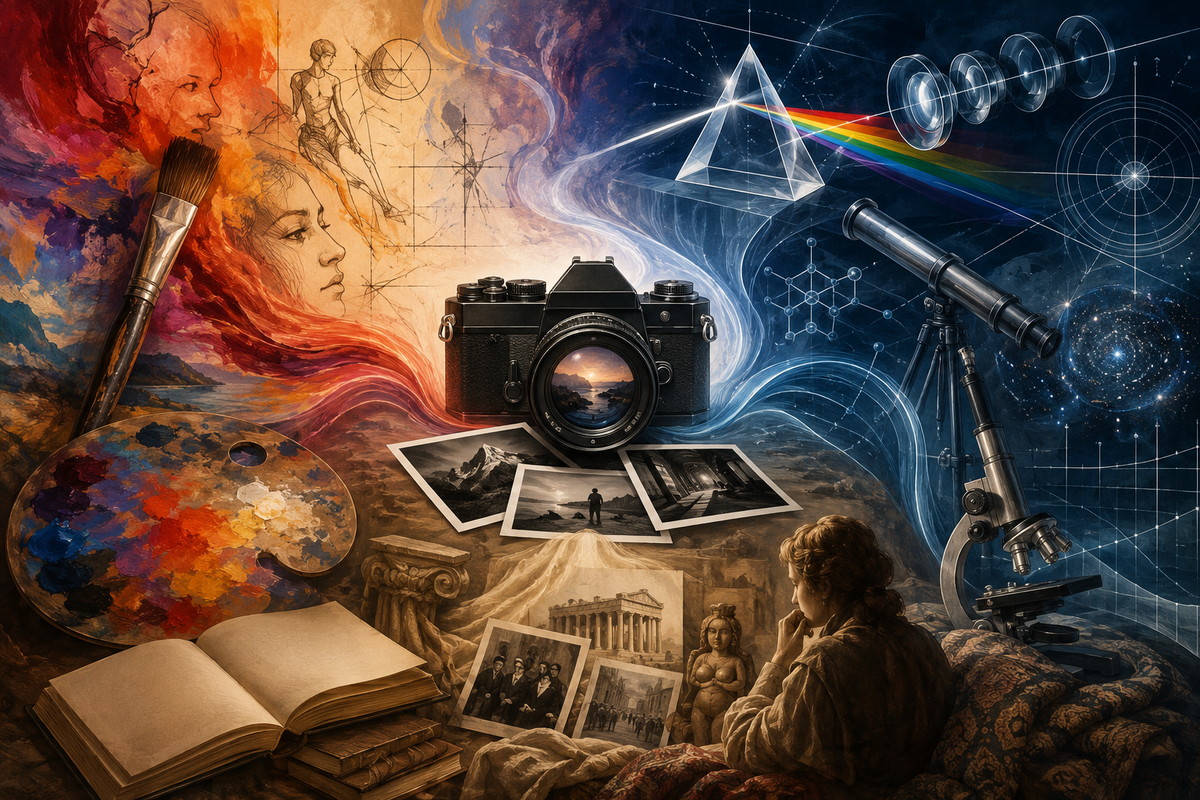
Art, science, and the humanities are not three neat kinds of subject. They name three broad ways of making sense of the world. Photography can occupy all three spaces.
What is an art?
An art is a form of purposeful making in which choices of form, medium, selection, and arrangement create an experience that exceeds just function. Art may represent the world, question it, alter how it feels, or draw attention to aspects of it that routine perception misses.
This does not mean that art must be beautiful, expressive, or made by a lone creative figure. Much modern and contemporary art would not meet any of those. A better test is that artistic work asks us to pay attention to how something has been made and what that making does to meaning. Dewey (1934) treated art as a mode of experience rather than a class of precious objects; Danto (1964) later argued that what counts as art depends in part on theory, context, and the “artworld” within which an object becomes intelligible.
What is a science?
A science is a disciplined form of enquiry that develops and tests accounts of the natural or social world through systematic evidence, explicit methods, criticism, and revision. Science does not consist of certain facts. It consists of organised attempts to reduce error.
Different sciences work in different ways. Experimental physics, field ecology, clinical psychology, and social epidemiology don’t share one common method. However, what links them is an explicit commitment to gather evidence, create interpretations, scrutinise the subject, and the possibility that claims may need to be corrected. Popper (1959) stressed testability; Kuhn (1962) showed that science also develops through shared models, institutions, disputes, and shifts in what researchers take to be important problems.
What is a humanity?
A humanity is concerned with meaning, value, history, culture, interpretation, and human expression. The humanities don’t just ask what happened or what causes what, but also what does this mean, to whom, within which history, and with what moral or political effect?
Their methods include close reading, historical analysis, comparison, critique, interpretation, archival work, and argument. Evidence still matters, but the aim is not always to discover a general principle. A historian may ask how an idea changed. A philosopher may test the strength of a concept. A literary scholar may examine how a text frames gender, class, grief, or power. The humanities maintain the complexity of something when reducing it simpler ideas too soon could distort the subject (Dilthey, 1989; Nussbaum, 2010).
What is photography?
Photography is hard to place because it isn’t one thing. At its most basic, it is a set of technical processes through which light, optics, photosensitive materials, or digital sensors produce images. Yet this account is far too thin.
Photography is an art when photographers mould form, sequence, mood, symbol, attention, and experience to stimulate the perception of a viewer.
Photography is a science when it enables measurement, observation, experiment, classification, recording, and forms of evidence. Astronomy, medicine, motion studies, remote sensing, and microscopy have all depended on photographic systems.
Photography belongs to the humanities when photographs become objects and tools of interpretation. A photograph can bear traces of empire, family life, race, class, gender, memory, conflict, labour, death, tourism, or belief. To study such images requires questions about authorship, context, power, history, and meaning.
I would therefore resist defining photography as either art, science, or humanity. Photography is a medium, a technology, a practice, a social act, and a way of knowing. It is a rare phenomenon that easily crosses the borders between these fields. A single photograph can be an instrument, an aesthetic object, a historical trace, a political act, and a private memory at the same time.
This is why photography creates such rich problems for education. To teach it only as art neglects evidence, optics, and technology. To teach it only as science neglects meaning and judgement. To teach it only through the humanities neglects making. Photography sits at the point where measurement, interpretation, and creation meet.
References
Danto, A. C. (1964). The artworld. The Journal of Philosophy, 61(19), 571–584.
Dewey, J. (1934). Art as experience. Minton, Balch.
Dilthey, W. (1989). Introduction to the human sciences (R. J. Betanzos, Trans.). Princeton University Press. (Original work published 1883)
Kuhn, T. S. (1962). The structure of scientific revolutions. University of Chicago Press.
Nussbaum, M. C. (2010). Not for profit: Why democracy needs the humanities. Princeton University Press.
Popper, K. R. (1959). The logic of scientific discovery. Hutchinson.