
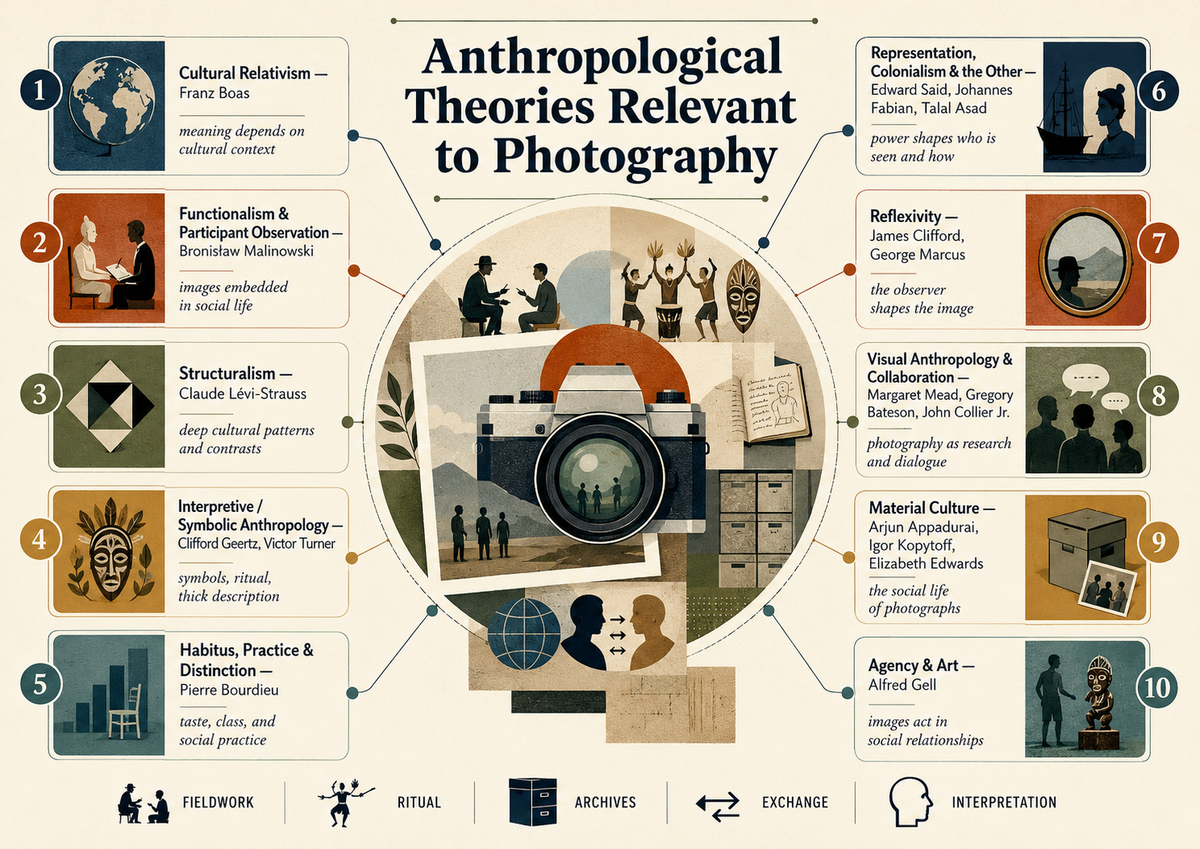
Anthropology offers no single theory of photography. Instead, several schools of thought help us examine photographs as cultural signs, social acts, material objects, records of encounters, and tools of power. The following theories have proved most useful.
1. Cultural relativism
Main originator: Franz Boas
Cultural relativism holds that beliefs and practices should be understood within their own cultural setting rather than judged against an outside standard. Boas developed this approach in opposition to nineteenth-century schemes that ranked societies from “primitive” to “civilised” (Boas, 1911).
For photography, this means that the meaning of an image cannot be assumed from its visible content. A gesture, item of dress, ritual, building, or use of space may carry meanings that an outside photographer does not grasp. Cultural relativism also challenges photographers to question whether their visual forms, such as portrait poses or ideas of beauty, rest on Western norms.
2. Functionalism and participant observation
Main originator: Bronisław Malinowski
Functionalism studies how customs and institutions help sustain a social group. Malinowski argued that anthropologists should conduct long-term fieldwork and take part in the daily life of the communities they study (Malinowski, 1922).
Applied to photography, this approach shifts attention from isolated scenes to their place within social life. A photograph of a wedding, market, protest, or religious act gains meaning from the roles, needs, ties, and institutions that surround it. The photographer should learn how an event works before treating its visual surface as self-explanatory.
3. Structuralism
Main originator: Claude Lévi-Strauss
Lévi-Strauss argued that cultures organise meaning through deep structures, often expressed through contrasts such as nature and culture, raw and cooked, sacred and secular, or self and other (Lévi-Strauss, 1963, 1966).
Structuralism encourages the photographer or critic to search for patterns beneath the subject matter. An image may gain force through contrasts between rich and poor, clean and polluted, centre and edge, male and female, or order and disorder. A photographic series may also reveal the categories through which a society classifies people, places, and things.
4. Symbolic and interpretive anthropology
Main originators: Clifford Geertz and Victor Turner
Interpretive anthropology treats culture as a network of meanings expressed through symbols. Geertz argued for “thick description”, which places an act within the layers of meaning that make it intelligible (Geertz, 1973). Turner examined symbols, ritual, social conflict, and transitional states, which he termed liminality (Turner, 1967, 1969). Geertz’s work marked a major turn towards culture as interpretation rather than a system governed by fixed laws.
For photography, the key question becomes not merely “What does this photograph show?” but “What does this scene mean to those involved?” A doorway, uniform, meal, memorial, or family object may hold shared and contested meanings. Thick description also suggests that captions, testimony, history, and local knowledge may form part of the photograph’s interpretation.
5. Habitus, practice and social distinction
Main originator: Pierre Bourdieu
Bourdieu used the term habitus for the learned dispositions through which people perceive, judge, and act. These dispositions arise from social class, education, family life, and past experience. His research on everyday photography showed that photographic choices reflect social rules and class-based ideas about taste, family, leisure, and respectability (Bourdieu, 1990; Bourdieu et al., 1990).
This theory helps explain why people photograph some events but not others, adopt certain poses, favour some genres, and judge some images as tasteful or crude. Photographic taste does not arise from free personal choice alone. It develops through social class, peer groups, institutions, and access to cultural resources.
6. Representation, colonialism and the construction of the “other”
Main originators: Edward Said, Johannes Fabian and Talal Asad
Postcolonial anthropology examines how Western institutions have represented colonised peoples as exotic, timeless, inferior, or fundamentally different. Said called this broad system of representation Orientalism (Said, 1978). Fabian showed how anthropology often placed the people it studied in an earlier historical time, even though observer and observed were contemporaries (Fabian, 1983). Asad examined anthropology’s links with colonial power (Asad, 1973).
This approach has direct force in photography. Colonial photographs did not merely document racial and cultural difference. They helped produce and classify it through costume studies, racial “types”, anthropometric images, staged scenes, and museum archives. Contemporary analysis therefore asks who controlled the camera, who named the subject, what institution kept the image, and whose interests the representation served.
7. Reflexivity and the crisis of representation
Main originators: James Clifford and George Marcus
Reflexive anthropology rejects the idea that the researcher can provide a neutral and complete account of another culture. Clifford and Marcus argued that ethnographic accounts are constructed, selective, political, and partial (Clifford & Marcus, 1986). Their work prompted anthropologists to examine the form and authority of their own representations.
In photography, reflexivity means acknowledging the photographer’s presence and choices. Camera position, access, timing, selection, captions, editing, and publication all shape what the photograph appears to say. A reflexive photographer may disclose the conditions under which an image was made, invite subjects to respond, or share control over selection and display.
8. Visual anthropology and collaborative image-making
Main originators: Margaret Mead and Gregory Bateson; later developed by John Collier Jr., David MacDougall and others
Bateson and Mead treated photography as a form of cultural inquiry rather than mere illustration. Their study of Balinese life used sequences of photographs to examine gesture, childhood, emotion, and social interaction (Bateson & Mead, 1942). Collier developed systematic forms of photographic observation and photo elicitation, in which photographs support interviews and discussion (Collier & Collier, 1986).
Visual anthropology later placed more stress on collaboration and on the knowledge contained in visual and sensory experience. Photographs may serve as research records, prompts for memory, objects made with participants, or means through which communities represent themselves.
9. Material culture and the social life of photographs
Main originators: Arjun Appadurai and Igor Kopytoff; developed for photography by Elizabeth Edwards
Material-culture theory studies objects through their production, exchange, use, movement, and changing status. Appadurai proposed that objects have “social lives”, while Kopytoff described their cultural biographies (Appadurai, 1986; Kopytoff, 1986). This approach has led anthropologists to study photographs as objects that gather new meanings as they pass through homes, albums, archives, museums, newspapers, and digital platforms.
Edwards extended this view within photographic anthropology. She argues that the physical form, handling, display, annotation, storage, and circulation of a photograph form part of its meaning (Edwards, 2001; Edwards & Hart, 2004). A worn family print, an archived colonial plate, and a phone image may show similar content but operate as different social objects.
10. Agency and the anthropology of art
Main originator: Alfred Gell
Gell argued that artworks should be studied through the social relations and actions they bring about rather than through beauty or symbolic meaning alone. Art objects act as social agents because people use them to persuade, impress, bind, frighten, remember, mourn, or claim authority (Gell, 1998).
From this view, a photograph does not merely represent something. It may cause shame, secure evidence, sustain kinship, prompt grief, enhance status, support protest, or strengthen state control. Its meaning lies in part in what people do with it and what it causes others to do.
Taken together, these theories suggest that photography is never a neutral record. It is at once a way of seeing, a social practice, an encounter shaped by power, and an object with a changing cultural life.
References
Appadurai, A. (Ed.). (1986). The social life of things: Commodities in cultural perspective. Cambridge University Press.
Asad, T. (Ed.). (1973). Anthropology and the colonial encounter. Ithaca Press.
Bateson, G., & Mead, M. (1942). Balinese character: A photographic analysis. New York Academy of Sciences.
Boas, F. (1911). The mind of primitive man. Macmillan.
Bourdieu, P. (1990). The logic of practice (R. Nice, Trans.). Stanford University Press. (Original work published 1980)
Bourdieu, P., Boltanski, L., Castel, R., Chamboredon, J.-C., & Schnapper, D. (1990). Photography: A middle-brow art (S. Whiteside, Trans.). Stanford University Press. (Original work published 1965)
Clifford, J., & Marcus, G. E. (Eds.). (1986). Writing culture: The poetics and politics of ethnography. University of California Press.
Collier, J., Jr., & Collier, M. (1986). Visual anthropology: Photography as a research method (Rev. and expanded ed.). University of New Mexico Press.
Edwards, E. (2001). Raw histories: Photographs, anthropology and museums. Berg.
Edwards, E., & Hart, J. (Eds.). (2004). Photographs objects histories: On the materiality of images. Routledge.
Fabian, J. (1983). Time and the other: How anthropology makes its object. Columbia University Press.
Geertz, C. (1973). The interpretation of cultures. Basic Books.
Gell, A. (1998). Art and agency: An anthropological theory. Clarendon Press.
Kopytoff, I. (1986). The cultural biography of things: Commoditization as process. In A. Appadurai (Ed.), The social life of things: Commodities in cultural perspective (pp. 64–91). Cambridge University Press.
Lévi-Strauss, C. (1963). Structural anthropology (C. Jacobson & B. G. Schoepf, Trans.). Basic Books.
Lévi-Strauss, C. (1966). The savage mind. University of Chicago Press.
Malinowski, B. (1922). Argonauts of the Western Pacific. George Routledge & Sons.
Said, E. W. (1978). Orientalism. Pantheon Books.
Turner, V. (1967). The forest of symbols: Aspects of Ndembu ritual. Cornell University Press.
Turner, V. (1969). The ritual process: Structure and anti-structure. Aldine.