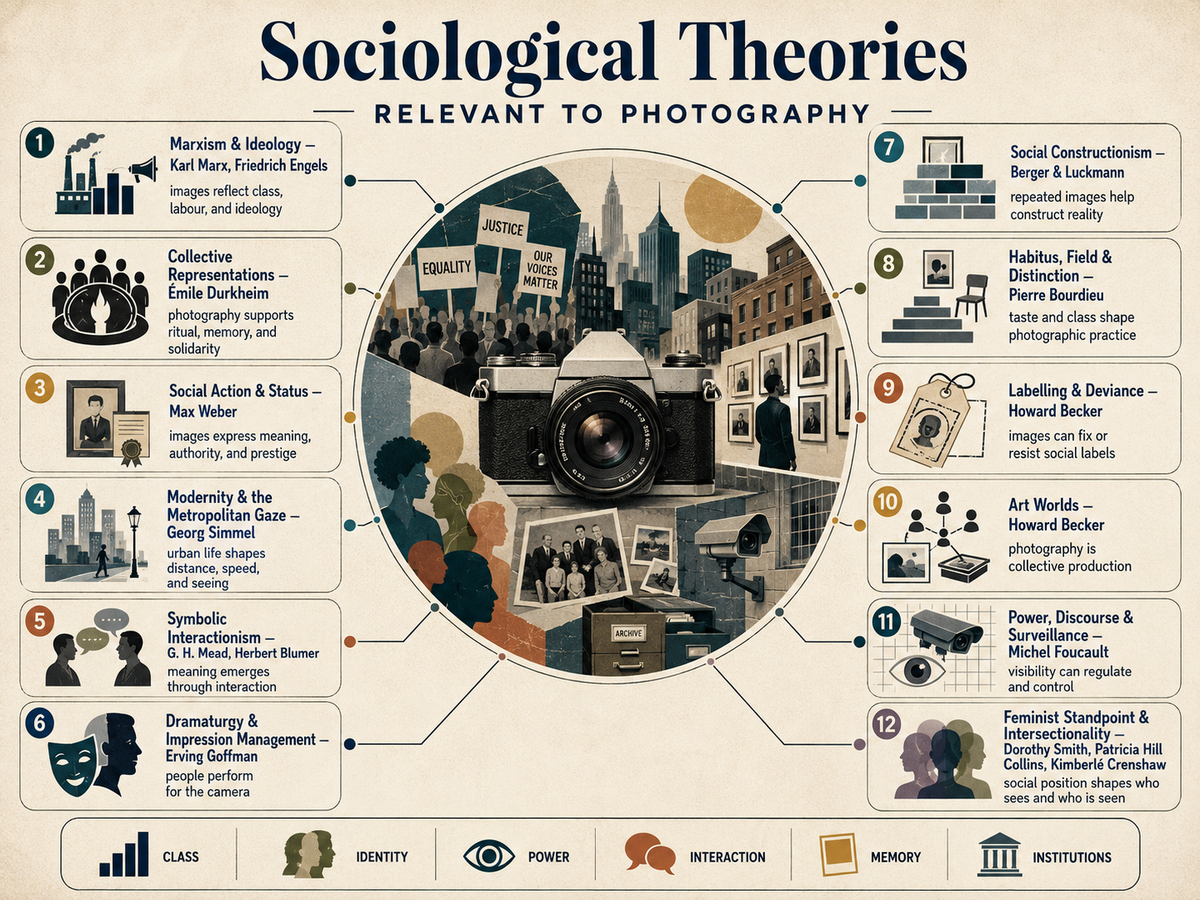
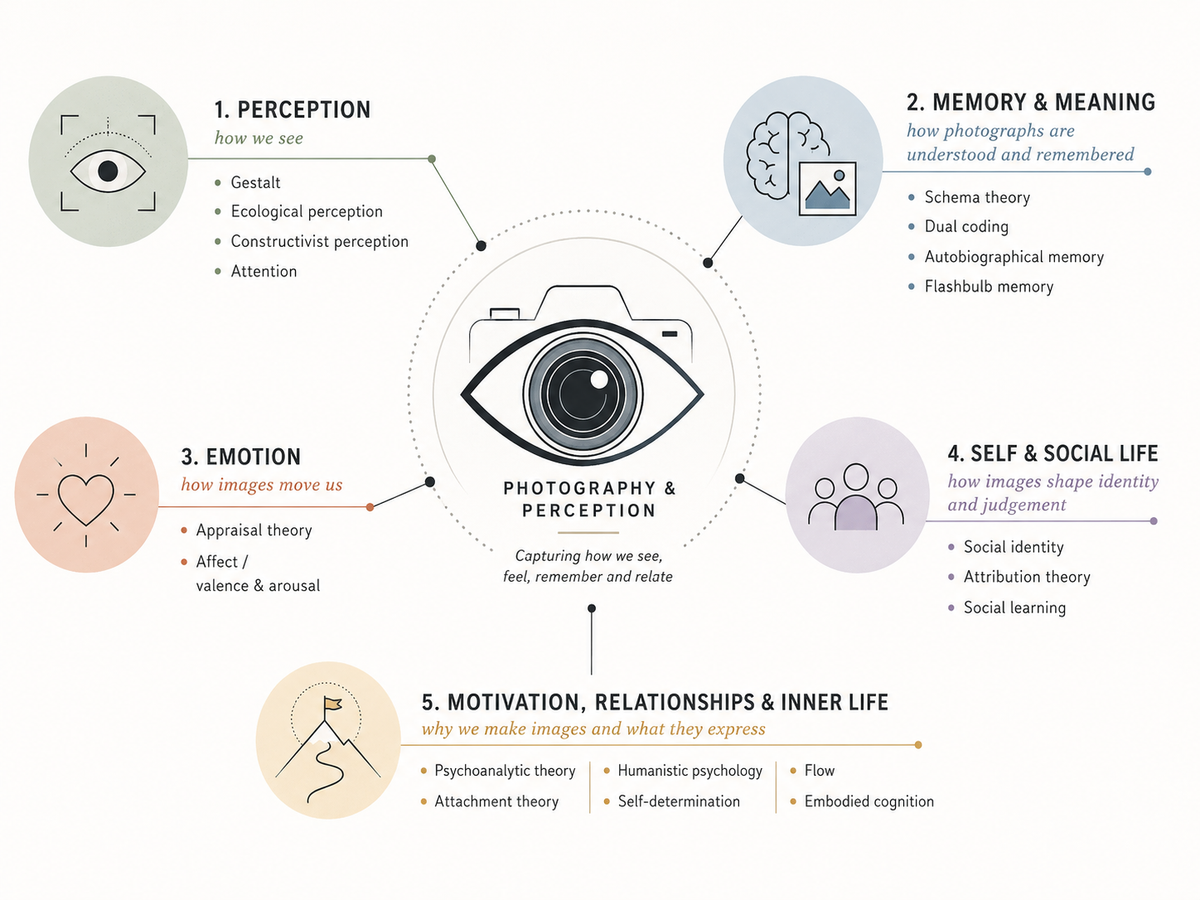
Psychology has no single, settled theory of photography. Instead, several theories explain how people make, view, interpret, remember, and use photographs. Some concern basic visual perception, while others address emotion, identity, social judgement, memory, creativity, and the unconscious. The theories below have the clearest value for photographic practice and critique.
1. Gestalt theory of perception
Main originators: Max Wertheimer, Wolfgang Köhler, and Kurt Koffka, with earlier work by Christian von Ehrenfels.
Gestalt psychology argues that people perceive organised wholes rather than first registering separate visual parts. The mind groups features through such principles as proximity, similarity, continuity, closure, figure–ground separation, and common fate (Koffka, 1935; Wertheimer, 1923/2012). Modern reviews confirm that part–whole structure and perceptual organisation remain central to Gestalt thought. (PMC)
In photography, Gestalt theory helps explain why some compositions feel coherent, why the eye links separate objects, and why negative space may form a second image. It applies to framing, visual balance, repetition, pattern, minimalism, and the separation of a subject from its setting.
2. Ecological theory of visual perception
Main originator: James J. Gibson.
Gibson argued that perception involves the active detection of information within the environment, rather than the mind constructing an inner picture from weak sensory data. He introduced the idea of affordances – the possibilities for action that an environment offers a given observer (Gibson, 1979).
A photograph may show doors as entrances, paths as routes, chairs as places to sit, or barriers as things that block movement. This theory suits documentary, landscape, architectural, and street photography because it asks how places invite, permit, restrict, or resist human action.
3. Constructivist theory of perception
Main originators: Hermann von Helmholtz and, in modern cognitive psychology, Richard Gregory.
Constructivist accounts hold that perception involves inference. The brain combines limited sensory data with prior knowledge, expectations, and assumptions to form the most likely interpretation of a scene (Gregory, 1970; Helmholtz, 1867/1962).
This helps explain visual ambiguity, optical illusion, scale errors, forced perspective, and the power of photographic context. Viewers do not receive the photograph as neutral data. They interpret it through learned ideas about depth, bodies, places, danger, beauty, and normality.
4. Information-processing and attention theories
Main originators: Donald Broadbent, Anne Treisman, and later Daniel Kahneman.
Attention theories describe how people select some visual information while filtering or neglecting other information. Broadbent proposed an early filter model, while Treisman argued that unattended information becomes weakened rather than wholly blocked. Kahneman treated attention as a limited mental resource (Broadbent, 1958; Kahneman, 1973; Treisman, 1964).
Photography directs this limited attention through focus, contrast, colour, scale, lighting, faces, and implied movement. Such theories also explain why photographers may fail to notice unwanted detail at the edge of the frame: attention concentrates on the intended subject, while the camera records the whole field.
5. Feature integration theory
Main originators: Anne Treisman and Garry Gelade.
Feature integration theory proposes that basic properties such as colour, orientation, shape, and movement receive early parallel processing. Focused attention then binds these separate features into perceived objects (Treisman & Gelade, 1980).
This theory has direct value for photographic composition. A visually dense frame may demand effort because viewers must bind many competing features. By contrast, strong contrast or an isolated colour can make a subject “pop” before the viewer has examined the rest of the image.
6. Schema theory
Main originators: Frederic Bartlett and, in developmental psychology, Jean Piaget.
Schemas are organised structures of prior knowledge. They guide what people notice, expect, understand, and remember (Bartlett, 1932; Piaget, 1952). A viewer recognises a wedding, protest, family meal, crime scene, or tourist site partly because existing schemas shape interpretation.
Schemas make photographs legible, but they also foster bias. A photograph may confirm or disturb a viewer’s ideas about age, gender, class, race, disability, family life, or national identity. Photographers can work with familiar schemas or disrupt them through unexpected settings, gestures, and forms.
7. Dual coding theory
Main originator: Allan Paivio.
Dual coding theory proposes partly distinct but connected systems for processing verbal and non-verbal information. Material encoded in both forms may prove easier to understand and recall than material encoded through one system alone (Paivio, 1971, 1986).
This theory helps explain the power of captions, titles, photo essays, advertising, and illustrated teaching. Words can anchor the meaning of an image, while images may make an abstract verbal claim more concrete. However, a caption may also narrow or distort interpretation.
8. Levels of processing theory
Main originators: Fergus Craik and Robert Lockhart.
Craik and Lockhart argued that lasting memory depends less on simple repetition than on the depth at which information receives processing. Semantic analysis and links with prior knowledge tend to support stronger memory than shallow attention to surface form (Craik & Lockhart, 1972).
A striking photograph may attract immediate attention, but an image that prompts thought, personal links, or moral concern may lodge more firmly in memory. This theory distinguishes visual impact from sustained psychological engagement.
9. Reconstructive and autobiographical memory
Main originators: Frederic Bartlett; later developed by Endel Tulving, Martin Conway, and others.
Bartlett showed that remembering is reconstructive rather than a literal replay of the past. Tulving distinguished episodic memory for experienced events from semantic knowledge, while Conway described autobiographical memory as a system shaped by personal aims and the self (Bartlett, 1932; Conway & Pleydell-Pearce, 2000; Tulving, 1972).
Photographs act as memory cues, but they do not preserve memory without change. They may strengthen some details, erase others, or replace remembered experience with the repeated experience of viewing the photograph. Personal photographs can also evoke vivid autobiographical memories and support mood regulation, although their effects vary with age and personal relevance. (DOI)
10. Flashbulb memory theory
Main originators: Roger Brown and James Kulik.
Flashbulb memories are vivid memories of the circumstances in which a person learned about a shocking public event (Brown & Kulik, 1977). Such memories feel photographic, but later research shows that confidence and vividness do not guarantee accuracy (Neisser & Harsch, 1992).
News photographs may become fused with personal recollection. People can come to remember an image supplied by the media as though it formed part of what they witnessed themselves.
11. Appraisal theories of emotion
Main originators: Magda Arnold and Richard Lazarus, with later work by Klaus Scherer.
Appraisal theories hold that emotion arises from a person’s assessment of what an event means for their needs, aims, values, and capacity to cope (Arnold, 1960; Lazarus, 1991; Scherer, 2001).
A photograph does not contain a fixed emotion. The same image may evoke fear, grief, anger, tenderness, amusement, or indifference because viewers appraise its meaning in different ways. Titles, captions, political beliefs, personal experience, and knowledge of the context alter that appraisal.
12. Dimensional theories of affect
Main originators: Wilhelm Wundt, later developed by James Russell.
Dimensional accounts map emotion through broad qualities rather than discrete categories. Russell’s circumplex model arranges affect around valence, from pleasant to unpleasant, and arousal, from calm to activated (Russell, 1980).
The model helps photographers analyse emotional tone. A quiet minimalist landscape may have positive valence and low arousal, while a photograph of civil unrest may combine negative valence with high arousal. Light, colour, contrast, scale, facial expression, and spatial tension may shift these dimensions.
13. Classical and operant conditioning
Main originators: Ivan Pavlov and B. F. Skinner, with John B. Watson influential in applying conditioning to human emotion.
Classical conditioning explains how a previously neutral cue can acquire emotional force through association. Operant conditioning explains how consequences strengthen or weaken behaviour (Pavlov, 1927; Skinner, 1938; Watson & Rayner, 1920).
Repeated links between images and products, social groups, places, or threats can shape emotional responses. Social media also applies operant principles: likes, praise, reach, and awards can steer what photographers make and post.
14. Social learning theory
Main originator: Albert Bandura.
Bandura argued that people learn through observing models, noting the outcomes of their actions, and judging their own capacity to act (Bandura, 1977, 1986). Photographs provide models of appearance, conduct, status, relationships, and ways of life.
This theory applies to advertising, fashion, photojournalism, family photographs, and social media. Images do not merely represent norms. They can teach and reinforce them.
15. Social identity theory
Main originators: Henri Tajfel and John Turner.
Social identity theory explains how people define themselves through group membership and distinguish between “us” and “them” (Tajfel & Turner, 1979). Photographs help construct group boundaries through clothing, symbols, settings, rituals, and shared histories.
The theory supports analysis of national, political, class, professional, ethnic, and subcultural imagery. It also raises ethical questions about who controls a group’s image and whether a photograph humanises, stereotypes, excludes, or stigmatises.
16. Attribution theory
Main originators: Fritz Heider, Harold Kelley, and Bernard Weiner.
Attribution theories examine how people infer the causes of behaviour. Viewers often explain another person’s conduct through character while neglecting situational pressure – a tendency linked with the fundamental attribution error (Heider, 1958; Kelley, 1967; Ross, 1977).
A still photograph strips behaviour from its temporal setting. A gesture caught in a fraction of a second may appear to disclose personality, guilt, hostility, intimacy, or despair when it reflects chance, fatigue, distraction, or action outside the frame.
17. Psychoanalytic theory
Main originator: Sigmund Freud, with major later developments by Melanie Klein, Donald Winnicott, Jacques Lacan, and others.
Psychoanalytic theory examines unconscious wishes, conflict, fantasy, defence, loss, and identification. Freud’s concepts of condensation and displacement provide ways to examine symbolic images, while his account of the uncanny describes the unease caused by something both familiar and strange (Freud, 1900/1953, 1919/1955).
Photography may stage desire, absence, voyeurism, mortality, repetition, and the return of what has been repressed. Winnicott’s concept of transitional phenomena also helps explain the emotional value of treasured photographs and albums as objects that connect inner and outer life (Winnicott, 1953).
18. Attachment theory
Main originators: John Bowlby and Mary Ainsworth.
Attachment theory proposes that early relationships shape expectations about closeness, safety, availability, and loss (Ainsworth et al., 1978; Bowlby, 1969/1982). Family photographs may serve as signs of belonging, continuity, care, separation, or exclusion.
The theory also supports therapeutic photography. Making or viewing images may help people explore relational patterns, attachment figures, grief, secure places, and the tension between closeness and autonomy.
19. Humanistic and person-centred theory
Main originators: Carl Rogers and Abraham Maslow.
Humanistic psychology stresses subjective experience, agency, personal meaning, and growth. Rogers argued that psychological growth depends on empathy, congruence, and unconditional positive regard, while Maslow explored motivation and self-actualisation (Maslow, 1954; Rogers, 1951, 1961).
In photography, this approach values the photographer’s lived experience rather than imposing a fixed expert reading. Participatory and therapeutic methods may use photographs to support self-expression, reflection, voice, and a more coherent sense of self.
20. Self-determination theory
Main originators: Edward Deci and Richard Ryan.
Self-determination theory proposes three core psychological needs: autonomy, competence, and relatedness (Deci & Ryan, 1985; Ryan & Deci, 2000). Photography may meet these needs by offering creative choice, skill development, and connection with others.
The theory also distinguishes intrinsic motives, such as curiosity and expression, from external motives, such as approval, prizes, status, or social media response. These motives may shape both artistic satisfaction and persistence.
21. Flow theory
Main originator: Mihaly Csikszentmihalyi.
Flow describes deep absorption in an activity where skill and challenge are well matched, aims remain clear, feedback feels immediate, and self-conscious thought recedes (Csikszentmihalyi, 1990).
Photographers may experience flow while walking, observing, working in the darkroom, editing, or printing. The theory explains why photographic practice may feel rewarding even when the resulting images receive no public response.
22. Embodied cognition and enactive perception
Main originators: Francisco Varela, Evan Thompson, and Eleanor Rosch, drawing on earlier work by Maurice Merleau-Ponty and Gibson.
Embodied approaches argue that cognition grows through the interaction of brain, body, action, and environment. Perception is something people enact through movement and practical engagement rather than something confined to internal representation (Varela et al., 1991).
Photography therefore involves more than vision. Posture, pace, distance, fatigue, physical access, camera handling, and movement through space affect what the photographer notices and how the image takes form. This approach has particular value for street photography, psychogeography, landscape, and the psychology of place.
A practical synthesis
These theories can be placed within three linked stages. Before the exposure, attention, schemas, motives, embodiment, and unconscious concerns shape what the photographer notices. Within the image, Gestalt organisation, contrast, depth cues, affordances, and emotional signs guide visual response. After the exposure, appraisal, memory, identity, attribution, and social context shape what the photograph comes to mean.
The key psychological point is that photography does not reproduce a simple meeting between an objective camera and an objective world. Selection begins before the shutter is pressed, the camera transforms the scene, and the viewer reconstructs meaning from the resulting image.
References
Ainsworth, M. D. S., Blehar, M. C., Waters, E., & Wall, S. (1978). Patterns of attachment: A psychological study of the strange situation. Lawrence Erlbaum Associates.
Arnold, M. B. (1960). Emotion and personality (Vols. 1–2). Columbia University Press.
Bandura, A. (1977). Social learning theory. Prentice Hall.
Bandura, A. (1986). Social foundations of thought and action: A social cognitive theory. Prentice Hall.
Bartlett, F. C. (1932). Remembering: A study in experimental and social psychology. Cambridge University Press.
Bowlby, J. (1982). Attachment and loss: Vol. 1. Attachment (2nd ed.). Basic Books. (Original work published 1969)
Broadbent, D. E. (1958). Perception and communication. Pergamon Press.
Brown, R., & Kulik, J. (1977). Flashbulb memories. Cognition, 5(1), 73–99. https://doi.org/10.1016/0010-0277(77)90018-X
Conway, M. A., & Pleydell-Pearce, C. W. (2000). The construction of autobiographical memories in the self-memory system. Psychological Review, 107(2), 261–288. https://doi.org/10.1037/0033-295X.107.2.261
Craik, F. I. M., & Lockhart, R. S. (1972). Levels of processing: A framework for memory research. Journal of Verbal Learning and Verbal Behavior, 11(6), 671–684. https://doi.org/10.1016/S0022-5371(72)80001-X
Csikszentmihalyi, M. (1990). Flow: The psychology of optimal experience. Harper & Row.
Deci, E. L., & Ryan, R. M. (1985). Intrinsic motivation and self-determination in human behavior. Plenum Press.
Freud, S. (1953). The interpretation of dreams. In J. Strachey (Ed. & Trans.), The standard edition of the complete psychological works of Sigmund Freud (Vols. 4–5). Hogarth Press. (Original work published 1900)
Freud, S. (1955). The uncanny. In J. Strachey (Ed. & Trans.), The standard edition of the complete psychological works of Sigmund Freud (Vol. 17, pp. 217–256). Hogarth Press. (Original work published 1919)
Gibson, J. J. (1979). The ecological approach to visual perception. Houghton Mifflin.
Gregory, R. L. (1970). The intelligent eye. Weidenfeld & Nicolson.
Heider, F. (1958). The psychology of interpersonal relations. Wiley.
Helmholtz, H. von. (1962). Treatise on physiological optics (J. P. C. Southall, Trans.). Dover Publications. (Original work published 1867)
Kahneman, D. (1973). Attention and effort. Prentice Hall.
Kelley, H. H. (1967). Attribution theory in social psychology. In D. Levine (Ed.), Nebraska symposium on motivation (Vol. 15, pp. 192–238). University of Nebraska Press.
Koffka, K. (1935). Principles of Gestalt psychology. Harcourt, Brace.
Lazarus, R. S. (1991). Emotion and adaptation. Oxford University Press.
Maslow, A. H. (1954). Motivation and personality. Harper & Brothers.
Neisser, U., & Harsch, N. (1992). Phantom flashbulbs: False recollections of hearing the news about Challenger. In E. Winograd & U. Neisser (Eds.), Affect and accuracy in recall: Studies of “flashbulb” memories (pp. 9–31). Cambridge University Press.
Paivio, A. (1971). Imagery and verbal processes. Holt, Rinehart and Winston.
Paivio, A. (1986). Mental representations: A dual coding approach. Oxford University Press.
Pavlov, I. P. (1927). Conditioned reflexes: An investigation of the physiological activity of the cerebral cortex (G. V. Anrep, Trans.). Oxford University Press.
Piaget, J. (1952). The origins of intelligence in children (M. Cook, Trans.). International Universities Press.
Rogers, C. R. (1951). Client-centered therapy: Its current practice, implications and theory. Houghton Mifflin.
Rogers, C. R. (1961). On becoming a person. Houghton Mifflin.
Ross, L. (1977). The intuitive psychologist and shortcomings in the attribution process. In L. Berkowitz (Ed.), Advances in experimental social psychology (Vol. 10, pp. 173–220). Academic Press. https://doi.org/10.1016/S0065-2601(08)60357-3
Russell, J. A. (1980). A circumplex model of affect. Journal of Personality and Social Psychology, 39(6), 1161–1178. https://doi.org/10.1037/h0077714
Ryan, R. M., & Deci, E. L. (2000). Self-determination theory and the facilitation of intrinsic motivation, social development, and well-being. American Psychologist, 55(1), 68–78. https://doi.org/10.1037/0003-066X.55.1.68
Scherer, K. R. (2001). Appraisal considered as a process of multilevel sequential checking. In K. R. Scherer, A. Schorr, & T. Johnstone (Eds.), Appraisal processes in emotion: Theory, methods, research (pp. 92–120). Oxford University Press.
Skinner, B. F. (1938). The behavior of organisms: An experimental analysis. Appleton-Century.
Tajfel, H., & Turner, J. C. (1979). An integrative theory of intergroup conflict. In W. G. Austin & S. Worchel (Eds.), The social psychology of intergroup relations (pp. 33–47). Brooks/Cole.
Treisman, A. M. (1964). Monitoring and storage of irrelevant messages in selective attention. Journal of Verbal Learning and Verbal Behavior, 3(6), 449–459. https://doi.org/10.1016/S0022-5371(64)80015-3
Treisman, A. M., & Gelade, G. (1980). A feature-integration theory of attention. Cognitive Psychology, 12(1), 97–136. https://doi.org/10.1016/0010-0285(80)90005-5
Tulving, E. (1972). Episodic and semantic memory. In E. Tulving & W. Donaldson (Eds.), Organization of memory (pp. 381–403). Academic Press.
Varela, F. J., Thompson, E., & Rosch, E. (1991). The embodied mind: Cognitive science and human experience. MIT Press.
Watson, J. B., & Rayner, R. (1920). Conditioned emotional reactions. Journal of Experimental Psychology, 3(1), 1–14. https://doi.org/10.1037/h0069608
Wertheimer, M. (2012). Investigations on Gestalt principles. In L. Spillmann (Ed.), On perceived motion and figural organization (pp. 127–182). MIT Press. (Original work published 1923)
Winnicott, D. W. (1953). Transitional objects and transitional phenomena: A study of the first not-me possession. International Journal of Psychoanalysis, 34, 89–97.