
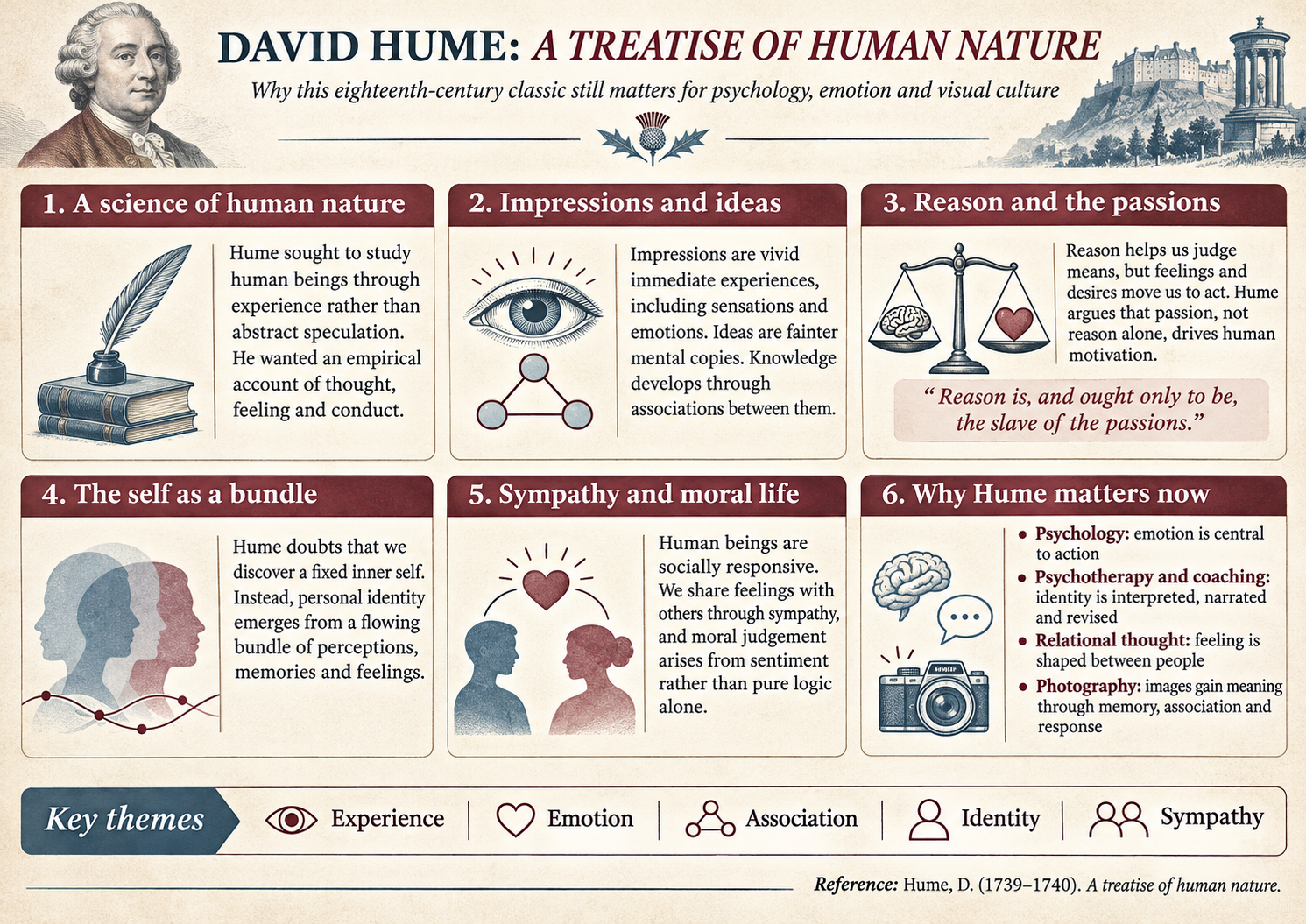

David Hume’s A Treatise of Human Nature represents one of the most significant attempts to establish a science of human nature. Writing during the Scottish Enlightenment, Hume sought to apply the principles of empirical enquiry to the study of human thought, feeling and conduct. Rather than beginning with abstract philosophical or theological principles, he sought to understand human beings through the study of their lived experience. In this respect, his work anticipates much of what we now recognise as psychology.
Central to Hume’s account of human nature is the distinction between impressions and ideas. Impressions arise from our immediate experiences, including sensations and emotions, while ideas are less vivid representations of those experiences. Our minds construct knowledge through the association of ideas, drawing on resemblance, proximity and perceived causal relationships. Hume argues that much of what we regard as knowledge rests on habit and expectation rather than logical certainty.
For contemporary psychology, perhaps Hume’s most important contribution lies in his account of the relationship between reason and emotion. His famous assertion that “Reason is, and ought only to be the slave of the passions” challenges the assumption that rational thought should govern emotional life (Hume, 1739–1740, 2.3.3). Reason helps us determine how to achieve our goals, but our feelings and desires provide the grounds for pursuing them. This distinction has profound implications for psychotherapy, coaching and the study of human motivation.
Hume also challenges the notion of a fixed, enduring self. Through introspection, he encounters not a stable self but a succession of perceptions, thoughts, sensations and feelings. Our sense of personal identity arises from the connections we establish between these experiences (Hume, 1739–1740, 1.4.6). This account resonates with contemporary approaches to narrative identity, reflective practice and the construction of selfhood. It invites us to consider whether personal development involves discovering an authentic self or constructing new ways of understanding ourselves.
Hume’s treatment of sympathy is of particular relevance to relational psychology. He recognises our capacity to share the emotional states of others and the extent to which our own feelings arise through social contact. His account anticipates aspects of emotional contagion, empathy and the interpersonal nature of emotional experience (Hume, 1739–1740, 2.1.11).
There are also implications for the psychology of photography. Hume’s distinction between impressions and ideas invites us to consider how visual experiences acquire emotional significance through memory and association. A photograph may evoke feelings that extend well beyond its depicted subject. Its psychological significance rests, in part, on the viewer’s prior experience.
Finally, Hume locates moral judgement within human sentiment rather than divine authority or pure reason. He also draws attention to the distinction between describing what is and prescribing what ought to be (Hume, 1739–1740, 3.1.1). This remains fundamental to ethical enquiry and the critical examination of social norms.
The enduring value of Hume’s work lies in his recognition of human beings as feeling, socially connected and psychologically complex creatures whose capacity for reason has limits. Nearly three centuries later, his work provides a rich philosophical basis for exploring the relationship between emotion, perception, identity and human conduct.
Reference
Hume, D. (1739–1740). A treatise of human nature: Being an attempt to introduce the experimental method of reasoning into moral subjects. Full original text – Hume Texts Online.
Rather obviously, the links to contemporary psychological practice and photography represent an interpretation of Hume’s work rather than claims that he formulated these modern disciplines.
Leave a Reply
You must be logged in to post a comment.