
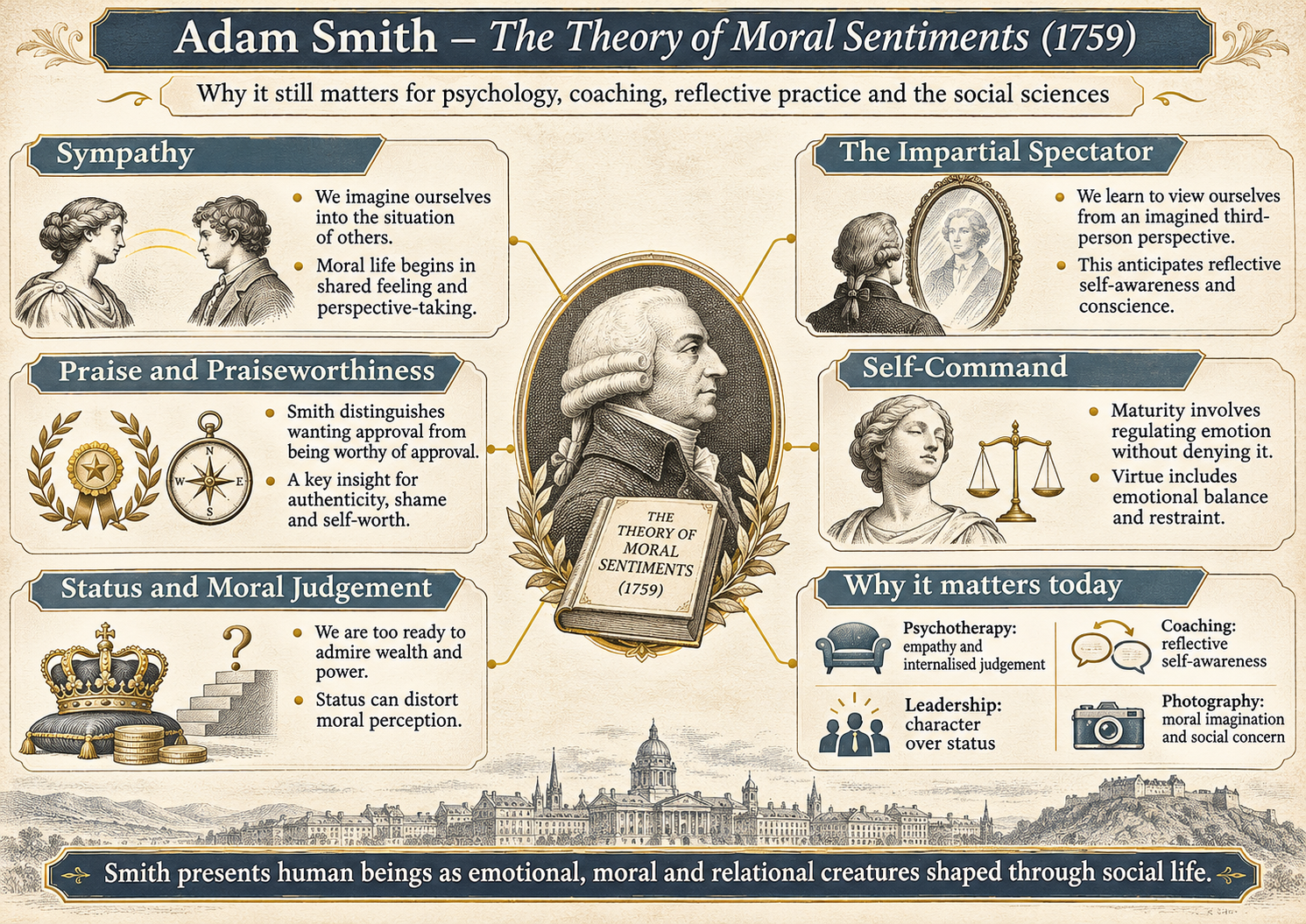

Although we tend to associate Adam Smith with economics and The Wealth of Nations, published seventeen years later, The Theory of Moral Sentiments is a work of moral philosophy with a substantial foundation in psychology. Smith seeks to explain how human beings develop moral judgement, regulate their emotions, form relationships and acquire a sense of social responsibility.
Viewed in the context of your interests in psychology, psychotherapy, coaching, reflective practice and the social sciences, Smith’s work is particularly relevant. He regards the moral self not as something that exists in isolation but as something that develops through our relationships with others.
1. Sympathy and the social nature of emotion
Smith argues that human beings possess a capacity to imagine and share the emotional experiences of others. He calls this sympathy, using the term in a broader sense than we do today. It encompasses much of what contemporary psychology describes as empathy and perspective-taking.
We cannot experience another person’s feelings directly. Instead, we imagine ourselves in their circumstances. Our emotional response arises, in part, from this act of imagination.
This has implications for psychotherapy and coaching, particularly the distinction between understanding another person’s subjective experience and projecting our own experience onto them.
2. The impartial spectator
Perhaps Smith’s most significant psychological concept is that of the impartial spectator. Through social experience, we develop the capacity to observe and assess ourselves from an imagined third-person perspective.
We learn to ask not merely whether our conduct satisfies our own needs, but whether a fair and informed observer would consider it reasonable.
This anticipates aspects of contemporary thinking about:
-
Metacognition and reflective self-awareness.
-
The internalisation of social norms.
-
The formation of conscience.
-
The development of moral identity.
-
The capacity to examine our own emotional responses.
For reflective practice, Smith offers an account of how we might develop sufficient psychological distance from our immediate experience to examine it with greater fairness.
3. Social approval and authenticity
Smith distinguishes between the desire to receive praise and the desire to be worthy of praise. These are quite different psychological motives.
Someone who depends upon social approval may adapt their behaviour to meet the expectations of others, irrespective of their own moral beliefs. A more mature individual seeks to act in ways that merit approval, even when none is forthcoming.
There are clear parallels with Carl Rogers’s concepts of conditions of worth, congruence and the internal locus of evaluation. There are also implications for our understanding of shame, self-esteem and the development of personal autonomy (Smith, 1790, Part III).
4. Emotional regulation and self-command
Smith regards self-command as a central human virtue. This involves the capacity to experience strong emotions without allowing them to govern our conduct.
His account is more subtle than simple emotional restraint. It concerns the relationship between our feelings, the circumstances that evoke them and their impact upon others.
This has relevance to emotional intelligence, emotional regulation, distress tolerance and the development of psychological maturity. Smith sees emotional regulation as a social as well as an individual process.
5. Social status and moral judgement
Smith questions our tendency to admire wealth, power and social status and to neglect those who possess little of them. In his final edition, he identifies this tendency as a major source of the corruption of moral judgement.
His observations anticipate aspects of contemporary social psychology, including status bias, social comparison, impression management and the relationship between power and perceived personal worth. They also invite us to question how educational and professional institutions define merit and success (Smith, 1790, Part I).
Adam Smith Works+1
6. Morality without religious authority
Although Smith employs theological language, his account of moral development rests to a large extent upon observable human relationships and psychological processes.
Human beings acquire moral understanding through their encounters with others, rather than through religious instruction alone. This makes his work particularly interesting from the standpoint of secular ethics and humanistic psychology, although it would be wrong to portray Smith himself as a secular humanist in the modern sense.
7. The psychology of photography
There is also a connection with your work on photography as a means of fostering social and behavioural change.
If sympathy depends upon our capacity to imagine ourselves in the circumstances of others, photographs may serve as a means of prompting moral imagination. Documentary photography, participatory photography and Photovoice might each be examined from this perspective.
However, Smith’s theory also raises a critical question: whose experiences do we find easiest to imagine, and whose suffering do we overlook? This could provide a useful theoretical foundation for exploring the relationship between imagery, empathy, social distance and moral concern.
Relevance to your academic work
I would regard The Theory of Moral Sentiments as a particularly useful historical foundation for five strands of your work:
| Academic interest | Smith’s contribution |
|---|---|
| Psychotherapy | Empathy, self-worth and the internalised judgement of others |
| Relational coaching | The social construction of self-awareness |
| Reflective practice | The impartial spectator |
| Transformative leadership | Moral character, self-command and the corrupting influence of status |
| Psychology of photography | Moral imagination and concern for others |
What makes Smith particularly relevant to your academic interests is his attempt to understand human beings as emotional, moral and relational creatures without reducing their behaviour to rational self-interest. He places the relationship between individual experience and social life at the centre of his account of human nature.
Had you pursued your present academic interests during the Scottish Enlightenment, moral philosophy would have been a natural intellectual home.
Reference and recommended reading
Smith, A. (1759). The theory of moral sentiments. A. Millar; A. Kincaid & J. Bell.
Smith, A. (1790). The theory of moral sentiments (6th ed.). A. Strahan; T. Cadell.
Read the complete text online.
The sixth edition, which incorporates Smith’s revisions over thirty-one years, is probably most useful. This account draws upon both the original theoretical framework and those later developments. The connections with contemporary psychology are interpretative parallels rather than claims of direct intellectual descent.
Leave a Reply
You must be logged in to post a comment.