

Thomas Reid and the Psychology of Common Sense
An inquiry into the human mind on the principles of common sense (1764)
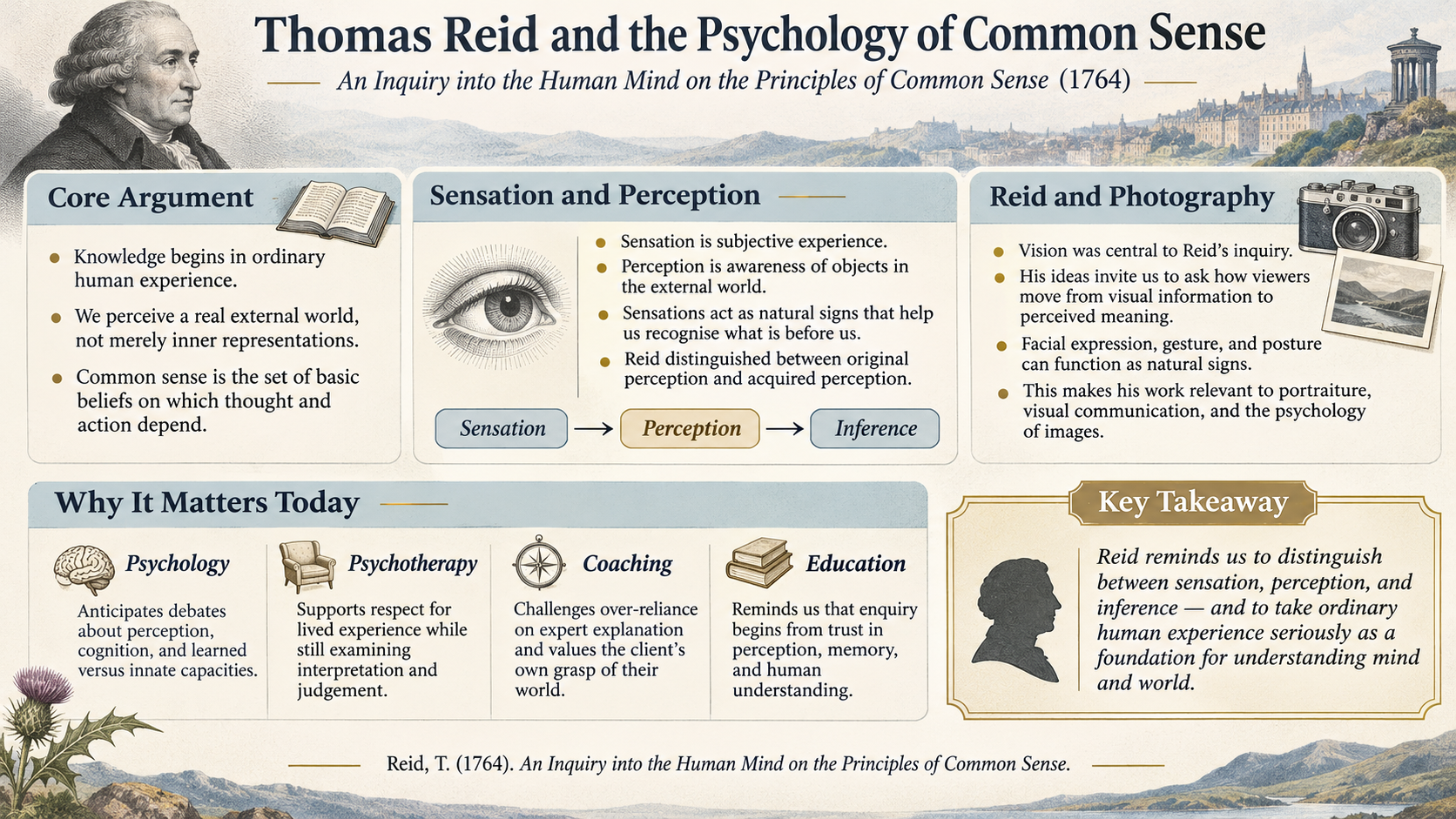
Thomas Reid’s contribution to the Scottish Enlightenment offers a distinctive account of how human beings perceive, interpret and understand the world. While David Hume had questioned the grounds on which we claim to possess knowledge, Reid sought to establish a philosophy of mind rooted in ordinary human experience. His work has much to offer those of us concerned with psychology, psychotherapy, coaching, education and the nature of photographic perception.
The grounds of human knowledge
Reid challenged the prevailing philosophical view that we have access to the external world only through mental representations of it. He argued that perception brings us into direct contact with the world rather than merely presenting us with internal copies of it. Although sensations play a part in perception, they are distinct from our awareness of the objects that give rise to them.
Central to his argument was the concept of common sense. By this, Reid didn’t mean popular opinion or conventional wisdom. He meant the fundamental principles of belief and judgement upon which human thought and action depend. These include our trust in perception, memory and the existence of a world beyond ourselves. We cannot establish all such principles through rational argument because rational argument itself depends upon them.
Sensation, perception and meaning
One of Reid’s most important contributions to psychology is his distinction between sensation and perception. A sensation is a subjective experience, whereas perception concerns our awareness of something in the external world. Sensations act as natural signs through which we recognise objects and their properties (Reid, 1764, Chapter V).
Reid also explored the distinction between original and acquired perception. Some perceptual capacities arise from our inherent constitution, while others develop through experience. This anticipates aspects of current debates within cognitive and developmental psychology about the relationship between innate capacities and learned responses.
Implications for psychotherapy and coaching
Reid’s philosophy raises questions about the extent to which we should trust our own experience. Within psychotherapy and coaching, there is often a tension between respecting a person’s subjective experience and examining the beliefs and judgements associated with it.
A Reidian perspective might encourage practitioners to respect the client’s capacity to understand their own world without assuming that every interpretation is sound. It also offers a challenge to theoretical frameworks that give greater weight to the practitioner’s explanation of an experience than to the experience of the client.
There are parallels here with both phenomenological enquiry and the person-centred approach, although Reid’s philosophical realism differs from some of their underlying assumptions.
Implications for photography
Reid devoted much of his book to vision, exploring colour, spatial depth, visible appearance and the relationship between sight and touch.
For the photographer, his distinction between sensation and perception raises a fundamental question: what is the relationship between the visual information contained within a photograph and what the viewer perceives?
His account of natural signs also has relevance to the psychology of images. Reid recognised that facial expressions, gestures and bodily postures convey aspects of human experience without the need for words (Reid, 1764, Chapter V).
This provides an early philosophical basis for exploring visual communication, portraiture and the emotional dimensions of photography.
The continuing relevance of Reid
Reid’s work reminds us that intellectual sophistication needn’t entail distrust of ordinary human experience. It also invites us to distinguish between what we experience, what we perceive and what we subsequently infer.
The links with contemporary psychology, coaching, psychotherapy and photography are interpretative extensions of his work rather than claims that Reid developed these disciplines himself. Nevertheless, his concern with the relationship between human experience and the world remains central to each of them.
Reference
Reid, T. (1764). An inquiry into the human mind on the principles of common sense. A. Millar, A. Kincaid & J. Bell.
Leave a Reply
You must be logged in to post a comment.