

Human nature, social life and the limits of progress
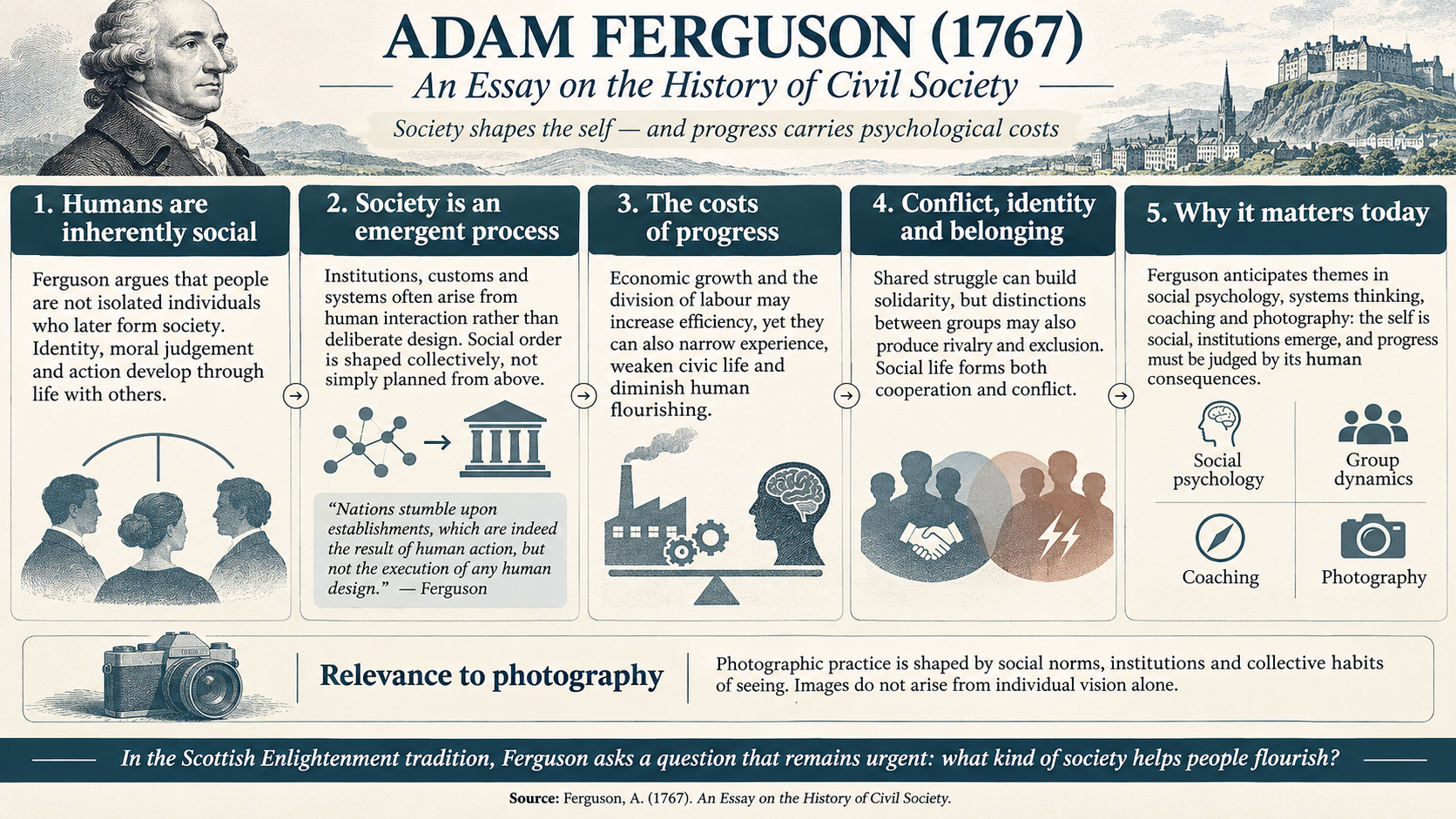
For Ferguson, human beings are inherently social. Society isn’t an artificial arrangement devised by otherwise independent individuals for their mutual benefit. Our sense of identity, moral judgement and capacity for action develop through our engagement with others. This anticipates central themes within contemporary social psychology, particularly the view that the individual cannot be understood apart from their social and cultural context.
Society as an emergent process
One of Ferguson’s most influential insights concerns the emergence of social structures. He argues that institutions, customs and systems of governance often develop without anyone having intended their eventual form. They are the products of human interaction rather than conscious design (Ferguson, 1767, Part III, Section II).
This anticipates aspects of contemporary systems thinking, organisational psychology and group dynamics. Within group coaching, for instance, patterns of behaviour, informal roles and shared norms emerge through interaction. No single participant necessarily creates or controls them. Ferguson’s work invites us to pay greater attention to these collective processes rather than attributing outcomes solely to individual intentions or leadership.
The psychological costs of progress
Ferguson was sceptical of the assumption that economic and technological progress necessarily leads to human flourishing. Although the division of labour increases productivity, it can also restrict intellectual development, weaken social bonds and diminish civic engagement (Ferguson, 1767, Part IV).
These concerns anticipate later theories of alienation and remain relevant to occupational psychology, leadership and psychotherapy. A society may become wealthier whilst leaving its members with a diminished sense of purpose, agency and belonging. Personal distress, from this perspective, cannot always be understood or addressed solely at the level of the individual.
Conflict, identity and belonging
Ferguson recognises that human beings possess capacities for both cooperation and conflict. Shared struggles can strengthen group identity and foster solidarity, whilst distinctions between groups can generate hostility. His account anticipates questions that would later become central to social identity theory and the study of intergroup relations.
For Ferguson, active participation in social life also provides opportunities for the development of character, moral judgement and intellectual capacities. Human flourishing involves more than personal comfort or the pursuit of self-interest.
Implications for photography and visual culture
Although Ferguson wrote before the invention of photography, his framework offers a means of understanding photographic practice as a social phenomenon. Visual conventions emerge through collective behaviour, cultural norms and institutional structures. What photographers regard as worthwhile, beautiful or meaningful reflects more than individual aesthetic judgement.
Documentary photography might also serve a civic function, making visible the social consequences of economic development, political decisions and institutional practices.
Ferguson’s historical account contains eighteenth-century assumptions about cultural development that warrant critical scrutiny. Nevertheless, his central question remains pertinent across psychology, education, coaching and photography: how might we create social conditions that foster human flourishing rather than merely increase wealth, efficiency or technical sophistication?
Reference
Ferguson, A. (1995). An essay on the history of civil society (F. Oz-Salzberger, Ed.). Cambridge University Press. (Original work published 1767). ISBN 978-0-521-44736-2.
Leave a Reply
You must be logged in to post a comment.