
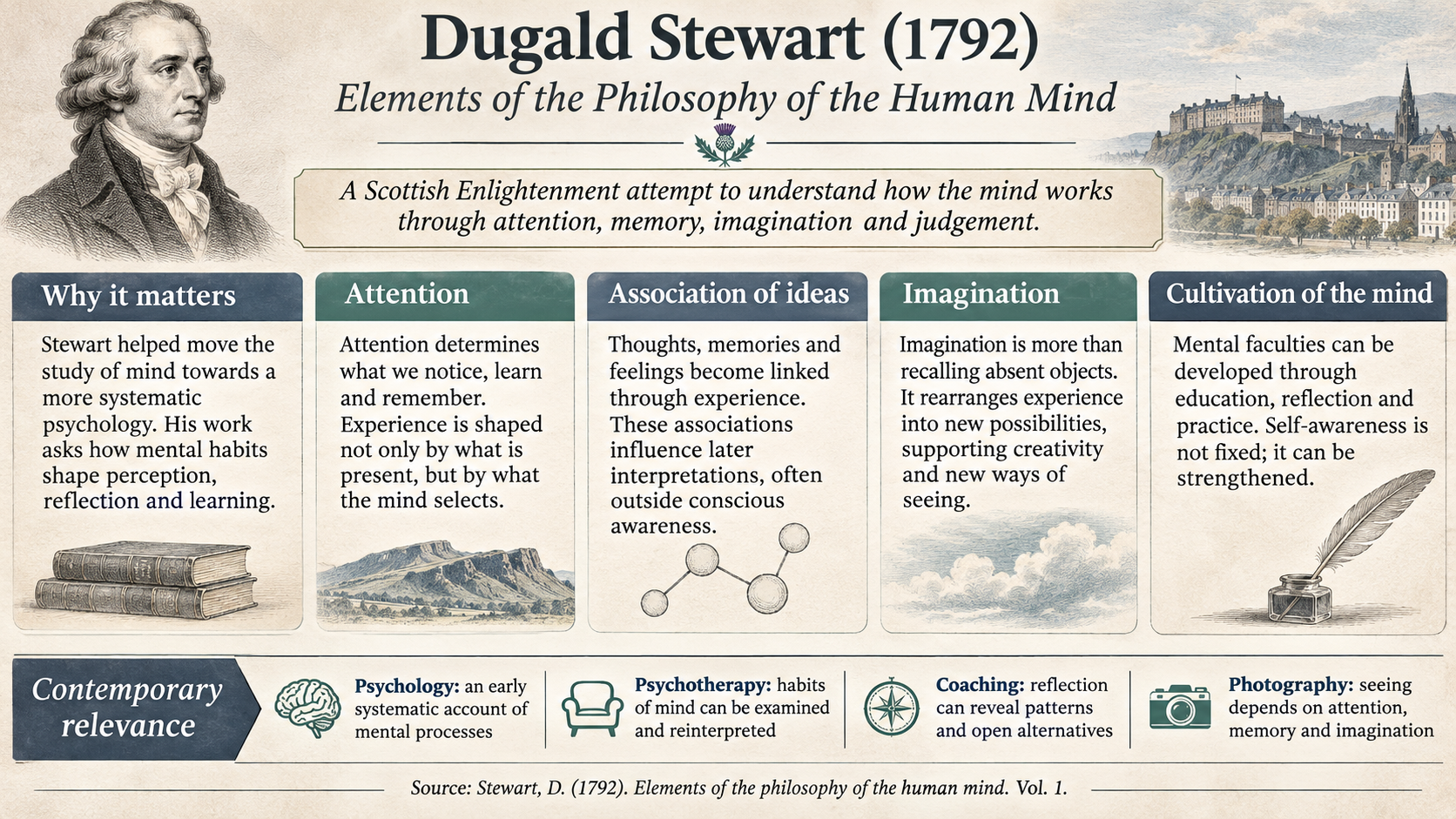

For those of us interested in psychology, psychotherapy, coaching, education and photography, Stewart’s work remains relevant because it explores the relationship between mental habits, conscious awareness and human development.
Attention and the construction of experience
Stewart regarded attention as a central feature of mental life. Our capacity to focus on certain aspects of experience, while disregarding others, shapes what we learn, remember and understand (Stewart, 1792, Chapter II).
This has particular relevance to the psychology of photography. Photographers develop habits of attention that influence what they notice and what they overlook. Learning photography might therefore involve the cultivation of attention as much as the acquisition of technical skills. Photographic practice can become a means of exploring how we attend to the world.
The association of ideas
Stewart devoted much of his work to the association of ideas. Thoughts do not occur in isolation. Past experiences establish links between ideas, sensations, memories and feelings. These links influence subsequent patterns of thought, sometimes without our conscious awareness (Stewart, 1792, Chapter V).
This has clear parallels with contemporary psychotherapy. Our responses to present circumstances may reflect associations formed through earlier experiences. From a coaching perspective, reflective enquiry can help people recognise these habitual connections and consider alternative ways of interpreting their experiences.
Stewart’s account also helps us understand why the same photograph can evoke quite distinct emotional responses in different viewers.
Imagination and human potential
Stewart distinguished imagination from the simple mental representation of absent objects. Imagination allows us to rearrange elements of past experience into new forms and possibilities (Stewart, 1792, Chapter VII).
This distinction matters in both creative practice and psychological development. The photographer can envisage new ways of representing the world, while the coaching client can envisage new ways of living within it. Imagination provides a means of exploring possibilities beyond the constraints of present circumstances.
The cultivation of the mind
Perhaps the most significant aspect of Stewart’s work is his view that we can cultivate our mental faculties through education and practice. Our intellectual habits need not remain fixed.
This offers a philosophical foundation for reflective practice. Through sustained attention to how we perceive, think, remember and interpret, we may develop greater self-awareness and intellectual flexibility.
Although Stewart lacked the experimental methods of modern psychology, his work raises a question that remains central to my own academic and professional interests: to what extent can understanding the workings of our minds change the way we experience and engage with the world?
Reference
Stewart, D. (1792). Elements of the philosophy of the human mind (Vol. 1). A. Strahan, T. Cadell and W. Creech. Digitised original edition.
This essay focuses on the original 1792 volume. Stewart published two further volumes in 1814 and 1827. Obviously, the links to photography, coaching and psychotherapy represent contemporary interpretations of his work rather than claims he made himself.
Leave a Reply
You must be logged in to post a comment.