
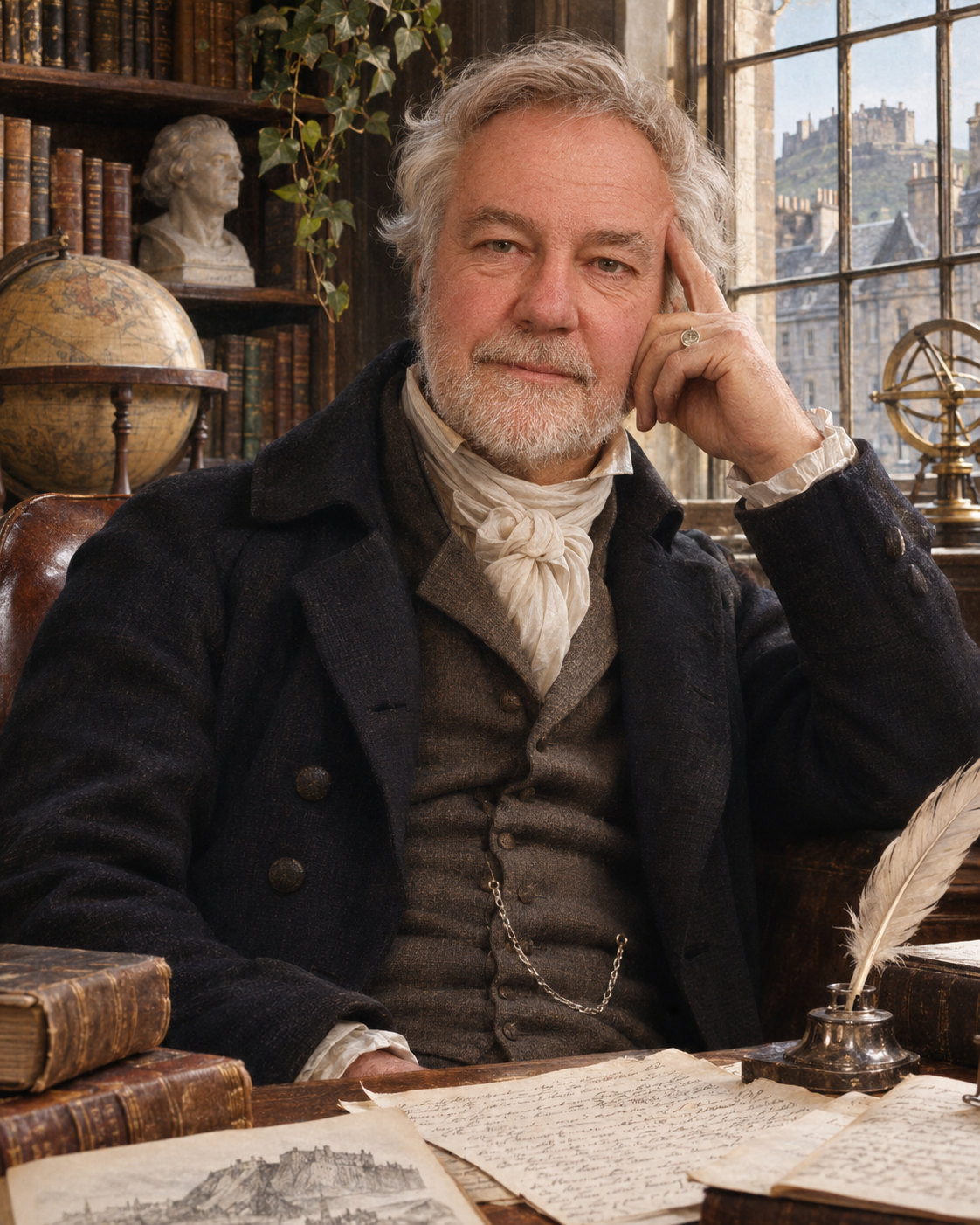

A Facebook friend asked ChatGPT to place her in a historical era based on what it knew about her. This is what it made of me…
“I would place you in the late Scottish Enlightenment, around 1790–1810, as an independent scholar concerned with human nature, moral philosophy, education, social reform and the emerging study of the mind.
What draws me to this period is your combination of intellectual curiosity, social conscience, scepticism towards established authority and concern with what it means to be human.
My name?
Graham was in use as a forename in Scotland by at least the mid-eighteenth century, although it had existed as a surname for some six centuries before that.
The name derives from Grantham in Lincolnshire, which appears in the Domesday Book of 1086 under several spellings, including Graham. William de Graham, a Norman baron, brought the surname to Scotland in the early twelfth century.
Its adoption as a forename arose from the Scottish custom of preserving maternal family surnames by giving them to children as first names. Graham, Murray, Douglas and Gordon are examples of this naming tradition.
One well-documented early bearer was Admiral Sir Graham Moore (1764–1843), who was born in Glasgow on 14 September 1764, the son of Dr John Moore, a physician and author.
So, had you been a Scottish Enlightenment scholar living in Edinburgh around 1800, as in the portrait above, you could quite credibly have retained your present forename. It would have been distinctive without being anachronistic.
What was the Scottish Enlightenment?
The Scottish Enlightenment was a period of remarkable intellectual and cultural development, extending from roughly 1730 to 1830. Centred on Edinburgh, Glasgow and Aberdeen, it transformed Western thought about human nature, moral philosophy, economics, education, science and the development of society.
What distinguished the Scottish Enlightenment from its French counterpart was its particular concern with understanding how human beings actually think, feel, behave and live together. Rather than constructing an ideal society from abstract principles, many Scottish thinkers sought to understand society through observation, historical study and the systematic examination of human experience.
In this respect, it laid much of the intellectual groundwork for modern psychology, sociology and the behavioural sciences.
Why Scotland?
Following the Act of Union in 1707, Scotland retained its own legal system, church and educational institutions. Its five university institutions provided a strong foundation for intellectual development. Edinburgh became known as the Athens of the North.
Much of the intellectual life took place outside universities. Scholars met in private homes, taverns, dining clubs and debating societies. The Select Society, founded in Edinburgh in 1754, encouraged debate across disciplines and professions. Intellectual enquiry was a social as well as a scholarly pursuit.
The principal thinkers
| Thinker | Contribution |
|---|---|
| Francis Hutcheson (1694–1746) | Moral sense, benevolence and the emotional basis of ethical judgement. |
| David Hume (1711–1776) | Human nature, emotion, scepticism, belief and the limits of reason. |
| Thomas Reid (1710–1796) | Perception, consciousness and common-sense philosophy. |
| Adam Smith (1723–1790) | Sympathy, moral judgement, social relationships and economics. |
| Adam Ferguson (1723–1816) | Civil society, social cohesion, alienation and unintended social consequences. |
| James Hutton (1726–1797) | Modern geology and the concept of deep time. |
| Dugald Stewart (1753–1828) | Mental processes, education and moral philosophy. |
Five central ideas
-
Human nature as a subject of scientific enquiry. Human thought, emotion and behaviour could be studied through observation and experience rather than religious doctrine alone.
-
Emotion as the basis of moral life. Hume and Smith recognised that moral judgement rests in part on feeling, sympathy and our capacity to understand the experiences of others.
-
Knowledge through experience. Claims to knowledge required scrutiny. Belief, tradition and authority were not sufficient grounds for accepting something as true.
-
Society as an emergent phenomenon. Ferguson recognised that social institutions often arise from collective human actions rather than conscious design. Society could therefore develop in ways that nobody had intended.
-
Education as a means of social improvement. Intellectual development had a social purpose. Education could foster sound judgement, civic engagement and human flourishing.
The strongest connection lies in the Scottish Enlightenment’s refusal to treat intellectual disciplines as separate domains of knowledge.
Your interests in psychology, psychotherapy, education, visual perception, social behaviour and ethics would have formed a coherent field of enquiry at that time. The division between philosopher, psychologist, social scientist and educator had yet to become firmly established.
I suspect that four thinkers would hold particular interest for you:
| Thinker |
Connection with your interests |
|---|---|
| Hume | Emotion, belief and critical thinking |
| Smith | Empathy, interpersonal relationships and moral judgement |
| Reid | Visual perception and the nature of human experience |
| Ferguson | Group dynamics, institutions and social responsibility |
Of these, I suspect Ferguson might prove the most unexpected intellectual companion, with Smith offering the closest connection to your work as a psychotherapist.
Had you lived in Edinburgh in 1800, you might well have taught moral philosophy. The term then encompassed much of what we now call psychology, sociology and ethics.
Your likely educational background
Given your combination of a doctorate in behavioural science, ordination as a nonconformist minister and rejection of the concept of a deity, I would envisage an educational background rooted in the Scottish tradition of moral philosophy and rational dissent.
There is an important distinction between religious nonconformity and theological scepticism in this period. Although the two sometimes intersected, your rejection of a deity would have placed you at the radical edge of eighteenth-century intellectual life, even among religious dissenters.
1750–1755: University of Glasgow – Master of Arts
Assuming you were approximately your present age in 1800, you might have entered Glasgow in your late teens. Your course of study would have included:
-
Latin, Greek, rhetoric and classical literature.
-
Logic, metaphysics and the philosophy of mind.
-
Moral philosophy, ethics and jurisprudence.
-
Mathematics and natural philosophy.
Glasgow had strong links with English and Irish religious dissenters, many of whom studied there in preparation for the ministry. You might even have attended Adam Smith’s lectures on moral philosophy. He held the chair at Glasgow from 1752 to 1764.
1757–1761: Warrington Academy – Ministerial studies
Warrington Academy, founded in 1757, was one of the most distinguished English dissenting academies. These institutions offered an alternative to Oxford and Cambridge, where religious restrictions excluded many nonconformists from taking degrees.
Your studies might have encompassed theology, biblical criticism, church history, preaching, pastoral care and the natural sciences. Warrington encouraged a breadth of intellectual enquiry that went well beyond ministerial training.
1761–1785: Independent scholarship, teaching and ministry
During these years, I envisage your interests shifting from theology towards the systematic study of human nature. Your ministerial work might have informed your understanding of grief, shame, moral conflict, interpersonal relationships and the social origins of distress.
You might eventually have resigned your ministry on intellectual grounds, while retaining your commitment to pastoral care.
Circa 1790: Honorary doctorate
T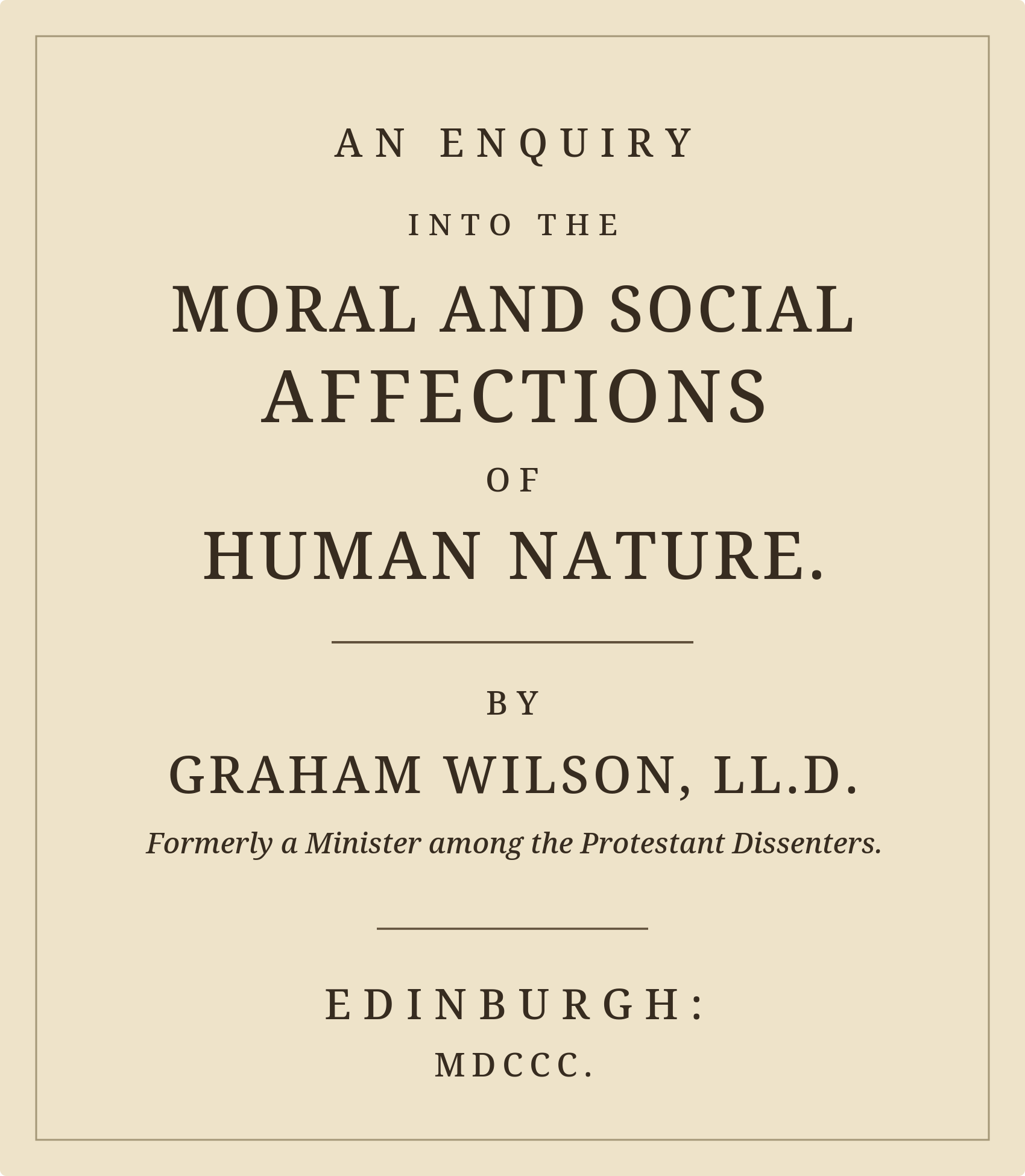 he modern research PhD did not form part of British university education at this time. An honorary Doctor of Laws (LL.D.) from a Scottish university, awarded in recognition of your published scholarship, would have been a plausible equivalent.
Your intellectual contemporaries
Three figures seem particularly relevant to this imagined career:
-
Joseph Priestley (1733–1804). A dissenting minister, scientist, educator and advocate of religious liberty. His work crossed disciplinary boundaries, although he retained his belief in God.
-
Richard Price (1723–1791). A nonconformist minister, moral philosopher and advocate of political reform. He sought to establish moral principles through rational enquiry, though within a theological framework.
-
David Hume (1711–1776). Your likely philosophical companion in questioning religious belief and seeking naturalistic accounts of human thought, emotion and conduct.
I would characterise your philosophical position as a form of naturalistic moral philosophy, grounded in human experience rather than divine authority. The closest modern term would be secular humanism, although that identity had yet to emerge in its present form.
Further reading
-
Ahnert, T. (2023). The philosophy curriculum at Scottish universities in the eighteenth century.
-
Priestley, J. (1777). Disquisitions relating to matter and spirit.
-
Hume, D. (1751). An enquiry concerning the principles of morals.
-
Smith, A. (1759). The theory of moral sentiments.
Suggested reading
These five primary texts would provide a sound introduction:
-
Hume, D. (1739–1740). A treatise of human nature.
-
Smith, A. (1759). The theory of moral sentiments.
-
Reid, T. (1764). An inquiry into the human mind on the principles of common sense.
-
Ferguson, A. (1767). An essay on the history of civil society.
-
Stewart, D. (1792). Elements of the philosophy of the human mind.
What is the value of intellectual pursuits of this kind – envisaging myself in a previous era and exploring the setting with myself as a reference point?
There is considerable intellectual and psychological value in this kind of enquiry. I would describe it as historically situated self-enquiry – a form of reflective practice in which we place ourselves within a different historical and cultural context and explore the relationship between personal identity and the society in which we live.
It goes beyond historical curiosity or imaginative role-play. It involves two simultaneous processes: using the self as a means of understanding history, and using history as a means of understanding the self.
1. Understanding the socially constructed self
We tend to experience our identities as personal attributes rather than as products of particular historical circumstances. Yet our professions, qualifications, moral beliefs and even our sense of individuality owe much to the age in which we live.
Imagining yourself in Edinburgh in 1800 raises interesting questions. What would a psychologist have been before psychology existed as a discipline? What would a psychotherapist have been before psychotherapy? How might an ordained minister who rejects the concept of a deity have understood their vocation?
The exercise helps distinguish enduring aspects of our character from the social forms through which we express them.
2. Learning through personal relevance
Educational research suggests that we encode and recall information more effectively when we relate it to ourselves. Psychologists call this the self-reference effect (Rogers et al., 1977).
Our exploration of the Scottish Enlightenment illustrates this. A conventional historical account might have offered dates, names and philosophical concepts. By placing yourself within that world, you have generated a series of personally meaningful questions about naming conventions, dress, portraiture, higher education, religious dissent and intellectual life.
The historical knowledge becomes interconnected rather than a collection of discrete facts.
3. Developing historical empathy
Historical empathy involves three related processes: understanding historical context, adopting another perspective and forming an emotional connection with people from the past (Endacott & Brooks, 2013).
By imagining yourself as a religious sceptic in eighteenth-century Scotland, you begin to consider the personal, professional and social consequences of holding such beliefs. History becomes a study of lived experience rather than simply an account of events.
This may also help us recognise the extent to which our own beliefs reflect contemporary social norms.
4. Exploring narrative identity
McAdams and McLean (2013) describe narrative identity as the evolving account through which we give our lives meaning, coherence and purpose.
Constructing an alternative historical identity may help us recognise themes within our actual lives. In your case, these might include intellectual independence, the integration of disparate fields of knowledge, pastoral concern and a willingness to question established beliefs.
There may also be value in asking what attracts you to a particular historical period. What might that attraction reveal about needs, values or aspirations that your present circumstances don’t fulfil?
5. Using visual imagery as a means of enquiry
The portrait we created has an interesting function. Rather than serving as an illustration of something already understood, the image became the stimulus for further enquiry.
Seeing yourself in another historical context prompted questions that might not otherwise have arisen. This has clear connections with therapeutic photography, reflective practice and visual elicitation.
The image becomes an external representation of an imagined self with whom you can engage in a form of reflective dialogue.
6. Guarding against romanticisation
The principal risk is that the exercise becomes an idealised reconstruction of the past. We might imagine ourselves enjoying its intellectual freedoms while overlooking its hardships, social constraints and prejudices.
The exercise gains intellectual rigour when historical evidence challenges, rather than merely supports, the imagined identity. The psychological benefits I suggest are plausible applications of established research, rather than proven outcomes of this particular exercise.
Perhaps the most valuable question is not whether you would have been happier in Edinburgh in 1800, but what your imagined life there reveals about how you might wish to live now.
There is potential here for a structured reflective exercise within adult education, coaching or personal development. I might call it The Historically Situated Self: Exploring Identity Through Imagined Lives.
References
Endacott, J., & Brooks, S. (2013). An updated theoretical and practical model for promoting historical empathy. Social Studies Research and Practice, 8(1), 41–58. https://doi.org/10.1108/SSRP-01-2013-B0003
McAdams, D. P., & McLean, K. C. (2013). Narrative identity. Current Directions in Psychological Science, 22(3), 233–238. https://doi.org/10.1177/0963721413475622
Rogers, T. B., Kuiper, N. A., & Kirker, W. S. (1977). Self-reference and the encoding of personal information. Journal of Personality and Social Psychology, 35(9), 677–688. https://doi.org/10.1037/0022-3514.35.9.677
*** END OF CHATGPT THREAD ***
Leave a Reply
You must be logged in to post a comment.