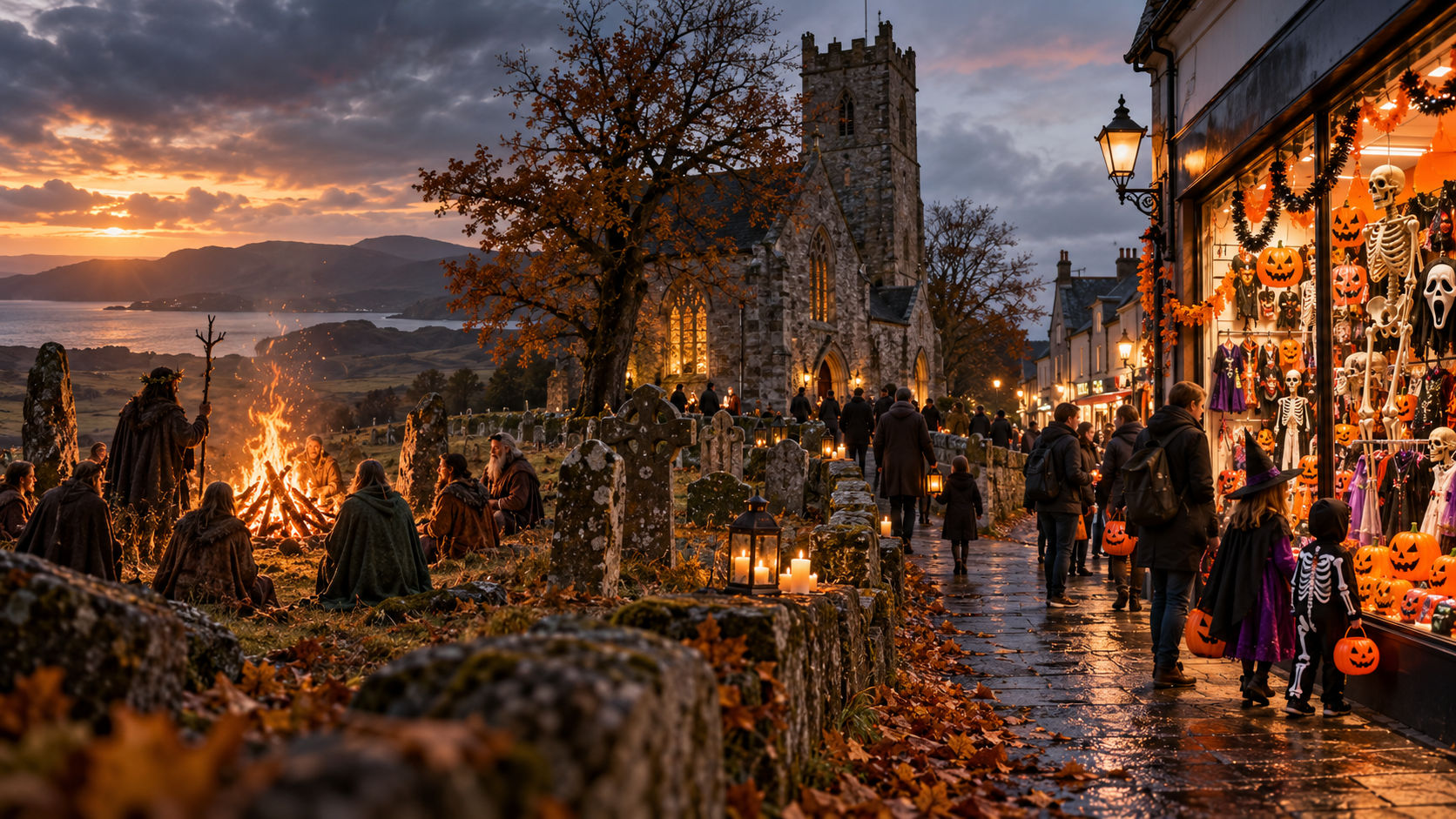

Every October, we celebrate Halloween with ghosts, witches, skeletons, and images of death. But where did these strange customs come from, and what was their original purpose?
The story begins more than a thousand years ago, in Celtic Ireland, with a festival called Samhain. Samhain marked the end of summer and the start of winter, around 1 November. It was an important date in farming communities, when the harvest was over and people faced the cold and uncertainty of winter. Our clearest written accounts come from the early Middle Ages, particularly between the eighth and twelfth centuries.
These Irish tales also link Samhain with the supernatural. They describe a time when beings from the Other world, could enter the human one, and when people might gain knowledge of the future. But this wasn’t simply a festival about frightening people. It marked a major change in the year and it helped communities make sense of forces that they couldn’t control.
Then Christianity added another layer. Christians had honoured saints and martyrs since at least the fourth century. During the eighth century, the Church in Rome began marking All Saints’ Day on the 1st November. By 835, this had gained wider official status. Around the year 1000, the Church also established the 2nd November as All Souls’ Day, dedicated to remembering and praying for the dead.
Did the Church DELIBERATELY take over Samhain? That’s often claimed, but we do have any firm historical proof. What we do know is that Christian beliefs and older folk customs came to coexist and influence one another. By the fifteenth century, people in England practised ‘souling’. Poorer people visited wealthier homes, receiving food in exchange for prayers for the dead.
In Scotland and Ireland, another custom, known as ‘guising’, involved people wearing disguises and seeking food or gifts. By the nineteenth century, this was firmly linked with Halloween.
During that century, Irish and Scottish migrants carried their customs to North America. And there, Halloween changed again. By the 1930s, American communities were developing modern trick-or-treating. During the 1950s, it spread widely as a children’s activity, while manufacturers promoted sweets, costumes and decorations.
The modern commercial Halloween was taking shape. And since the late twentieth century, that American version has spread back to Britain, often displacing or reshaping older local customs.
So look at what has happened. A festival marking seasonal change became linked with spiritual beliefs and remembrance of the dead. Those customs evolved into community rituals, then children’s entertainment, and finally a major consumer market.
We’ve retained the ghosts, skeletons and images of death, but much of their meaning has disappeared. Perhaps the greatest loss isn’t the ancient rituals themselves. It’s the idea that a festival should help us understand something important about life. What DOES our modern Halloween help us understand, apart from how much we’re willing to spend?
Leave a Reply
You must be logged in to post a comment.