
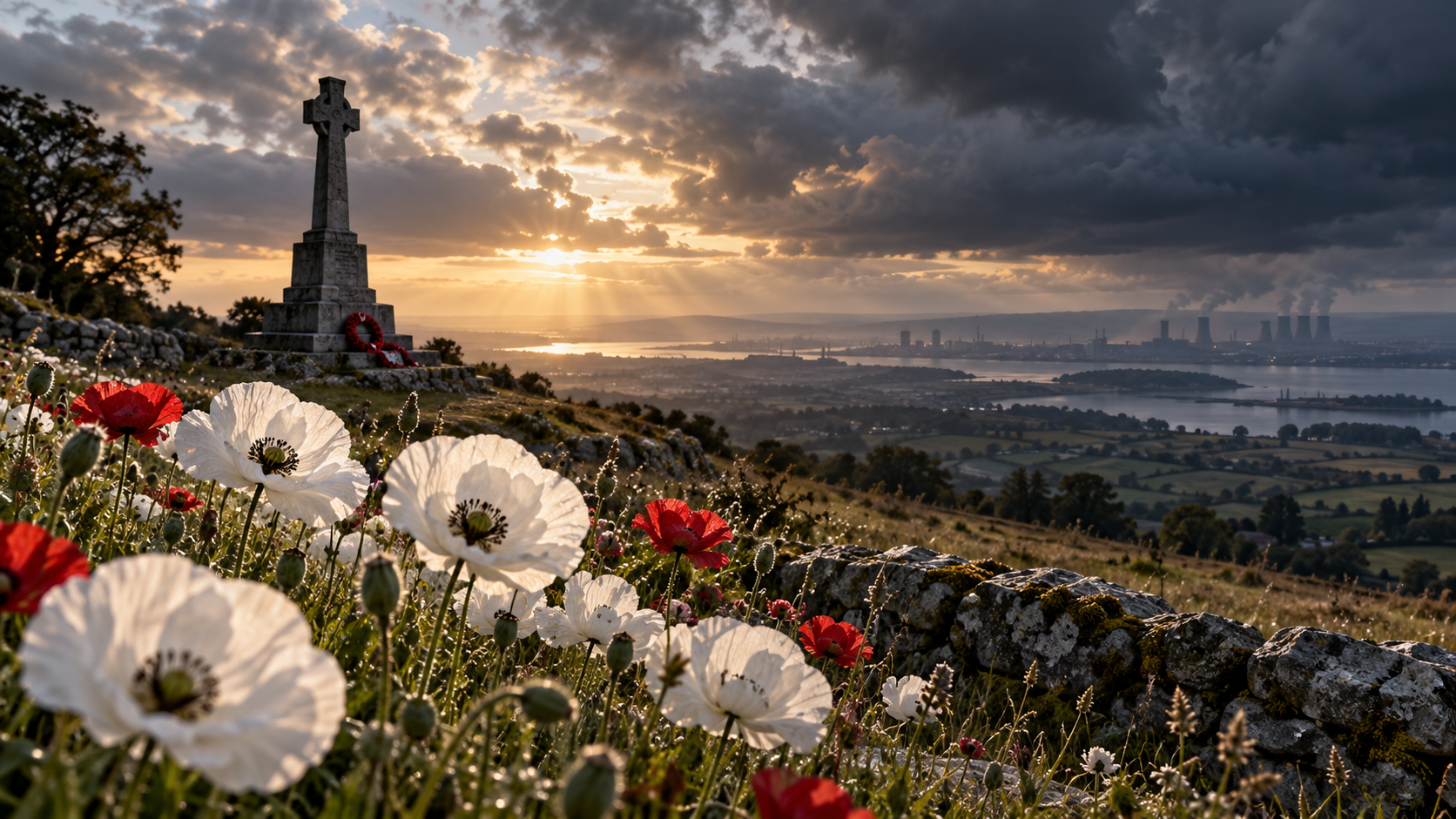

Remembrance, pacifism and the growing threat of nuclear war
Every November, the white poppy provokes a degree of hostility that seems remarkable for such a modest symbol. Those who wear it may face claims that they disrespect the armed forces, diminish the sacrifice of the war dead or lack the courage to defend their country. These claims reveal how far public remembrance has drifted from one of the most urgent lessons of the First World War: that humanity must find ways to prevent such slaughter from happening again.
The white poppy does not reject remembrance. It asks us to take remembrance seriously, by recognising the human cost of war and questioning why armed conflict remains such an accepted means of settling disputes. At a time when nuclear threats, nationalism and political hostility are growing, its message deserves renewed attention.
A tradition rooted in the experience of war
The white poppy first appeared in Britain in 1933, introduced by the Co-operative Women’s Guild. Many of its members had lost husbands, sons, brothers and friends during the First World War. They feared that acts of remembrance were becoming detached from the commitment to preventing future wars.
Their response was not to reject the red poppy, but to give renewed force to the pledge of ‘Never Again’. The Peace Pledge Union (PPU), founded in 1934, later became the main organisation promoting white poppies (Peace Pledge Union, n.d.).
Today, the white poppy represents three principles: remembrance of all victims of war, both military and civilian; opposition to militarism and the glorification of warfare; and a commitment to building peace.
These principles do not deny the courage of soldiers or the suffering of their families. They extend concern to everyone whose life war destroys, regardless of nationality or uniform.
Indeed, the Royal British Legion itself recognises that wearing a poppy is a personal choice and respects the right to wear other symbols of remembrance. Its 2025 guidance makes clear that the red poppy can be worn alongside other emblems (Royal British Legion, 2025).
The supposed conflict between red and white poppies is therefore neither necessary nor historically justified. They express different, though potentially compatible, responses to the same human tragedy.
The peace movement is far older than the white poppy
Organised pacifism did not begin in the twentieth century. In 1660, the Quakers declared their opposition to warfare and established a peace tradition that continues today. During the First World War, many Quakers served in ambulance units, aided civilians or resisted military conscription (Quakers in Britain, n.d.).
The wider peace movement has drawn on religious conviction, socialist thought, humanitarian principles and opposition to imperialism. Its members have challenged the assumption that violence offers the most reliable way to achieve political goals.
Pacifism has never been a single, fixed doctrine. Some pacifists reject all armed violence as a matter of conscience. Others support nonviolent resistance while accepting that governments have a duty to protect those facing aggression. Peace movements have also differed over sanctions, military alliances and the legitimacy of armed self-defence.
What unites them is the belief that war should not be treated as inevitable, honourable or beyond question.
After 1945, the nuclear arms race gave this tradition new urgency. The Campaign for Nuclear Disarmament, founded in 1958, helped bring public concern about nuclear weapons into British politics. Its message challenged the claim that peace could rest securely on the permanent threat of mass destruction.
The nuclear threat is not theoretical
The danger of nuclear war has returned to the centre of international politics. Russia’s invasion of Ukraine, its nuclear threats and its conflict with Western governments have raised the risk of escalation. The use of nuclear threats to deter outside intervention also poses a serious challenge to international security.
The Stockholm International Peace Research Institute estimated that nine nuclear-armed states possessed approximately 12,187 nuclear warheads in January 2026. Around 2,100 to 2,200 deployed warheads remained on high operational alert. SIPRI also warned that nuclear arms control was weakening while states were modernising their arsenals (SIPRI, 2026).
These figures do not establish that nuclear war is inevitable, or even imminent. They do, however, demonstrate the scale of the risks that political leaders are prepared to accept.
The doctrine of nuclear deterrence assumes that the threat of devastating retaliation will prevent an opponent from launching an attack. Supporters argue that this has helped prevent direct war between nuclear powers. Critics point out that deterrence depends on sound judgement, reliable information and the absence of grave error.
These conditions cannot be guaranteed.
The Peace Movement therefore raises a question that governments seldom address with sufficient candour: should the survival of entire populations depend on the judgement of a small number of political and military leaders?
What are the alternatives to armed conflict?
Opposition to war is frequently dismissed as a failure to understand aggression. Yet the choice is not simply between military action and surrender.
International law already offers a different framework. The United Nations Charter requires states to settle disputes by peaceful means and prohibits the threat or use of force against another state’s territorial integrity or political independence. It also recognises the right of self-defence following an armed attack (United Nations, 1945).
Peaceful approaches include diplomacy, mediation, arms control, negotiated security agreements, economic pressure, international legal action and civilian resistance. None guarantees success. Nor should any become a pretext for leaving an invaded population without protection.
Research provides grounds for taking nonviolent action seriously. Chenoweth and Stephan (2011) found that major nonviolent resistance campaigns between 1900 and 2006 were more than twice as successful as violent campaigns in achieving their stated political goals. Their findings challenge the assumption that force is always the most effective response to oppression. They do not, however, prove that civilian resistance can defeat every military invasion.
The challenge for pacifists is to develop credible alternatives rather than rely on moral opposition alone. In Ukraine, this means recognising both Russia’s responsibility for its aggression and the right of Ukrainians to determine their own future. A settlement imposed through military threats, territorial seizure or the denial of national independence would not provide a just peace.
For those committed to nonviolence, the task is to defend that right through political, economic and humanitarian means without accepting an unlimited escalation of warfare.
Pacifism in an age of populism
Contemporary populist politics often divides society into opposing camps: patriots and traitors, allies and enemies, the strong and the weak. Such divisions leave little room for moral doubt or informed debate.
Within this climate, pacifism may be portrayed as weakness, disloyalty or sympathy for an aggressor. Yet opposing war does not require sympathy for those who wage it. Condemning Russian aggression and opposing a wider war between nuclear powers are not contradictory positions.
The white poppy challenges the belief that national loyalty must include support for military force. It also challenges the idea that compassion should stop at national borders.
This can demand courage. Conscientious objectors have faced prison, public contempt and exclusion for refusing to fight. Their history reminds us that rejecting violence does not mean avoiding personal risk.
There is also a psychological dimension. Fear encourages people to seek certainty, strong leaders and simple accounts of complex threats. National identity can become a source of security, while those who question the dominant view may be treated as outsiders. Peace movements must resist these pressures without dismissing the genuine fears that sustain them.
Their task is not to deny danger, but to insist that fear must not determine political judgement.
What wearing a white poppy means today
To wear a white poppy in 2026 is to make a public commitment. It means remembering the dead without treating their deaths as a justification for further killing. It means recognising the suffering of civilians as well as soldiers, and accepting that people on opposing sides of a conflict retain their common humanity.
It also means asking difficult questions. Does increasing military expenditure make us safer? Are governments investing enough in diplomacy and conflict prevention? Are economic and political interests prolonging wars? What risks are we imposing on future generations by retaining nuclear weapons?
A white poppy offers no simple answer to these questions. Nor does it remove the painful moral choices involved when one state invades another.
Its value lies in refusing to let war become the unquestioned answer.
Remembrance should involve more than honouring those who died. It should require us to examine the political decisions that led to their deaths, the failures that allowed conflict to grow and the steps that might prevent its return.
The white poppy carries a tradition stretching back through generations of peace campaigners, conscientious objectors and families bereaved by war. Far from disrespecting their sacrifice, it takes seriously the possibility that we owe them something more than an annual ceremony.
We owe them a determined effort to ensure that future generations do not have to make the same sacrifice.
That is not a rejection of remembrance. It is one of its most demanding forms.
References
Chenoweth, E., & Stephan, M. J. (2011). Why civil resistance works: The strategic logic of nonviolent conflict. Columbia University Press. https://cup.columbia.edu/book/why-civil-resistance-works/9780231156820/
Peace Pledge Union. (n.d.). White poppies: Frequently asked questions. https://www.ppu.org.uk/remembrance/white-poppies-frequently-asked-questions
Quakers in Britain. (n.d.). Quakers and World War I. https://www.quaker.org.uk/faith/our-history/ww1
Royal British Legion. (2025). Remembrance: Key points. https://branches.britishlegion.org.uk/media/zvzkqvtc/remembrance-key-points_aug25.pdf
Stockholm International Peace Research Institute. (2026). SIPRI yearbook 2026: Armaments, disarmament and international security. Oxford University Press. https://www.sipri.org/yearbook/2026
United Nations. (1945). Charter of the United Nations. https://www.un.org/en/about-us/un-charter/full-text
Leave a Reply
You must be logged in to post a comment.