
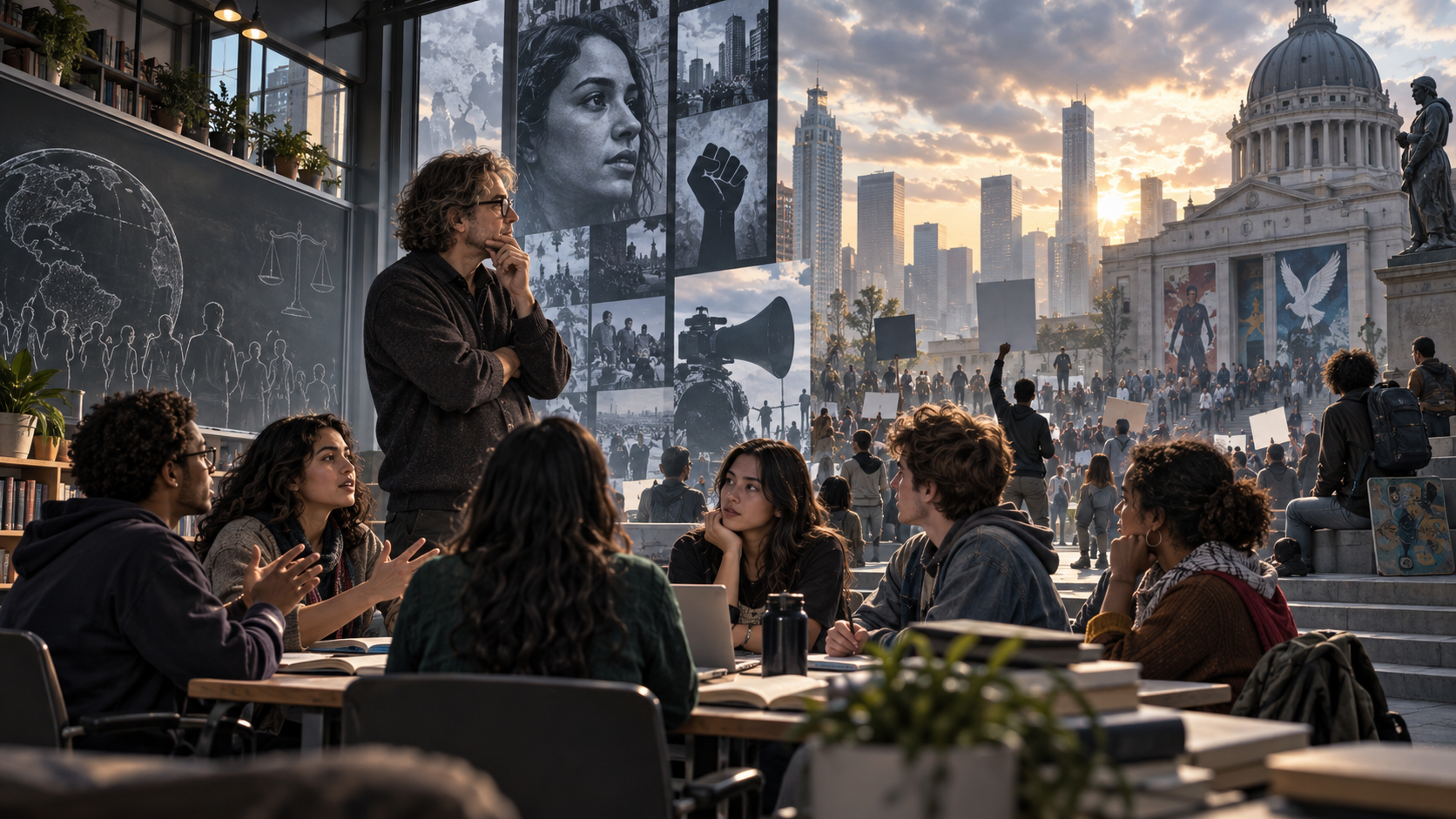

Henry A. Giroux occupies an unusual place within Critical Theory because he takes questions first posed about capitalism, ideology and culture and brings them into the field of education. His central claim is simple but far-reaching: education is never just the transfer of knowledge. It also shapes how people understand themselves, other people and the social world. Teaching therefore sits within wider struggles over culture, power and democracy.
Giroux’s work draws on several strands of twentieth-century thought. From the Frankfurt School he takes the concern that culture can help sustain forms of domination. From Antonio Gramsci comes the idea that power depends not only on force but on consent, formed through institutions and everyday culture. From Paulo Freire comes the view that education can either reproduce existing relations of power or help people question them. Giroux brought these traditions together within what became known as critical pedagogy.
His early work challenged theories that treated schools as little more than machines for social reproduction. In *Theory and Resistance in Education* (1983), Giroux accepts that schools can reproduce class relations, dominant values and established forms of authority. Yet he objects to accounts that make this process appear complete. Students and teachers aren’t simply acted upon by institutions. They can interpret, resist and reshape the meanings they encounter. Education therefore becomes a contested space rather than a one-way means of social control (Giroux, 1983/2024). Giroux’s own publication record shows how this concern with ideology, resistance and schooling formed the core of his early work.
This emphasis on agency is important. Some forms of Critical Theory can appear to leave little room for individual action. If ideology penetrates culture, education and everyday thought, it becomes difficult to explain how people might recognise or resist it. Giroux tries to preserve both sides of the problem. Social structures constrain thought and action, but they don’t determine them fully. Pedagogy becomes one place in which that tension can be examined.
This leads to one of Giroux’s best-known ideas: teachers should be understood as intellectuals rather than as technicians. *Teachers as Intellectuals* (1988) argues against the reduction of teaching to the delivery of material designed elsewhere. Teachers make decisions about knowledge, authority, interpretation and values. They therefore take part in the formation of public culture, whether or not they describe their work in those terms. Giroux’s later writing continues to treat education as a public and democratic practice rather than merely as vocational training.
This does not mean that critical pedagogy requires teachers to instruct students in the correct political view. That would merely replace one form of authority with another. Its stronger claim is that education should make assumptions open to examination. Students should be able to ask whose knowledge has acquired authority, whose experience has been excluded, what interests particular ideas serve and what alternative accounts might exist. Critical pedagogy therefore concerns the conditions under which judgement becomes possible.
Giroux later widened this argument through the concept of “public pedagogy”. Education, in this sense, occurs far beyond the school or university. Film, television, advertising, journalism, popular culture and digital media all teach people how to interpret the world. They circulate ideas about success, gender, race, nation, violence, citizenship and social worth. Giroux argues that politics itself has an educative force because public culture helps form the people who participate in political life (Giroux, 2003, 2004).
This extension of pedagogy into culture marks an important link between Giroux and the wider Critical Theory tradition. Culture isn’t treated as a secondary reflection of economic or political power. It becomes one of the places where power works. What people repeatedly see, hear and encounter helps establish which social arrangements appear normal and which alternatives appear unthinkable.
Giroux’s critique of neoliberalism follows from this argument. He uses the term to describe more than a set of economic policies. He is concerned with the spread of market values into institutions and areas of life once understood in civic or social terms. Within higher education, this can mean treating students as customers, courses as products and knowledge mainly as preparation for employment. Giroux argues that such changes narrow the public purpose of education by weakening its role in critical thought, democratic debate and civic life (Giroux, 2004, 2010).
This aspect of his work has become increasingly prominent. His research ranges across critical pedagogy, media, popular culture, youth, higher education and political theory, with recurring attention to corporate power, public memory, civic literacy and the effects of neoliberalism. The scope of this work makes clear that Giroux no longer treats education as a bounded institution. Pedagogy becomes a way of analysing how societies produce particular forms of consciousness.
Photography fits readily within this account. Photographs don’t merely record the world. They help teach viewers how to see it. Documentary images may shape assumptions about poverty, conflict, migration, family or national identity. Advertising teaches forms of desire. News photography establishes which events deserve attention and which forms of suffering become visible. Personal photography can reinforce ideas about the kinds of lives that deserve display.
From Giroux’s perspective, the important question would therefore not be limited to what a photograph represents. It would also concern what the image teaches. What forms of social knowledge does it reproduce? What assumptions does it leave untouched? Whose viewpoint acquires authority? Which people become subjects and which become objects of scrutiny? Such questions move photographic criticism away from aesthetics alone and towards the cultural work performed by images.
The same approach also prevents too simple an account of visual culture. If Giroux’s early theory of resistance remains important, images need not reproduce dominant meanings. Photography can expose exclusions, recover lost histories or make familiar social relations strange enough to invite thought. Cultural production therefore becomes another contested space in which dominant meanings may either harden or fracture.
There are grounds for caution in Giroux’s work. His later political writing can employ terms such as authoritarianism, neoliberalism and fascism across a wide range of events and institutions. Such breadth can weaken analytic precision if different forms of power become grouped too quickly under the same label. Critical pedagogy also contains a persistent tension: a teacher committed to emancipation may become too certain about what emancipation should mean. A theory designed to resist authority must therefore remain able to question its own authority.
Yet this tension may strengthen rather than weaken Giroux’s relevance to Critical Theory. His work keeps returning to a problem that runs through the whole tradition: how can people become aware of the cultural and social forces that shape their thought without assuming that another authority can simply tell them what to think instead?
Giroux’s answer lies in pedagogy understood as a practice of inquiry, critique and possibility. Education matters because it helps shape the terms through which the world becomes intelligible. Culture matters for the same reason. Neither determines thought completely, but neither is neutral.
This is perhaps the most useful way to place Giroux within Critical Theory. He shifts attention from ideology as something imposed upon people towards the processes through which people learn to make sense of the world. Once pedagogy is understood in this wider sense, classrooms, universities, television, social media, political speech and photographs all become sites in which meaning and power meet.
The critical question then changes. It is no longer only: *What does this mean?* It becomes: *How did we learn to regard this meaning as natural, and what might allow us to see it differently?*
References
Giroux, H. A. (1988). *Teachers as intellectuals: Toward a critical pedagogy of learning*. Bergin & Garvey.
Giroux, H. A. (2003). Public pedagogy and the politics of resistance: Notes on a critical theory of educational struggle. *Educational Philosophy and Theory, 35*(1), 5–16.
Giroux, H. A. (2004). Public pedagogy and the politics of neo-liberalism: Making the political more pedagogical. *Policy Futures in Education, 2*(3–4), 494–503.
Giroux, H. A. (2010). Bare pedagogy and the scourge of neoliberalism: Rethinking higher education as a democratic public sphere. *The Educational Forum, 74*(3), 184–196.
Giroux, H. A. (2024). *Theory and resistance in education: Towards a pedagogy for the opposition*. Bloomsbury Academic. (Original work published 1983).
Leave a Reply
You must be logged in to post a comment.