
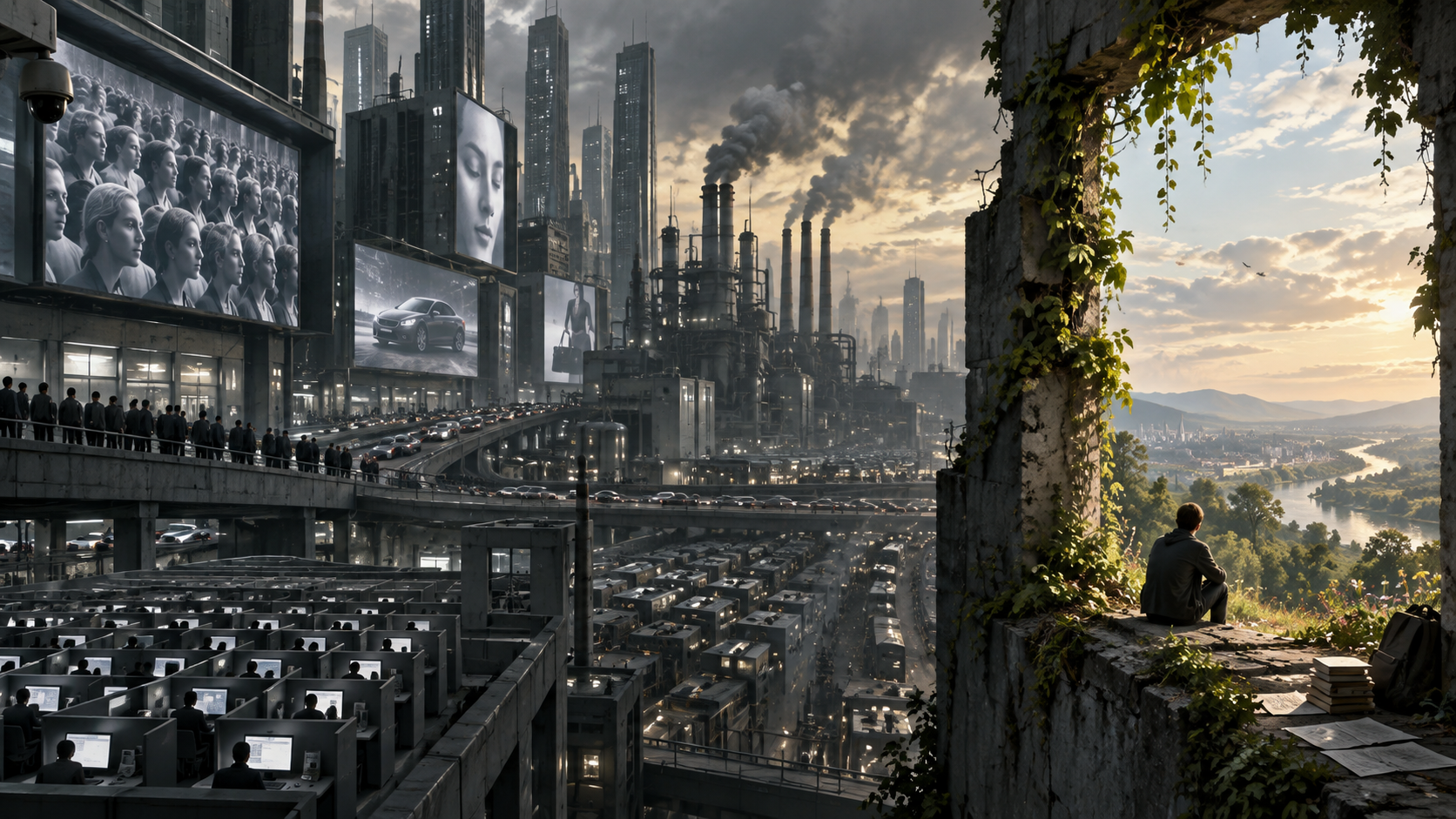

Herbert Marcuse (1898–1979) was one of the leading thinkers of the Frankfurt School and a major figure in twentieth-century Critical Theory. His work joined Marx, Freud and German philosophy in an attempt to explain a problem that orthodox Marxism had struggled with: why people in rich capitalist societies often adapt to systems that constrain them rather than resist them. Marcuse therefore focused not only on class and economic power, but also on desire, culture, technology, consumption and the shaping of thought itself.
Marcuse began with Marx’s idea of alienation but gave it a wider psychological scope. Capitalism, in his account, does more than organise labour and distribute wealth. It shapes what people come to regard as normal, desirable and even pleasurable. This means domination doesn’t have to rely mainly on force. A social order can preserve itself by producing forms of life that people learn to want.
This argument became central to One-Dimensional Man (1964). Marcuse claimed that advanced industrial societies absorb many of the forces that might otherwise challenge them. Rising living standards, mass consumption, entertainment and technological efficiency can bind people to the existing order. Political conflict then narrows because the system presents its assumptions as common sense rather than as one set of choices among others. Critical thought becomes ‘one-dimensional’ when people lose the conceptual space from which they might imagine a different form of society.
An important part of this argument concerns what Marcuse called ‘false needs’. He distinguished needs tied to human flourishing from desires produced by social systems that depend upon consumption, competition and conformity. This doesn’t mean that Marcuse thought individuals were simply deceived by advertising. His stronger claim was that social institutions help form desire itself. People may gain real pleasure from commodities and lifestyles that also help reproduce the conditions that constrain them.
This is one reason Marcuse remains useful for analysing consumer culture. A person may experience extensive choice between products while having little influence over the economic and social structures within which those choices occur. Choice, in this sense, isn’t necessarily the same as freedom.
Marcuse developed the psychological side of this argument in Eros and Civilization (1955), where he reworked Freud. Freud had argued that civilisation depends upon repression because instinctual wishes must be restrained if social life is to function. Marcuse accepted part of this argument but asked whether modern society imposes much more repression than civilisation itself requires. He called this additional constraint ‘surplus-repression’.
The distinction matters because Marcuse believed modern technology had created the material possibility of reducing much unwanted labour. If production could meet basic human needs with less work, then societies might organise life around greater freedom, pleasure, creativity and play. Yet capitalism tends instead to turn increased productivity into further production and consumption. Technological progress therefore contains two opposed possibilities: it can enlarge human freedom or deepen social control.
Marcuse consequently resisted simple hostility towards technology. His criticism concerned the social purposes built into technological systems. Technology may appear neutral while embodying assumptions about efficiency, control, productivity and administration. A technically rational society can therefore remain politically irrational if its remarkable capacity serves forms of domination rather than human need.
His concept of ‘repressive desublimation’ develops the same point in the sphere of culture and sexuality. Traditional society restricted desire through direct moral controls. Consumer capitalism may instead permit certain forms of sexual expression, pleasure and cultural rebellion while stripping them of much of their disruptive force. Sexual imagery, rebellion and dissent can themselves become commodities. What looks like liberation can therefore coexist with deeper conformity.
Art occupies an unusual place in Marcuse’s thought. He believed that serious art could preserve experiences and possibilities that ordinary social life suppresses. Art needn’t give political instructions. Its critical power can lie in refusing the apparent inevitability of the present. Imagination matters because it permits people to conceive forms of life that don’t yet exist. Marcuse called the wider refusal to accept established social limits the ‘Great Refusal’.
This also explains his interest in groups outside established political structures. By the 1960s he had become sceptical of the orthodox Marxist expectation that industrial workers alone would become the main agents of social change. He saw potential resistance among students, racial minorities, anti-war movements and other groups whose experience placed them partly outside dominant forms of social integration. His influence on the New Left followed in large part from this argument, although he rejected the popular description of himself as its intellectual ‘guru’.
Marcuse’s work therefore asks a question that runs through much of Critical Theory: if domination has become woven into everyday pleasure, consumption, language and common sense, where can critical consciousness come from?
His answer never settled into a single political programme. He found possibilities in art, Eros, education, protest, marginal social groups and the human ability to imagine circumstances beyond those already given. Critical thought begins when what appears natural becomes visible as historically produced and therefore capable of change.
For work concerned with photography, psychology and education, Marcuse offers an especially useful bridge. His ideas raise questions about whether images challenge dominant ways of seeing or reproduce them, whether consumer choice enlarges agency or disguises constraint, and whether apparently radical visual forms remain critical once advertising, fashion and social media absorb them. A photograph might therefore matter not merely because of what it represents, but because it can interrupt what Marcuse called one-dimensional thought by allowing something otherwise difficult to imagine to become perceptible.
References
Marcuse, H. (1955). Eros and civilization: A philosophical inquiry into Freud. Beacon Press.
Marcuse, H. (1964). One-dimensional man: Studies in the ideology of advanced industrial society. Beacon Press.
Marcuse, H. (1969). An essay on liberation. Beacon Press.
Marcuse, H. (1978). The aesthetic dimension: Toward a critique of Marxist aesthetics. Beacon Press.
Stanford Encyclopedia of Philosophy. (2025). Herbert Marcuse. (Stanford Encyclopedia of Philosophy)
Stanford Encyclopedia of Philosophy. (2023). Critical Theory (Frankfurt School). (Stanford Encyclopedia of Philosophy)
Leave a Reply
You must be logged in to post a comment.