
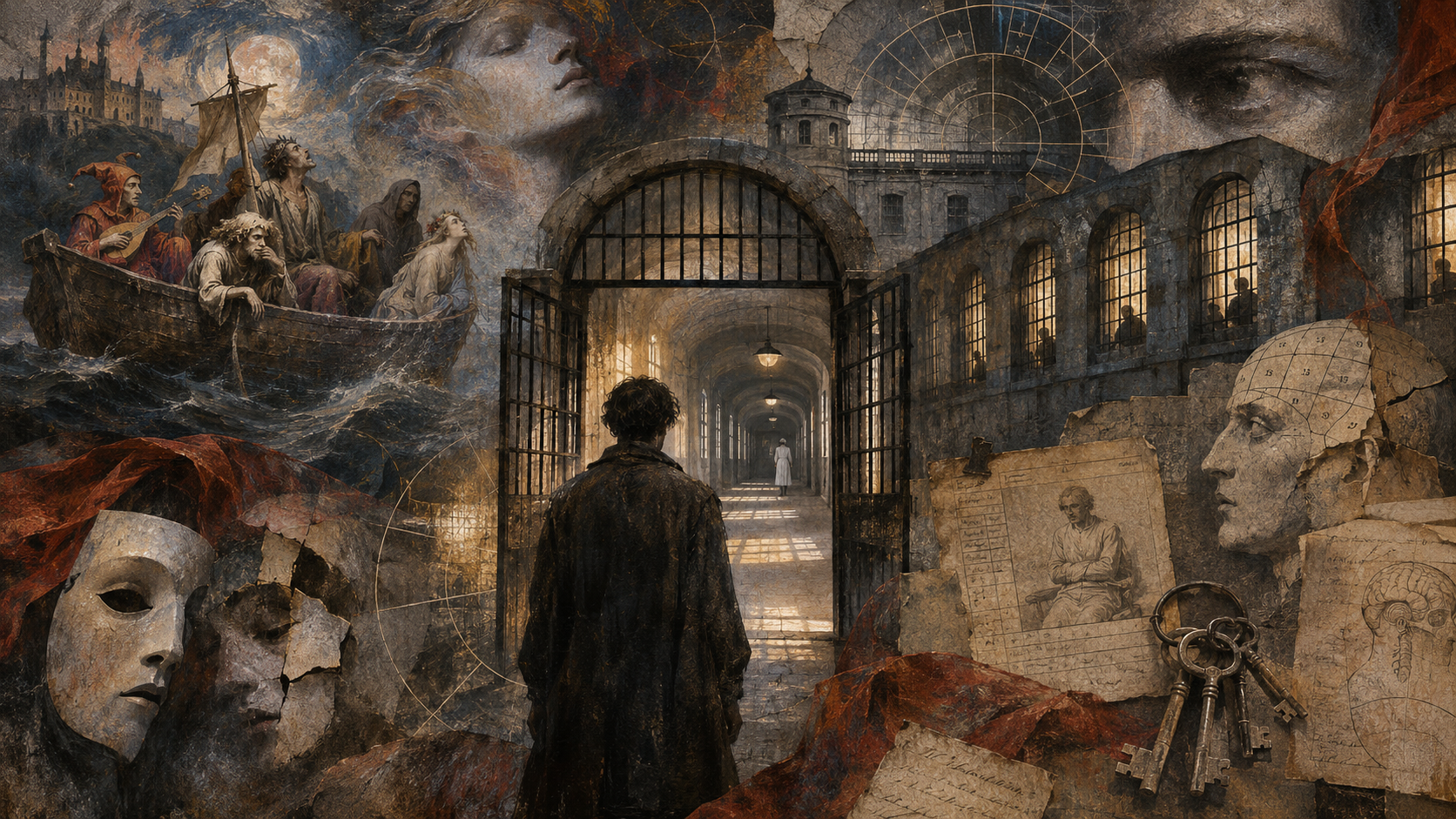

In Madness and Civilisation, Michel Foucault challenges the assumption that the history of mental illness represents a steady progression from superstition and cruelty towards scientific knowledge and humane treatment. Instead, he argues that Western societies have repeatedly changed how they define, understand and respond to madness, and that these changes reflect wider shifts in social values, moral judgement and institutional power.
His central argument is that madness is not simply a medical condition waiting to be discovered and treated. The ways societies identify, classify and manage madness also depend on their ideas about reason, morality, work and social order.
Foucault does not deny the existence of psychological distress. Rather, he questions how certain forms of human experience came to be treated as evidence of illness, deviance or incapacity, and how those judgements shaped the lives of people described as mad.
Madness before the age of reason
Foucault begins by examining attitudes towards madness in medieval and Renaissance Europe. He suggests that madness occupied an uncertain but significant place in cultural life.
The figure of the fool appeared in literature, painting and religious thought, sometimes representing a form of insight that challenged accepted wisdom. Madness could be associated with danger and disorder, but also with imagination, spiritual experience and uncomfortable truths.
Foucault draws particular attention to the Ship of Fools, a recurring image in late medieval culture in which people considered mad were depicted travelling by boat, separated from settled society.
For Foucault, the image suggests an ambiguous relationship between exclusion and freedom. Those regarded as mad could exist at the margins of society without being entirely reduced to medical or institutional categories.
This account is not a claim that medieval societies treated people with mental distress kindly. It establishes a contrast with the more systematic forms of confinement that followed.
The Great Confinement
One of the book’s most significant arguments concerns what Foucault calls the Great Confinement of the seventeenth century.
He describes the development of institutions that confined people regarded as socially undesirable. These included the poor, unemployed, people who breached moral expectations and those considered mad.
The Hôpital Général, established in Paris in 1656, provides a central example. Despite its name, it was not primarily a hospital in the modern medical sense. It served as an institution for confinement, supervision and the enforcement of social order.
Foucault argues that this development reflected the growing importance of work, economic discipline and moral conformity. People who could not or would not meet accepted standards of conduct became targets for institutional control.
Madness was therefore grouped with poverty, idleness and other forms of perceived disorder.
The distinction between those who behaved rationally and those who did not became part of a wider process through which society defined acceptable behaviour.
Foucault’s historical account of a single, widespread Great Confinement has attracted criticism. Nevertheless, his broader question remains important: how often do institutions presented as forms of care also serve to exclude people who do not conform to social expectations?
The separation of reason and madness
Foucault argues that the Enlightenment, despite its commitment to reason and human progress, created a sharper division between rational and irrational experience.
Reason became the standard against which human thought and behaviour were judged. Madness increasingly appeared as its opposite, something that could no longer participate in legitimate knowledge or public debate.
This division did more than identify differences in mental functioning. It established a relationship in which those considered rational claimed the authority to interpret, classify and speak on behalf of those considered mad.
For Foucault, this process contributed to what he describes as the silencing of madness.
The experiences of people labelled mad became less important than the explanations offered by those who observed and managed them.
This raises a question that remains relevant to psychology and psychotherapy: who has the authority to define another person’s experience, and what happens when professional explanations displace the person’s own account?
The birth of the asylum
During the late eighteenth and early nineteenth centuries, reformers began to challenge the physical restraints and harsh treatment associated with earlier institutions.
Philippe Pinel in France and William Tuke in England became prominent figures in the development of approaches that placed greater emphasis on humane treatment and moral reform.
Conventional histories often present these developments as decisive steps towards modern psychiatric care.
Foucault offers a more critical interpretation.
He argues that the removal of physical restraints did not necessarily produce freedom. Instead, institutions developed forms of psychological and moral control that encouraged patients to regulate their own behaviour.
The asylum became a setting in which staff assessed conduct, rewarded compliance and sought to reshape individuals according to prevailing ideas about rationality and acceptable behaviour.
The authority of the physician also grew. Medical judgement increasingly determined how institutions understood patients and interpreted their experiences.
Foucault’s argument is not that kindness and improved living conditions were meaningless. It is that more humane treatment could coexist with forms of domination that were less visible than physical coercion.
Psychiatry, knowledge and power
A central theme of the book concerns the relationship between medical knowledge and institutional authority.
Foucault questions the assumption that psychiatric knowledge developed independently of the institutions in which practitioners produced and applied it.
He suggests that psychiatric classifications emerged within systems that already distinguished between reason and unreason, acceptable and unacceptable conduct, and normal and abnormal behaviour.
The creation of diagnostic categories therefore involved more than the neutral observation of psychological phenomena. It also reflected judgements about the boundaries of acceptable human experience.
This argument anticipates Foucault’s later work on the relationship between knowledge and power.
Institutions do not merely respond to existing categories of people. They also contribute to the creation and maintenance of those categories.
The consequences can be profound. Once society defines someone as mentally ill, that classification may influence their treatment, legal rights, employment prospects, social relationships and sense of identity.
This does not mean that psychiatric diagnoses lack clinical value. It means that their use carries social consequences that extend beyond the consulting room.
Madness as a form of resistance
Foucault also examines the relationship between madness, art and cultural expression.
He discusses figures such as Goya, Nietzsche, Van Gogh and Artaud, whose work challenged established distinctions between reason, imagination and psychological disturbance.
He suggests that certain forms of artistic expression expose aspects of human experience that rational systems cannot fully contain or explain.
Madness, in this sense, represents more than a medical category. It also raises questions about the limits of reason and the cultural rules that determine what can be expressed, understood or accepted.
There is a risk in this argument. Romanticising madness can obscure the distress, disability and social hardship that many people experience.
Nevertheless, Foucault raises an important distinction between recognising suffering and treating all departures from accepted norms as signs of pathology.
Reflections on contemporary life
Madness and Civilisation has particular relevance to psychotherapy, counselling and the wider mental health professions.
Modern psychiatry has developed treatments that can relieve distress and improve people’s lives. Psychological therapies also offer ways for individuals to examine their experiences, develop greater self-understanding and make changes they value.
Foucault’s work does not invalidate these achievements. It does, however, prompt questions about the social assumptions that guide professional practice.
For example, psychological services often assess progress through changes in symptoms, daily functioning, employment, social relationships and behaviour.
These measures can provide useful evidence of improvement. Yet they may also reflect expectations about what a person should be able to do and how they should live.
A person who struggles to maintain employment in a demanding workplace may experience genuine psychological distress. Treatment may help them cope. But concentrating exclusively on their symptoms risks overlooking the conditions that contribute to those symptoms.
Similarly, an individual’s rejection of conventional social roles may represent an informed personal choice rather than evidence of psychological dysfunction.
Foucault encourages a distinction between helping people reduce suffering and encouraging them to conform to prevailing standards of behaviour.
This distinction is especially important when professionals hold greater institutional authority than those seeking their help.
Criticism and historical limitations
Foucault’s account has attracted substantial criticism from historians of medicine and psychiatry.
Critics argue that he sometimes presents complex historical changes as more uniform than the evidence allows. His descriptions of confinement, the development of asylums and the relationship between medicine and social control have all generated debate.
His portrayal of madness before the Enlightenment can also suggest a degree of cultural acceptance that historical evidence does not always support.
An important qualification concerns the English text itself. Madness and Civilisation is a translation of a shortened French edition. The full English translation, published in 2006 as History of Madness, contains much more of Foucault’s historical research and supporting material. This distinction matters when assessing the strength of his arguments (Bracken, 2015).
Foucault also gives less attention to the biological dimensions of mental illness than many contemporary researchers would consider necessary.
These limitations do not eliminate the value of his analysis. They suggest that his work is most useful as a critical examination of the historical relationship between knowledge, institutions and authority, rather than as a complete account of psychiatric history.
The continuing significance of Foucault’s argument
The lasting importance of Madness and Civilisation lies in its challenge to the belief that medical progress and social progress necessarily develop together.
Foucault shows how changes presented as more rational and humane may introduce new forms of authority and control.
His analysis also challenges the assumption that professional knowledge exists outside the social and political conditions in which practitioners develop and apply it.
For me, the most significant issue concerns the relationship between understanding another person’s experience and claiming authority over its meaning.
Psychotherapy depends on the possibility that people can explore their experiences within a relationship that respects their autonomy. Yet the therapist also brings concepts, theories and professional expectations that influence how those experiences are understood.
The challenge is to recognise the value of psychological knowledge without allowing it to displace the person’s own understanding of their life.
Foucault’s work encourages a form of professional reflection that extends beyond questions of treatment effectiveness. It asks practitioners to consider whose interests their interventions serve, which standards they reinforce and whether the people receiving care have a meaningful voice in defining their own needs.
Perhaps the most important question concerns the distinction between care and control. Both may involve observation, assessment and intervention. The difference cannot rest solely on professional intentions. It must also involve the individual’s autonomy, the social context and the consequences of institutional authority.
Madness and Civilisation remains valuable because it encourages us to question practices that appear self-evidently reasonable. It asks whether our efforts to understand and help others sometimes restrict the range of human experience that we are prepared to recognise and accept.
References
Bracken, P. (2015). On Madness and Civilisation: A History of Insanity in the Age of Reason (1961), by Michel Foucault. The British Journal of Psychiatry, 207(5), 434. https://doi.org/10.1192/bjp.bp.115.165274
Foucault, M. (2001). Madness and civilization: A history of insanity in the age of reason (R. Howard, Trans.). Routledge. (Original work published 1961). ISBN 978-0-415-25385-7.
Foucault, M. (2006). History of madness (J. Murphy & J. Khalfa, Trans.; J. Khalfa, Ed.). Routledge. (Original work published 1961).
Leave a Reply
You must be logged in to post a comment.