
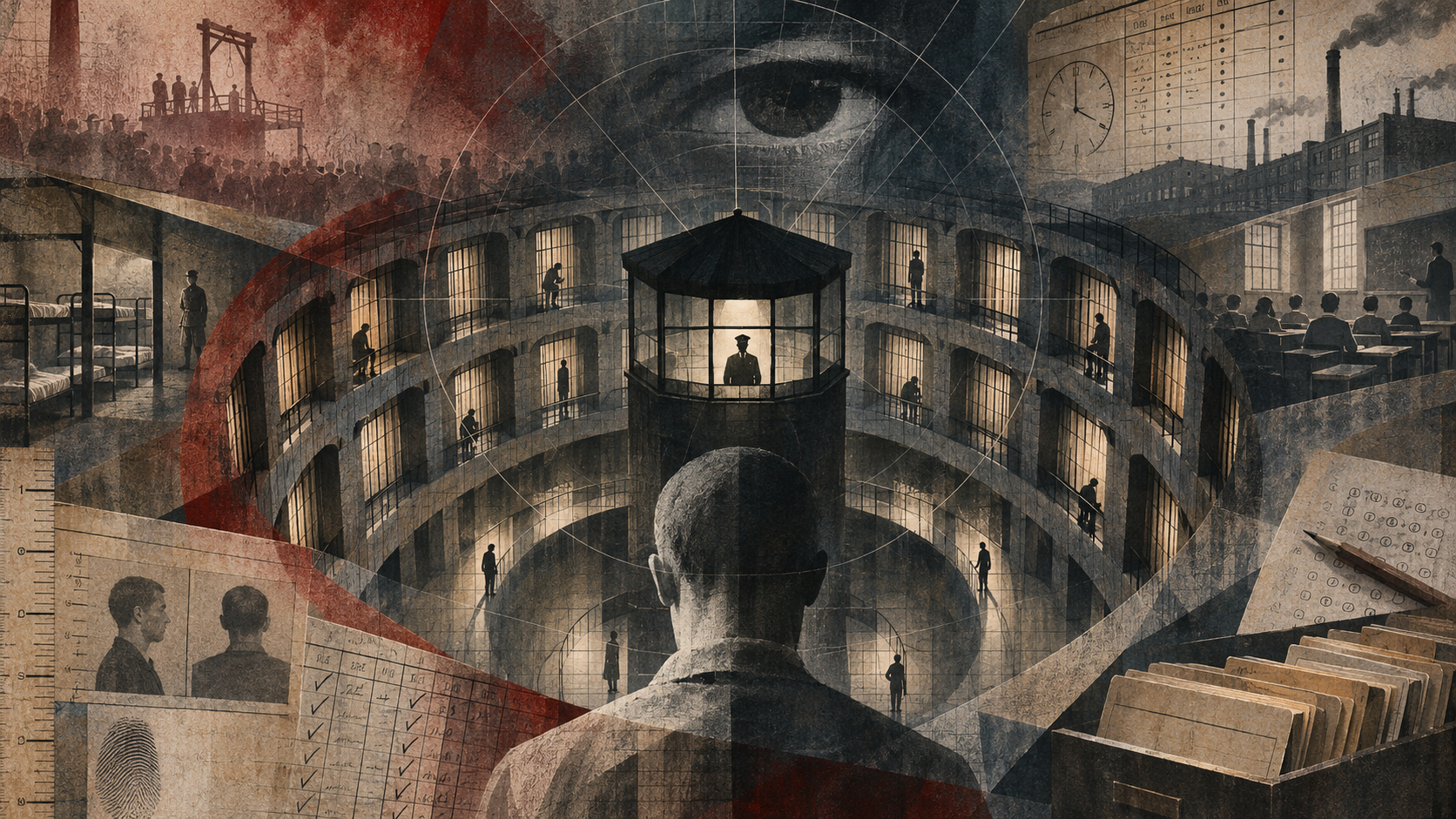

In Discipline and Punish: The Birth of the Prison, Michel Foucault examines a major change in the way Western societies exercise power. He traces the shift from public acts of physical punishment to systems of discipline that seek to shape how people think, behave and understand themselves. His central argument is that modern societies have not abandoned coercion. Instead, they have developed forms of control that are less visible, more continuous and, in some respects, more effective.
Foucault begins with a disturbing account of the public execution of Robert-François Damiens in Paris in 1757. He contrasts this with a strict daily timetable for young prisoners less than a century later. The contrast reveals a change in the purpose of punishment. Where sovereign power once displayed its authority through violence against the body, modern institutions increasingly sought to regulate conduct through surveillance, routine, examination and correction.
From punishment to discipline
For Foucault, the emergence of the modern prison was part of a much wider transformation. Schools, hospitals, factories, barracks and prisons developed similar techniques for organising people. They divided space, regulated time, assessed performance and established standards of acceptable behaviour.
These institutions did more than restrict what people could do. They helped produce what Foucault calls docile bodies: people whose actions could be trained, measured and directed towards useful ends.
Discipline operates through small, repeated interventions. Timetables, attendance records, examinations, rankings and performance reviews may appear to be routine administrative practices. Yet they also establish expectations about how people should behave. They reward conformity and identify those who depart from accepted norms.
This suggests that power does not depend solely on laws, commands or physical force. It can work through the ordinary arrangements of institutional life.
The Panopticon and the internalisation of surveillance
One of Foucault’s most influential discussions concerns Jeremy Bentham’s design for the Panopticon, a prison organised around a central observation tower. Prisoners occupy separate cells and cannot know whether someone is watching them at any given moment.
The significance of this design lies in its psychological effects. When people believe that they may be under observation, they begin to regulate their own behaviour. The observer need not watch them at all times because the possibility of surveillance encourages self-discipline.
Foucault treats the Panopticon as a model of modern disciplinary power rather than simply a proposal for prison design.
Its principles extend beyond prisons. Schools, workplaces and other institutions may create conditions in which people monitor themselves against expected standards. Control becomes embedded in the individual’s own conduct.
This raises a troubling question: when people believe they are acting freely, how much of their behaviour reflects expectations they have learned to impose upon themselves?
Normalisation and the examination
A further theme concerns the relationship between discipline and the production of knowledge.
Modern institutions observe, classify and compare individuals. Examinations, assessments, diagnoses and case records transform people into subjects who can be described, measured and judged.
Foucault argues that these practices establish norms against which individuals are assessed. The distinction between normal and abnormal becomes a means of exercising power.
This is especially relevant to psychology, education and psychotherapy. Psychological assessment can help people understand their experiences and gain access to support. Yet it can also define particular forms of thought or behaviour as deficient, disordered or undesirable.
Foucault does not claim that all such knowledge is false. His concern is that knowledge and power develop together. The categories through which institutions understand people also influence how those institutions treat them.
The examination illustrates this relationship. It combines observation, judgement and documentation, producing knowledge about individuals while placing them within systems of comparison and control.
Why the prison persists
Foucault challenges the assumption that prisons survive because they succeed in reducing crime.
He argues that prisons have repeatedly failed to achieve their stated aims of rehabilitation and crime prevention. Nevertheless, imprisonment remains central to modern criminal justice.
His explanation is that prisons perform functions beyond their declared purpose. They help define and manage a category of people identified as delinquents. In doing so, they distinguish certain forms of unlawful conduct from others and reinforce wider systems of social control.
The prison therefore forms part of what Foucault calls a carceral network, through which disciplinary practices extend across society.
This argument shifts attention away from whether prisons work as intended and towards the political and social interests served by their continued existence.
Power, knowledge and the individual
Perhaps the most significant aspect of Discipline and Punish is Foucault’s account of how power shapes the individual.
Power is not simply something that one person or institution possesses and imposes upon others. It operates through relationships, practices and forms of knowledge. It produces categories of identity, establishes standards and influences what people come to regard as true about themselves.
This challenges the familiar distinction between an autonomous individual and an oppressive institution. Foucault suggests that modern institutions help construct the very forms of individuality through which people understand themselves.
The person who strives to be productive, responsible, healthy, competent or normal may be responding to expectations that have become part of their sense of self.
Such expectations are not necessarily harmful. They may support learning, cooperation and personal development. The critical issue concerns who establishes them, whose interests they serve and what happens to those who cannot or will not conform.
Reflections on contemporary life
Although Foucault wrote before the emergence of digital surveillance, his analysis has clear relevance to contemporary society.
Workplace monitoring, educational performance measures, social media metrics and algorithmic assessments can encourage people to observe and regulate their own conduct. In many cases, individuals participate willingly because the standards appear reasonable, useful or necessary.
The connection is not exact. Digital systems differ from the enclosed institutions that Foucault studied, and their effects depend on ownership, governance and context. Nevertheless, his work provides a way to question the relationship between visibility, judgement and control.
His analysis also raises questions for psychotherapy and coaching. Both practices encourage self-awareness and reflection, often with the aim of increasing personal autonomy. Yet they may also reinforce social expectations about appropriate emotions, productive behaviour and individual responsibility.
A therapeutic approach that concentrates exclusively on changing the individual may overlook the social conditions that contribute to distress. Similarly, coaching that encourages people to adapt to demanding workplaces may strengthen the very systems that generate their difficulties.
This does not invalidate either practice. It suggests that reflection should include the social and institutional contexts within which personal change takes place.
The continuing significance of Foucault’s argument
Discipline and Punish offers a history of punishment, but its wider contribution lies in showing how modern power can operate through practices that appear ordinary, rational and beneficial.
Foucault’s account also has limitations. His emphasis on discipline can leave insufficient room for resistance, solidarity and the ways people reinterpret or challenge institutional expectations. His historical claims have attracted debate, particularly concerning the development and purposes of imprisonment.
Nevertheless, the book remains important because it questions the assumption that greater knowledge, more detailed assessment and more systematic management necessarily lead to greater freedom.
For me, its most useful contribution is the distinction between encouraging people to develop their capacities and requiring them to conform to standards established by others. Education, therapy and coaching may involve both processes, sometimes without making the distinction clear.
Foucault invites us to examine not only how institutions control people, but also how individuals learn to control themselves. His work suggests that meaningful autonomy requires more than freedom from direct coercion. It also requires an awareness of the norms, judgements and expectations that shape what we believe we ought to become.
Reference
Foucault, M. (1977). Discipline and punish: The birth of the prison (A. Sheridan, Trans.). Pantheon Books. (Original work published 1975). ISBN 978-0-394-49942-0.
Leave a Reply
You must be logged in to post a comment.