
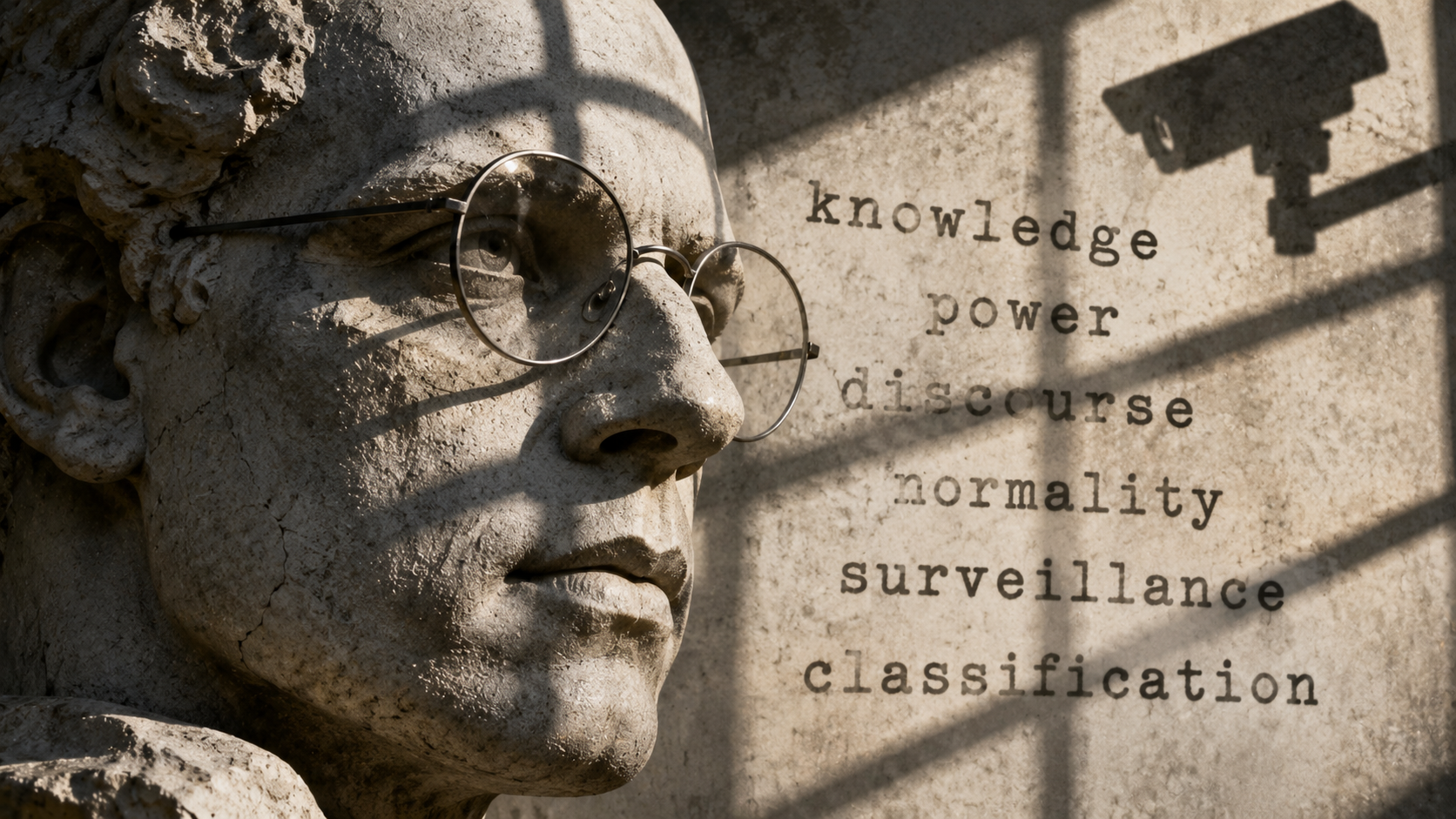

Michel Foucault’s work on power and knowledge challenges the idea that knowledge simply describes an independent reality. He argues that what a society accepts as true depends partly on institutions, professional practices, forms of classification and relations of power. Knowledge and power therefore work together.
This argument is developed most clearly in the interviews and essays collected as Power/Knowledge (1980), although it runs through much of Foucault’s work.
Foucault rejects a simple model in which power belongs mainly to governments, rulers or dominant classes. Power also operates through schools, hospitals, prisons, clinics, universities, professions and administrative systems. It acts through routine practices: examining, recording, testing, diagnosing, ranking and classifying people.
Knowledge forms part of this process. Categories such as normal and abnormal, sane and insane, healthy and pathological, criminal and law-abiding do not merely describe people. They help organise how institutions treat them and how individuals come to understand themselves.
Foucault therefore speaks of “power/knowledge”. Power produces knowledge, while knowledge allows new forms of power to operate. Medical knowledge, for example, can help cure disease, but it also gives medical institutions authority to define illness and normality. Psychological knowledge can help people understand distress, while also creating categories through which behaviour gets measured and judged.
This does not mean that Foucault thought all knowledge was false. His argument is more subtle. He asks how some statements acquire the status of truth and why certain people gain the authority to define what counts as valid knowledge.
This leads to his idea of a “regime of truth”. Every society has institutions and practices that help determine which forms of knowledge receive legitimacy. Universities, courts, medical bodies, governments and media organisations all contribute to these processes.
Discourse plays a central role. For Foucault, discourse means more than language. It includes the concepts, rules and practices that make some ways of talking and thinking possible while excluding others. A discourse about mental illness, crime or sexuality shapes what can be said, who may speak with authority and what kinds of intervention appear justified.
Foucault also rejects the idea that power only represses. Power is productive. It creates identities, categories, forms of behaviour and ways of understanding the self. Modern power often works by encouraging people to monitor and regulate themselves.
This is especially clear in Discipline and Punish, where Foucault describes disciplinary power. Schools, prisons, factories and hospitals organise space, time and behaviour. They observe individuals, compare them with norms and encourage self-surveillance (Foucault, 1977).
The political importance of this argument is substantial. If power works through knowledge, then political critique must examine not only laws and governments but also apparently neutral systems of expertise. Questions such as “Who defines the problem?”, “What counts as evidence?”, “Who gets classified?”, and “Whose knowledge is excluded?” become political questions.
A concise statement of Foucault’s argument would be:
Power does not merely control knowledge from outside. Power helps produce what counts as knowledge, while knowledge creates new ways of exercising power.
This places Foucault at the centre of critical theory because he shifts attention from obvious forms of domination towards the ordinary institutions, classifications and expert practices through which social reality is organised.
References
Foucault, M. (1977). Discipline and punish: The birth of the prison (A. Sheridan, Trans.). Pantheon.
Foucault, M. (1980). Power/knowledge: Selected interviews and other writings, 1972–1977 (C. Gordon, Ed.). Pantheon Books.
Foucault, M. (1984). The history of sexuality: Volume 1, An introduction (R. Hurley, Trans.). Penguin.
Leave a Reply
You must be logged in to post a comment.