
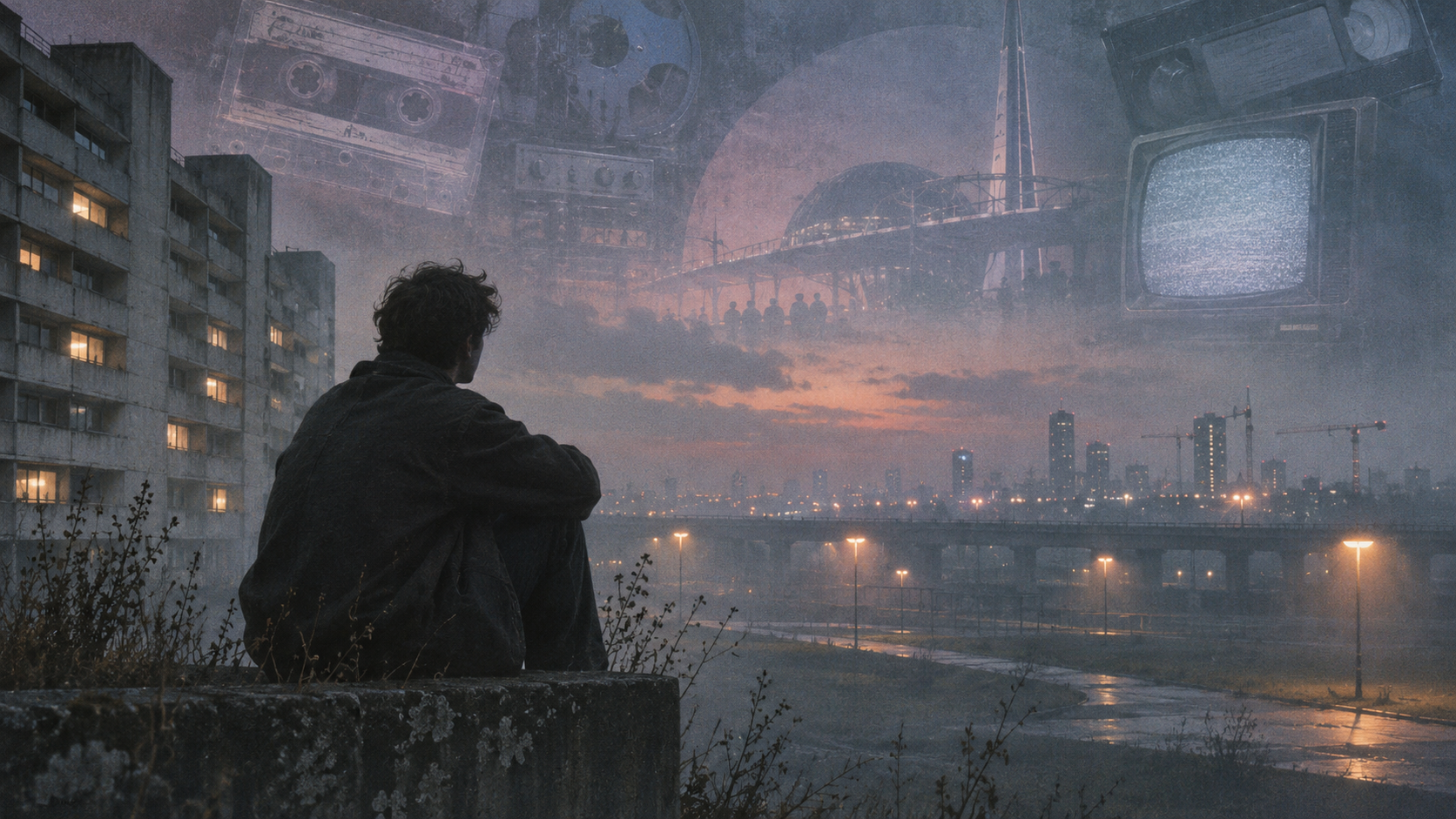

Mark Fisher’s Ghosts of My Life: Writings on Depression, Hauntology and Lost Futures (2014) is a collection of essays about culture, politics, music, film and mental health. Its central idea is that contemporary culture feels haunted by futures that were once imagined but never arrived.
Fisher draws heavily on Jacques Derrida’s concept of “hauntology”. For Derrida, the present is never fully self-contained. It is inhabited by traces of what has gone and by possibilities that were expected but did not come to pass. Fisher applies this idea to late twentieth- and early twenty-first-century culture. He argues that much current music, film and design no longer feels oriented towards genuinely new futures. Instead, culture recycles styles, moods and forms from earlier decades.
This produces what Fisher calls the “slow cancellation of the future”. He does not mean that no new technology appears. Rather, he means that cultural time has become stuck. The future once seemed likely to bring new forms of social life, art and political change. By the 2000s and 2010s, Fisher argues, these expectations had weakened. Popular culture began to look backwards, often with nostalgia, pastiche and retro styling.
For Fisher, this cultural stagnation has a political cause. He links it to neoliberalism and what he elsewhere called “capitalist realism” – the sense that capitalism is not simply dominant but almost impossible to imagine beyond. If no credible alternative social order can be pictured, then culture also loses some of its capacity to imagine difference.
Depression is important within this framework. Fisher resists accounts that treat depression only as an individual medical problem. He argues that distress can also reflect social conditions: insecure work, bureaucratic pressure, isolation, low control and the erosion of collective hope. This does not mean that depression has no biological or personal dimensions. His point is that political and economic structures shape how distress is produced and understood.
Music plays a central role in the book. Fisher writes about artists such as Joy Division, Burial and The Caretaker because their work seems to contain traces of lost possibilities. Burial’s music, for example, evokes fragments of earlier rave culture while sounding empty, distant and spectral. For Fisher, such music does not merely express nostalgia. It registers the absence of a future that once seemed possible.
The book also explores memory, repetition and cultural loss. Fisher is especially interested in how media preserve earlier cultural moments while also stripping them of their original context. Old styles can return endlessly, but their political force may fade. What remains is the image or sound of the past without the social conditions that gave it meaning.
A useful way to state Fisher’s central argument is this:
Contemporary culture is haunted not only by the past, but by futures that failed to happen.
This gives Ghosts of My Life a clear place within critical theory. It links culture to political economy and treats depression, nostalgia and cultural repetition as symptoms of a wider social condition. Its question is not simply why culture looks backwards, but why the future has become so difficult to imagine.
References
Derrida, J. (1994). Specters of Marx: The state of the debt, the work of mourning and the new international (P. Kamuf, Trans.). Routledge.
Fisher, M. (2009). Capitalist realism: Is there no alternative? Zero Books.
Fisher, M. (2014). Ghosts of my life: Writings on depression, hauntology and lost futures. Zero Books.
Leave a Reply
You must be logged in to post a comment.