

Walter Benjamin and the Meaning of Photographs
In 1931, the German philosopher and cultural critic Walter Benjamin (1892–1940) published Little History of Photography (Kleine Geschichte der Photographie). Although framed as a review of recent books on photography, the essay became one of the most influential early works of photographic theory.
Benjamin was less concerned with photography as an art form than with what photographs reveal about the world, how they alter human perception, and how their social and political uses shape what we know.
Photography and the optical unconscious
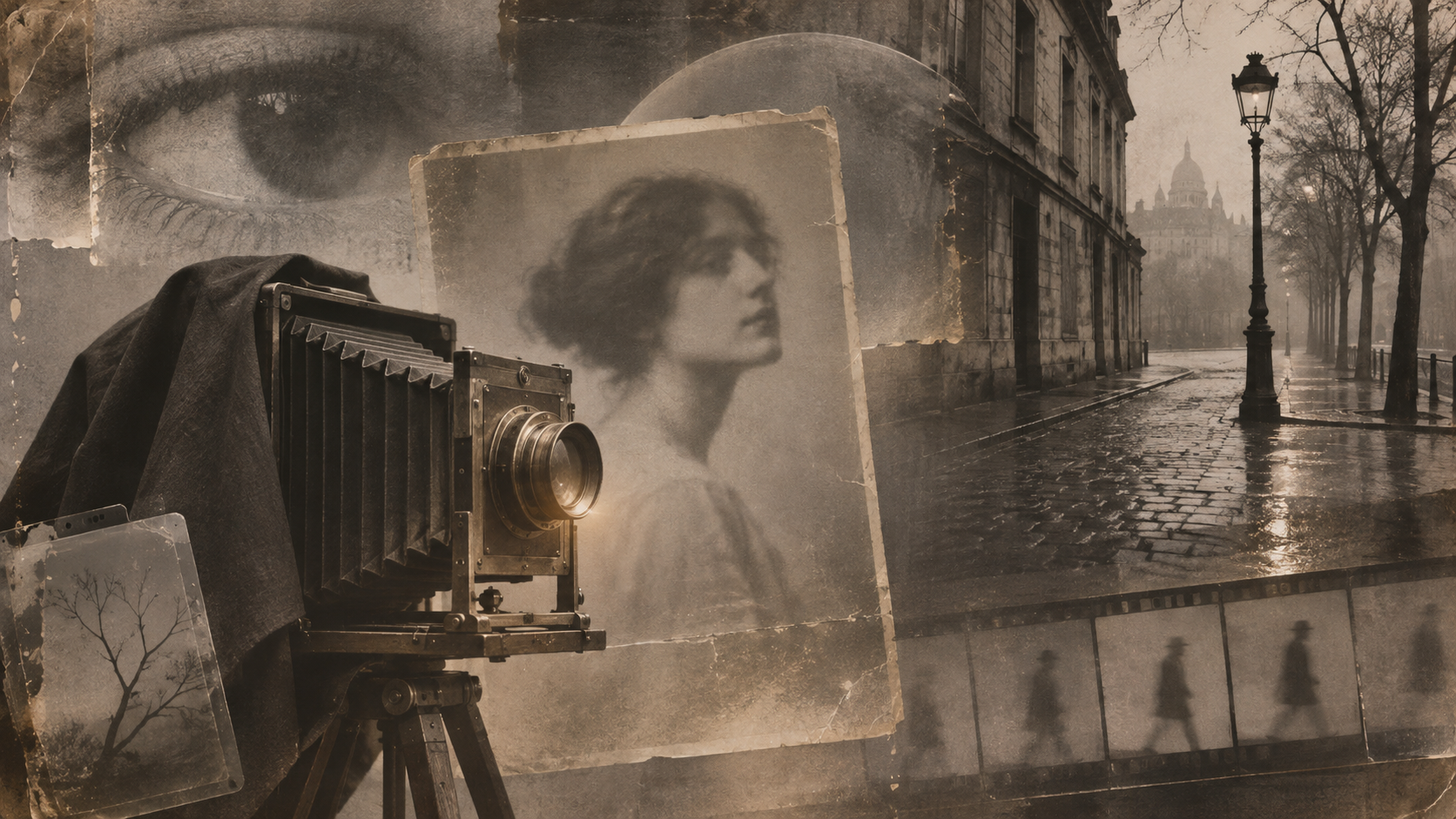
One of Benjamin’s most important ideas is the optical unconscious. He argues that the camera reveals aspects of reality which the human eye fails to recognise.
A photograph can isolate a fraction of a second, preserve an unnoticed gesture, or expose details that pass beyond conscious attention. Through enlargement and close study, we can discover things that were present but unseen.
Benjamin draws a parallel with psychoanalysis. Just as Freud sought to reveal mental processes beyond conscious awareness, photography can disclose aspects of the visible world that escape ordinary perception.
The significance extends beyond the camera’s technical powers. Photographs may reveal social relations, emotional expressions and historical details which neither the photographer nor the subject intended to record.
Photography, time and memory
Benjamin also examines the unusual relationship between photography and time. A photograph preserves a moment from the past, but its meaning may change as the future unfolds.
He describes an early portrait of the photographer Carl Dauthendey and a woman Benjamin believed to be his first wife. Knowing that Dauthendey’s first wife later died by suicide, Benjamin reads the woman’s expression as anticipating her fate.
Subsequent research has challenged his identification of the woman. This error is revealing in itself. It shows how knowledge acquired after an event can shape what we believe we see in a photograph.
For Benjamin, photographs preserve more than their makers intended. Their small, incidental details may acquire significance many years after the exposure. A photograph can therefore become a point of contact between past experience and present knowledge.
The loss of aura
Another central concept is aura, which Benjamin associates with the distinctive presence of something that seems distant or beyond our immediate grasp, even when it stands before us.
He finds this quality in some early photographic portraits, where long exposures, restrained poses and the relationship between subject and camera give the image a sense of singular presence.
As photographic technology developed, images became easier to produce, reproduce and distribute. Benjamin saw this change as part of a wider shift in culture. Photography could weaken traditional ideas about art, authenticity and the unique object.
Yet he did not regard the loss of aura as a simple decline. New photographic methods could also challenge established ways of seeing and make images available to a wider public.
Photography as social criticism
Benjamin was particularly interested in photographers who moved beyond conventional ideas of beauty.
He admired Eugène Atget’s photographs of largely empty Parisian streets. Rather than treating these scenes as picturesque views, Benjamin compared them to crime scenes, suggesting that photographs could provide evidence requiring investigation and interpretation.
He also discussed August Sander’s portraits of German society. Sander’s systematic approach offered a means of examining social class, occupation and the structure of society through images of its people.
Such work suggested that photography could serve a critical social purpose rather than merely record appearances.
Benjamin argued that photographs needed interpretation and context. His discussion of captions raises a question that remains important: how does the meaning of an image change when we place words beside it?
Why Benjamin still matters
Little History of Photography helped establish photography as a subject for philosophical, psychological and political analysis. It also anticipated arguments that Benjamin would develop in The Work of Art in the Age of Mechanical Reproduction (1935–1936).
Its importance lies in treating photography not simply as a means of making pictures, but as a practice that changes the relationship between people, images and knowledge.
The essay remains relevant to documentary photography, visual research and photographic education. It encourages us to distinguish between what a photograph shows, what its maker intended and what a viewer subsequently discovers.
It also raises questions about digital photography and artificial intelligence. Images can now be altered, generated and distributed on a scale Benjamin could scarcely have envisaged. His concerns about authenticity, context and the political use of images have gained renewed force.
Perhaps the essay’s most enduring contribution is its challenge to the assumption that seeing and understanding are the same thing. Photography can disclose aspects of the world that we might otherwise miss, but the image cannot explain itself. Its meaning depends on history, context and the questions we bring to it.
References
Benjamin, W. (1931/1999). Little history of photography (E. Jephcott & K. Shorter, Trans.). In M. W. Jennings, H. Eiland, & G. Smith (Eds.), Selected writings: Volume 2, Part 2, 1931–1934 (pp. 507–530). Harvard University Press.
Benjamin, W. (2015). On photography (E. Leslie, Ed. & Trans.). Reaktion Books. https://www.lscp.co.uk/
Benjamin, W. (2008). The work of art in the age of its technological reproducibility: Second version. In M. W. Jennings, B. Doherty, & T. Y. Levin (Eds.), The work of art in the age of its technological reproducibility, and other writings on media (pp. 19–55). Harvard University Press.
Leave a Reply
You must be logged in to post a comment.