
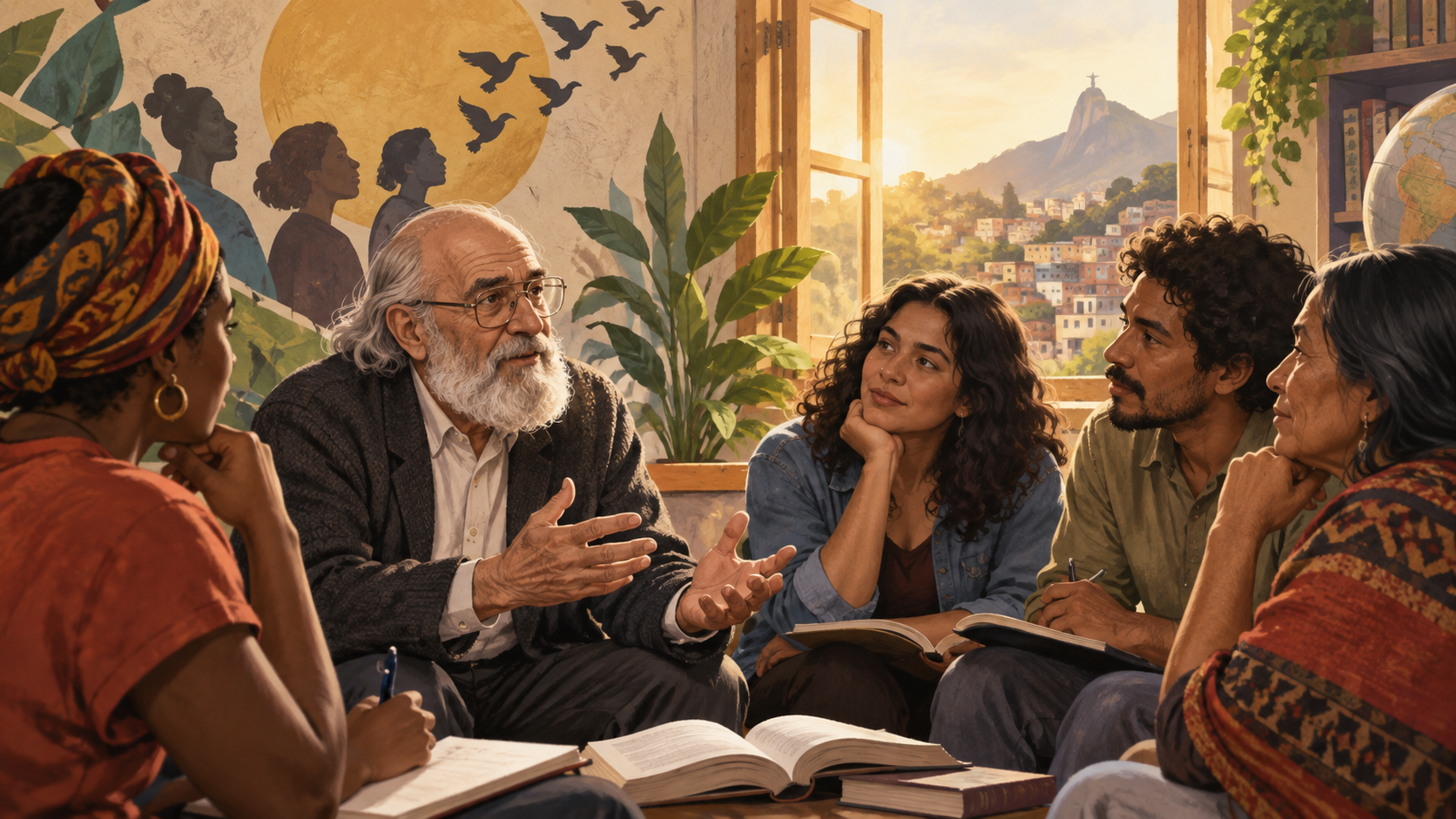

Paulo Freire (1921–1997) was a Brazilian educator and philosopher whose work reshaped debates about education, power and social change. His best-known book, Pedagogy of the Oppressed (first published in Portuguese in 1968), argued that education is never neutral. It can reproduce existing social relations, or it can help people understand and challenge them.
Freire attacked what he called the “banking model” of education. In this model, teachers possess knowledge and deposit it into students, who receive and reproduce it. Freire thought this approach encouraged passivity and reinforced unequal relations between teacher and learner. He proposed a dialogical form of education instead, in which teachers and students investigate the world together. The teacher still brings knowledge and skill, but doesn’t treat students as empty vessels.
A central concept in Freire’s work is conscientização, often translated as “critical consciousness”. This means learning to recognise how social, economic and political structures shape everyday life. A person may first view poverty, exclusion or poor working conditions as personal misfortune. Through dialogue and reflection, they may come to see how such experiences connect with wider systems of power. Education can then support informed action rather than mere adaptation.
Freire therefore linked reflection with action through the idea of praxis. Praxis involves a continuing cycle in which people examine their conditions, act upon them, reflect on the results and act again. Reflection without action risks becoming detached theory; action without reflection risks becoming uncritical activism (Freire, 1970/2018).
His teaching method also emphasised problem-posing education. Rather than asking students to memorise predetermined answers, teachers begin with real problems drawn from learners’ lives. Students examine these problems, question assumptions and develop explanations with others. This approach has had a strong influence on adult education, community development and critical pedagogy.
Freire also treated dialogue as an ethical relationship. Genuine dialogue requires respect, humility and a willingness to listen. He rejected the idea that liberation could simply be delivered to people by experts. People must take part in the process through which they understand and change their own conditions.
His later work developed these themes. In Pedagogy of Hope, Freire defended hope as a disciplined commitment to the possibility of change rather than simple optimism. In Teachers as Cultural Workers, he stressed that teaching always involves choices about knowledge, authority and values (Freire, 1994, 1998).
Freire remains important because he shifts the central educational question from “How should we transmit knowledge?” to “What kinds of people, relationships and forms of society does education help to create?” That question has influenced critical pedagogy, feminist education, decolonial education, participatory research and forms of teaching based on dialogue and reflection.
For photography education in particular, Freire offers a useful basis for moving beyond the traditional crit. Instead of the tutor acting as the final authority on whether an image succeeds, the group can examine what the image does, whose viewpoint it presents, what assumptions shape it and what each participant might change in their own future practice. Learning then becomes shared enquiry rather than judgement.
References
Freire, P. (1994). Pedagogy of hope: Reliving pedagogy of the oppressed. Continuum.
Freire, P. (1998). Teachers as cultural workers: Letters to those who dare teach. Westview Press.
Freire, P. (2018). Pedagogy of the oppressed (M. B. Ramos, Trans.; 50th anniversary ed.). Bloomsbury Academic. (Original work published 1970)
Leave a Reply
You must be logged in to post a comment.